

Quick Answer: What Is Meshrep?
Meshrep(麦西热甫,màixīrèfǔ)is a tradition of Uyghur(维吾尔族,Wéiwú’ěrzú)community gatherings, associated especially with Xinjiang and also practised in Central Asian communities. Music, dance, food, games and oral expression form part of its social life.[1]
- Organization: Hosts and participants sustain a gathering’s customs.
- Exchange: Entertainment accompanies social learning and interaction.
- Variation: Locality, membership and purpose shape the occasion.
Meshrep names a broader gathering tradition, not simply one dance or a fixed concert programme.
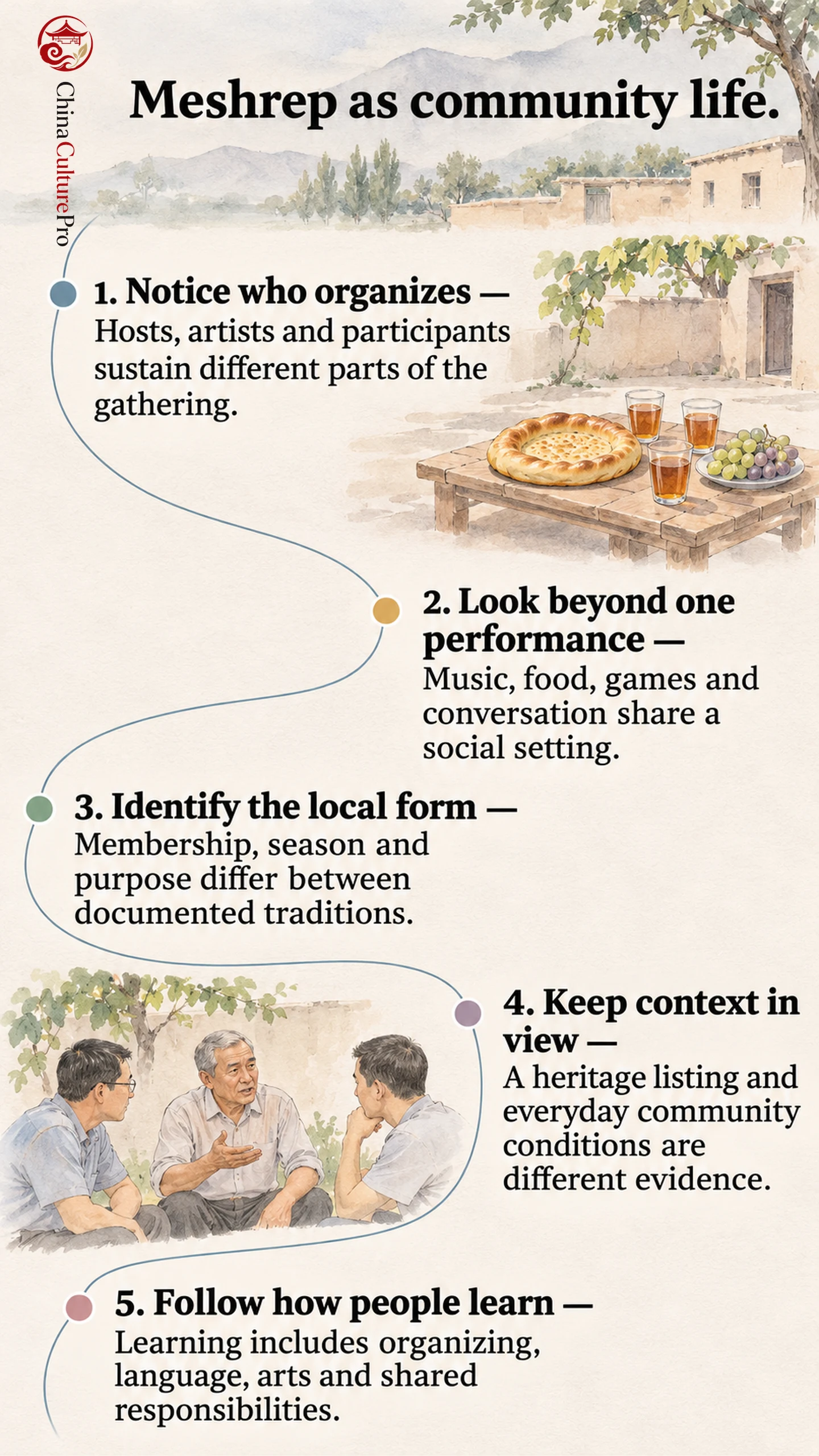
A gathering can move from a shared meal to a joke, a game or music. What connects these activities is the relationship between participants: who hosts, who responds and how people learn to act together. This guide introduces meshrep through those relationships within Uyghur culture, alongside specific regional examples and changing conditions of transmission.
How Gatherings Are Organized
Organizers maintain the conventions of a gathering, while folk artists contribute musical and dance skills. Coordinating participation and performing are complementary responsibilities, drawing on different kinds of knowledge.[2]
Some documented forms involve a regular group of men whose members take turns hosting in family homes. Festival and welcoming occasions may involve broader participation. Membership and hosting schedules need to be identified for the particular tradition.[2][3]
Jokes and an informal community court can make conduct a shared subject of discussion. Mock trials and comic performances address behaviour through interaction; the court belongs to the gathering’s conventions rather than ordinary state judicial proceedings.[3]
When viewing a recording, look beyond the person dancing. Notice who initiates an activity, how participants answer, and whether people are performing for one another or mainly for an outside audience. These are different kinds of evidence about how a gathering works.
Music, Games and Shared Food
Muqam(木卡姆,mùkǎmǔ)combines musical, poetic and dance traditions, with regional repertoires and different instrumental practices. Uyghur muqam can be performed within a meshrep, but the musical tradition and the social event are not interchangeable terms. Hearing a musical excerpt does not establish that a recording documents a whole gathering.[4]
Within muqam, lyrics can carry folk ballads, proverbs, narrative and classical poetry. Pieces may feature a soloist or a group, with bowed, plucked or wind instruments among the possibilities. Identifying the actual repertoire and musicians is more informative than assuming every gathering presents the same complete suite.[4]
Preparing and sharing food contributes to hospitality alongside games and oral expression. A menu alone does not define the gathering.[1]
Regional Forms and Occasions
Regional names point toward local histories, environments and purposes. The examples below should be read at that scale, rather than as stages every meshrep must follow.
| Documented form or setting | Particular features |
|---|---|
| Ili(伊犁,Yīlí)and related Central Asian groups | Some regular men’s groups rotate hosting between family homes.[3] |
| Tahe meshrep(塔合麦西热甫,Tǎhé màixīrèfǔ)in Mulei(木垒,Mùlěi) | A mountain and pastoral setting, with gatherings for festivals, weddings and invitations; its musical organization includes a solo opening and sections with a lead singer and group responses.[5] |
| Kok meshrep(阔克麦西热甫,Kuòkè màixīrèfǔ)in Hami(哈密,Hāmì) | The local heritage description associates indoor gatherings with the period after the autumn harvest through winter and into the following spring.[6] |
The Mulei and Hami traditions were recorded as separate extensions under China’s national project X-49 in 2008. Their details show why one generic seasonal label or one filmed performance cannot describe the whole category.[5][6]
Safeguarding and Changing Conditions
UNESCO inscribed China’s Meshrep element on the List of Intangible Cultural Heritage in Need of Urgent Safeguarding in 2010. That is a different designation from the Representative List. It recognizes a living practice requiring safeguarding, not a guarantee that transmission is secure.[1]
In its 2023 review, the committee noted reported measures including financial support for bearers, facilities, apprenticeship, education and documentation. Those are records of safeguarding activity; assessing the practice also requires attention to participants’ ability to organize and sustain their own gatherings.[7]
A 2020 interview with ethnomusicologist Rachel Harris highlights that distinction. She described restrictions on independent community gatherings in Xinjiang and criticized state-directed spectacles presented as safeguarding. Her assessment concerns community autonomy and the purpose of participation, questions that a heritage label or a stage photograph cannot resolve by itself.[3]
These different kinds of evidence matter when reading about intangible cultural heritage. A formal listing, a report of support and an account of everyday practice answer related but different questions. Each needs its own date and context.
Community Learning beyond Xinjiang
A documented gathering in an Almaty suburb on July 4, 2022 offers a concrete example outside China. Local elders supported a new group for boys aged 12 to 17, with an experienced member teaching conventions and helping the boys choose leaders. Roles included responsibility for entertainment and food, showing that learning involved organization as well as performance.[8]
The account describes boys switching from Uyghur to Russian, an entertainer offering a hip-hop song, and older men demonstrating dance steps. These details reveal negotiation between familiar contemporary forms and the skills elders wanted to transmit. The report describes an initial teaching event and hopes for future independent meetings, rather than a completed long-term outcome.[8]
The Kazakhstan example is not part of China’s UNESCO nomination. It helps show how a related gathering tradition can be renewed under different conditions. For any recording or description, ask where the event took place, who organized it, who participated and whether it documents a recurring association, a teaching session or a staged presentation.
FAQs About Meshrep
Is meshrep just a dance?
No. Dance is one possible activity within a gathering that also involves social interaction, food, music, games and learning.
Are meshrep and muqam the same?
No. Muqam is an artistic tradition that can be performed within the broader social setting of meshrep.
Are all meshrep gatherings men-only?
No single membership rule describes every regional form. Distinguish regular men’s groups from other local arrangements and occasions.
What does the UNESCO listing recognize?
It recognizes China’s Meshrep element as needing urgent safeguarding, rather than certifying every performance using the name.
Sources
[1] UNESCO. Meshrep
[2] UNESCO. Examination of Nomination Files, Meshrep Assessment
[3] Filip Noubel, interview with Rachel Harris. The Uyghur Meshrep: A Traditional Community Gathering Censored in China
[4] UNESCO. Uyghur Muqam of Xinjiang
[5] China Intangible Cultural Heritage. Uyghur Tahe Meshrep, Mulei
[6] China Intangible Cultural Heritage. Uyghur Kok Meshrep, Hami
[7] UNESCO. Decision 18.COM 7.a.12
[8] Uyghur Meshrep Project. Establishing a New Meshrep in an Almaty Suburb, July 4, 2022