
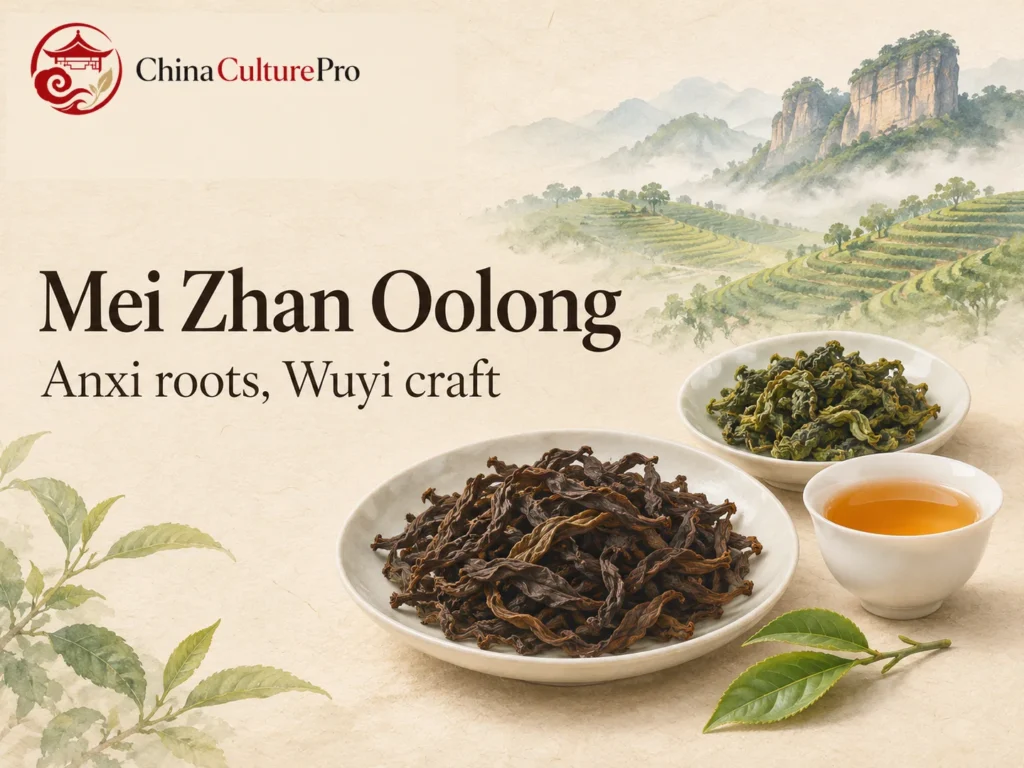

Quick Answer: What Is Mei Zhan Oolong?
Mei Zhan(梅占,méi zhàn)oolong is tea made from a named tea-plant cultivar native to Anxi, Fujian. The same cultivar is also grown and processed elsewhere, including Wuyi.[1,2,5]
- Plant: Mei Zhan identifies the cultivar, rather than one compulsory finished tea category.
- Craft: Withering, working the leaves, heat fixation, rolling and baking turn the harvested leaf into oolong.[3]
- Styles: Lighter Anxi and roasted Wuyi examples offer different floral, fruity and savory profiles.[4,5]
Check the growing location and roast separately from the cultivar name.

A shared cultivar name can lead to different cups. Origin and finishing help explain why.
Where Mei Zhan Comes From
The cultivar’s recorded home is Sanyang village, Lutian town, Anxi County. Its elongated oval leaves belong to a tea plant suitable for making black, green and oolong teas. That distinction between tea cultivar and tea type explains why Mei Zhan appears on more than one kind of tea packet.[2]
Local accounts offer two stories about its name: one involves a visitor borrowing a reference to plum blossoms, while another tells of gifted seedlings and a later naming. Both are presented as legends, not documents proving an exact discovery year or a single inventor.[1]
How Mei Zhan Is Processed into Oolong
The traditional Anxi process has four broad stages: withering, zuoqing(做青,zuòqīng)or working the leaves, heat fixation, and rolling with baking. The sequence distinguishes aroma development from the later shaping and drying of the leaf.[3]
The cultivar supplies part of the aroma, but processing changes its expression. Research using leaves picked from the same batch found that different processing environments affected the composition and relative amounts of aroma compounds. A shared cultivar therefore need not produce identical cups.[7]
Anxi and Wuyi Styles: What Changes in the Cup?
| Actual example | Reported character | What the label adds |
|---|---|---|
| Longjuan, Anxi, spring 2023 | Lighter oolong with buttery floral, yellow-plum and savory spice notes | A named Anxi origin and a lighter processing style |
| Dashuikeng, Wuyi, May 2022 | Light-to-medium roast; woody, fruity, nutty and earthy notes with a tangy finish | A different growing location and an explicit roast description |
These are individual lots, not permanent flavor rules for either region.[4,5] A separate spring 2024 Wuyi example describes plum, candied ginger and molasses-cookie notes after hand finishing, showing variation within Wuyi itself.[6] These tasting comparisons do not imply added fruit, ginger or cookies.
Mei Zhan is also distinct from Tieguanyin(铁观音,tiěguānyīn)and Mao Xie(毛蟹,máo xiè), other cultivars in Anxi’s tea tradition. Shared origins do not make the names interchangeable.[3]
Choosing and Brewing Mei Zhan Oolong
Look for harvest, production place and roast information alongside the cultivar name. A seller’s tea origin label should help you distinguish an Anxi batch from a Wuyi one, rather than making you infer location from “Mei Zhan.”
- For the lighter spring 2023 Anxi example, measure 3 g of tea for 100 ml of water at 90°C.[4]
- Infuse that Anxi tea four times for 60, 60, 60 and 90 seconds.[4]
- Pour off the finished infusion and taste before adjusting the next one. Keep the leaf quantity and brewing water consistent when comparing batches.
For a larger-cup alternative, the May 2022 Wuyi example specifies 2.5 g per 250 ml at 90°C for 2–3 minutes.[5] The two methods use different leaf loadings and timings; keep each complete set together.
FAQs About Mei Zhan Oolong
Is Mei Zhan Always an Oolong Tea?
No. The cultivar is also suitable for black and green tea. A finished tea’s processing category must be checked separately from its plant name.[2]
Does Mei Zhan Contain Plum Blossoms?
The name and floral descriptions do not mean flowers were added. The named oolong examples describe tea made from the cultivar; check ingredients if a product is sold as a blend.[4,5]
Is Mei Zhan Another Name for Tieguanyin?
No. They are separately named cultivars associated with Anxi. Similar processing or a shared growing region does not turn one into the other.[3]
Sources
[1] Anxi County People’s Government. 安溪梅占
[2] International Camellia Register. Meizhan
[3] Li Yuhai. 安溪梅占乌龙茶传统初制技术探讨
[4] Nannuoshan. Anxi Mei Zhan
[5] Curious Tea. Master Zhou’s Yan Cha – Mei Zhan
[6] Verdant Tea. 2024 Mei Zhan Wuyi Oolong
[7] Guo Yuqiong and colleagues. Formation and Changes of Aromas during the Leaf Processing under Different Conditions in Meizhan Tea