

Quick Answer: How Does a Cultivar Differ from a Tea Type?
A tea cultivar identifies selected plant material; a tea type describes the manufactured tea. Both help explain what is in the cup.[1][3]
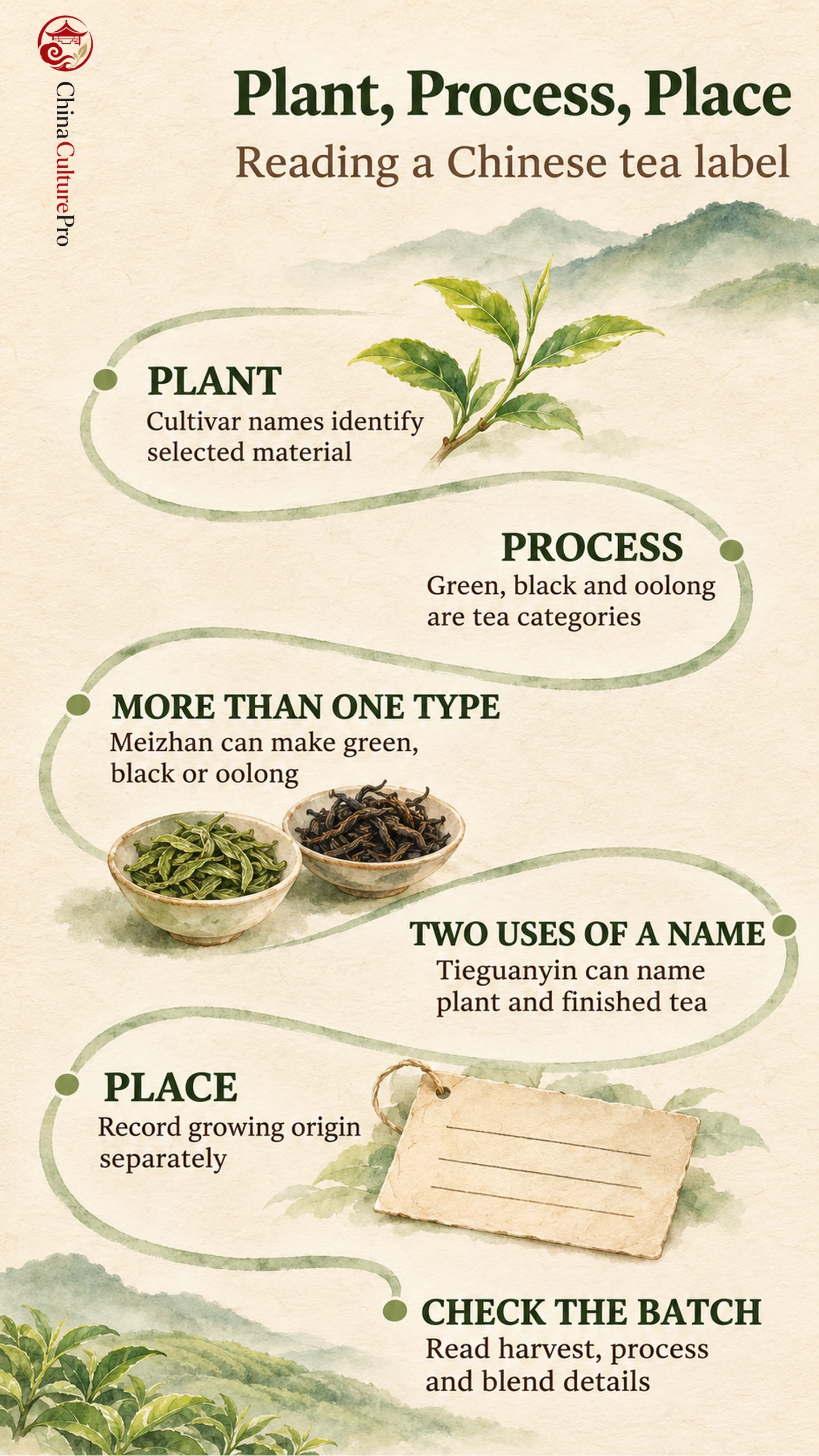
- Plant: a cultivar is maintained for distinguishing characteristics.[1]
- Process: green, black and oolong are tea categories, not cultivar names.[4]
- Overlap: one cultivar can be made into more than one tea type.[3]
- Place: a cultivar name alone does not establish a packet’s growing origin.[7]
A plant name is useful information, but it is not a complete product description.
A plant name and a manufacturing category can appear together on one tea label.
Plant Names and Tea Categories Compared
| Terme | Ce que le terme désigne | Exemple |
|---|---|---|
| Species | A botanical classification. | Camellia sinensis, the tea plant.[2] |
| Botanical variety | A botanical rank within a species. | Camellia sinensis var. sinensis and var. assamica are examples, not tea categories.[1][2] |
| Cultivar | Selected cultivated plants maintained for particular characteristics. | Meizhan(梅占,méizhān)is a named tea cultivar.[1][5] |
| Tea type | A category distinguished through manufacture. | Green tea, black tea and oolong.[4] |
These terms do not form a sequence of quality grades. In everyday retail English, “variety” may simply mean a kind of tea; ask which meaning is intended.
What a Cultivar Does—and Does Not—Identify
Cultivars are selected for characteristics that remain recognizable when propagated appropriately. A selection can originate in the wild or through breeding; “cultivar” does not automatically mean a laboratory-created hybrid. Botanical writing conventionally places cultivar names in single quotation marks, without italics.[1]
Plant material influences the leaves’ starting composition, which manufacture then changes. A cultivar name therefore cannot predict the finished tea independently of its processing.[3]
Can One Cultivar Make Different Tea Types?
Yes. Meizhan is recorded as suitable for black, green and oolong tea. Check which finished tea the seller actually lists.[5]
A controlled study made both oolong and black tea using each of two cultivars, TTES No. 18 and Chin-shin. Processing and cultivar both influenced infusion color: the black-tea process produced a deeper yellow-orange color, while the two plant materials also differed. This demonstrates that plant and process can interact; it does not prove that every cultivar performs equally well under every process.[3]
Tea categories are not assigned solely by the dried leaf’s color or the darkness of a brewed cup. Check the stated oxidation and heat treatment instead of identifying the tea by appearance alone.[4]
When One Name Refers to Both Plant and Tea
Tieguanyin(铁观音,tiěguānyīn)illustrates the overlap. It is a registered cultivar name associated with Anxi in Fujian, and the same name is used for a finished oolong tea. A field description and a retail tea listing may therefore be discussing different things.[6][7]
Ask about the plant material as well as the finished style. Tieguanyin roasting levels describe a further processing distinction, not separate proof of a cultivar’s identity.[4][6]
How to Read a Tea Label in Four Passes
Use separate fields to avoid making a product name answer questions it leaves open. Cultivar disclosure is especially useful when a batch contains more than one cultivar.[7]
- Record the finished tea category or style as stated.
- Record the cultivar, population material or blend information if supplied; leave it unknown if absent.
- Record the growing place separately from the plant name.
- Check harvest and processing details before comparing two packets as though they were equivalent.
For a packet with a place claim, continue with tea origin labels in China. A fuller description helps you ask precise questions; it does not independently authenticate the seller’s claims.
FAQs About Tea Cultivars and Types
Are Cultivar and Variety the Same Thing?
Not in precise botanical usage. A cultivar is selected cultivated plant material; a botanical variety is a taxonomic rank. Informal tea writing often uses “variety” more loosely.[1]
Is Every Cultivar a Clone?
No. The definition requires selected characteristics to be retained through appropriate propagation; it does not define every cultivar as a single clone.[1]
Does One Cultivar Always Taste the Same?
No. Plant identity is only part of the explanation. Processing also matters, so a cultivar name alone cannot fix the finished tea’s character.[3]
Does a Cultivar Name Prove Where Tea Was Grown?
No. Keep the plant claim and growing-origin claim separate, and ask for details about the actual batch.[7]
Sources
[1] Scott Zona / NC State Extension. The Nomenclature of Horticultural Plants: An Explanation
[2] Royal Botanic Gardens, Kew. Camellia sinensis (L.) Kuntze
[3] Chung-Tse Chen, Chin-Ying Yang and Jason T. C. Tzen. Effect of tea manufacturing processes and cultivars on tea infusion color
[4] Tony Gebely / World of Tea. A New Look at Tea Classification
[5] International Camellia Register. Meizhan
[6] International Camellia Register. Tieguanyin
[7] International Specialty Tea Association. Standards For Specialty Tea — Cultivar