


Quick Answer: What Is the Chinese Diaspora?
The Chinese diaspora includes migrants and descendants whose lives connect Chinese ancestry or heritage with communities around the world. Chinese communities overseas (海外华人, hǎiwài huárén) differ in origins, languages, citizenship, migration histories and relationships with ancestral places. They are not one uniform population.[1]
- Migration: Routes and conditions shaped where communities formed and how people stayed connected.
- Culture: Languages, institutions, family practices, food and creative work carry and reshape heritage.
- Belonging: Chinese heritage can coexist with a strong local or national identity.
This is a guide to cultural connections and differences, not a test of ancestry, language fluency or political allegiance.
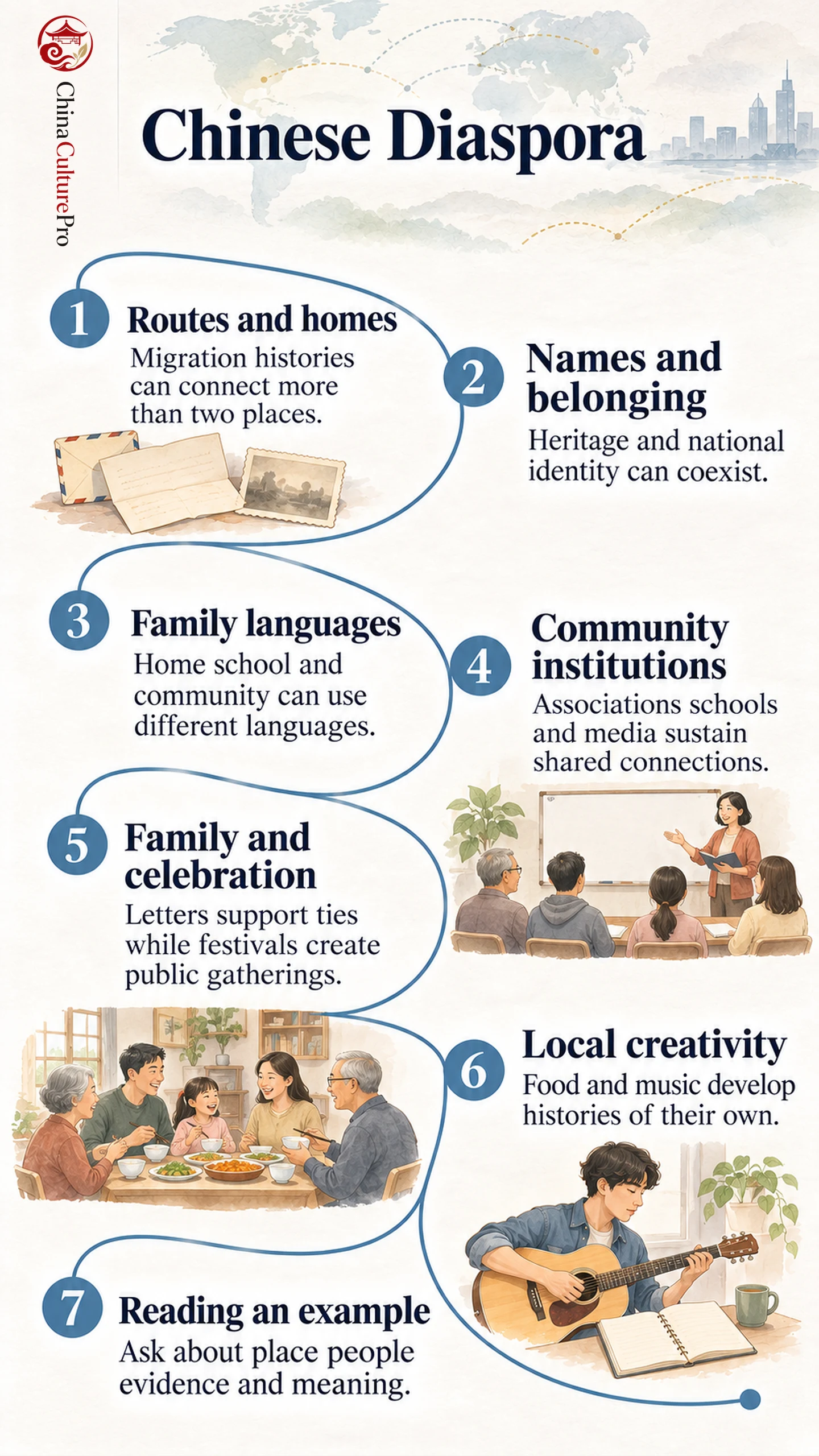
A family letter, a weekend language class and a locally written song reveal different parts of diaspora life. Chinese heritage continues through what people learn, use and create, while the places where they live shape those choices and the opportunities available to them.
Migration Routes and Multiple Homes
Guangdong and Fujian were major sources of Chinese migration before World War II, with routes extending into Southeast Asia, the Americas and Oceania. Later migration drew on more varied places and backgrounds. Some people migrated again after living in another country, making their histories more complex than a single departure from China.[1]
Work and opportunity were shaped by unequal conditions. In colonial Malaya and the Netherlands East Indies, plantation and mining demand drew laborers as well as merchants and brokers. The histories behind Chinese communities in Malaysia and Indonesia therefore include both livelihoods and colonial systems.[9]
Chinese migrants in the United States and Australia also faced exclusion and racial hostility. The institutions people built reflect both these barriers and their own organizing efforts.[9]
Names, Citizenship and Belonging
Ancestry, citizenship and cultural identification describe different things. A person can belong to a country as a citizen while maintaining Chinese family heritage. Labels and preferences also change through local histories; they should not be assigned solely from appearance or a surname.
The development of Singapore Chinese culture illustrates this distinction. Chinese ethnic belonging became part of an independent, multicultural national setting. The histories of local communities include changing language use, education and cultural institutions, rather than an identity simply imported intact from China.[4]
Local traditions can acquire names and histories of their own. Chinese Peranakan culture is one example of heritage developed through regional relationships. Their languages, social practices and material culture can be understood through those local histories.
Languages in Families and Community Schools
There is no single language spoken by everyone in the diaspora. A family may use Cantonese (粤语, Yuèyǔ), Hokkien (福建话, Fújiànhuà; Mandarin label in Southeast Asian usage), Mandarin, another language, or a combination. These differences reflect origins and later places of settlement.[1]
A review of Chinese diaspora language contact, focused mainly on Anglophone and other Western settings, describes people who speak several Chinese varieties, one variety, or none. It also examines community schools, heritage learning and language brokering, in which people help others communicate across languages.[3]
This makes family language and classroom language separate questions. Learning Mandarin can create new opportunities without necessarily continuing the particular language spoken by a grandparent. Multilingual speakers may also draw on different languages within a conversation or for different relationships.[3]
The guide to Chinese diaspora languages follows those distinctions. Fluency is one aspect of cultural participation; it cannot establish the whole story of a person’s belonging.
Associations, Neighborhoods and Public Life
Huiguan (会馆, huìguǎn) are associations that can connect people through regional origins or shared language backgrounds. Other organizations have formed through kinship and related networks. Such institutions helped migrants build relationships and support one another beyond an individual household.[9]
Associations, schools and newspapers have been important to cultural transmission in Singapore’s Chinese communities. They carried social, educational and cultural functions, and their roles changed with the surrounding society. A school classroom, a newspaper and an association hall preserve different kinds of connections.[4]
The histories of Chinese associations and Chinatown neighborhoods offer useful starting points. Read an association building or commercial street alongside its users, activities and period to understand how community life was organized.
Family Ties, Letters and Celebrations
Qiaopi (侨批, qiáopī) are correspondence and remittance documents connecting emigrants with family members in China. The preserved collections include letters, receipts and account records. Nineteenth- and twentieth-century examples document connections from Asia, North America and Oceania.[2]
These papers show that maintaining family relationships involved material support as well as messages. Family letters and remittance records place everyday concerns alongside the financial ties that sustained relationships across distance.
Celebrations can also bring heritage into public life. Auckland Council’s listing for the 2026 Auckland Lantern Festival presented lanterns, performances and food as a celebration of Chinese and Pan-Asian culture and the Chinese New Zealand community, welcoming people of different backgrounds.[8]
Household New Year traditions and a public festival have different settings and audiences. Participation in either can vary with family, belief, time and personal preference.
Food and Music as Local Cultural Forms
Food can connect heritage with new audiences. In the 1980s, Paul Ma’s China Kitchen in Yorktown Heights, New York, combined restaurant dining with Dine and Learn classes about Chinese cooking and culture. Patterned ceramic plates preserved in a museum collection were used in both settings.[5]
In Peru, chifa names a Chinese-Peruvian food tradition. A 2022 account of research in Lima described a restaurant meal that included a banana-leaf-wrapped sticky-rice item called tamale china. This particular meal brings local culinary choices into view.[6]
These examples belong within the global history of Chinese food. Changes in ingredients, presentation or audience can become part of a tradition’s history. A dish’s local significance cannot be decided solely by whether it matches a menu elsewhere.
Creative work provides another example. Xinyao (新谣, xīnyáo) is a form of homegrown Singapore Mandarin songwriting that developed among local youth. Writing songs about local experiences made Chinese-language music a means of creating new culture. Its story connects with the wider regional world of Chinese-language popular music.[7]
How to Read a Diaspora Example
A useful comparison begins with a particular community or practice. Ask:
- Place and period: Where did this form develop, and which migration history shaped it?
- People and institutions: Who made, taught, funded or used it?
- Evidence and meaning: Is the account a family memory, a collection record, research, or a public presentation?
These questions keep a broad diaspora label connected to actual lives. They also leave room for people to explain their own identities and for cultural practices to change across generations.
FAQs About the Chinese Diaspora
Does Chinese ancestry imply Chinese citizenship?
No. Ancestry and citizenship are different categories. Chinese heritage alone does not establish a person’s nationality or political views.
Does everyone in the Chinese diaspora speak Mandarin?
No. People may speak Mandarin, other Chinese languages, several languages, or no Chinese language. Family and school language can differ.
Is diaspora culture simply an older version of culture in China?
No. Local conditions, relationships and creative choices produce traditions with their own histories. Continuity and change can happen together.
Are all Chinese diaspora communities based in Chinatowns?
No. A neighborhood is one setting for community life. Families, schools, associations and cultural work provide other ways to sustain connections.
Can people maintain more than one cultural belonging?
Yes. Chinese heritage and local or national belonging can coexist. Their significance depends on individual and community histories.
Sources
[1] Journal of Ethnic and Migration Studies, Taylor & Francis. Reimagining Chinese Diasporas in a Transnational World: Toward a New Research Agenda
[2] UNESCO Memory of the World. Qiaopi and Yinxin: Correspondence and Remittance Documents from Overseas Chinese
[3] Cambridge University Press. The Chinese Diaspora: Language Maintenance and Loss
[4] Singapore Chinese Cultural Centre, Culturepaedia. Singapore Chinese Culture: National Identity, Ethnic Belonging and Cultural Construction
[5] National Museum of American History, Smithsonian Institution. Plate, Dinner: Paul Ma’s China Kitchen
[6] University of Pennsylvania, Penn Today. Chinese Americans, Countries Apart
[7] Singapore Chinese Cultural Centre, Culturepaedia. Chinese Culture and Music Education in Singapore
[8] Auckland Council, OurAuckland. BNZ Auckland Lantern Festival: Archived Event Listing
[9] Education About Asia. Made in China or Born Abroad? Creating Identity and Belonging in the Chinese Diaspora