


Quick Answer: What Shapes Chinese Culture in Singapore?
Chinese culture in Singapore develops through the lives of Chinese Singaporeans (新加坡华人, Xīnjiāpō huárén) within a multicultural country. It carries connections with Chinese traditions while reflecting local languages, institutions, relationships and creative choices. It is part of Singaporean life, not simply a copy of culture elsewhere.[6]
- Languages: Mandarin and English coexist with varied community language heritages.
- Practices: Schools, associations, food and festivals connect heritage with local settings.
- Change: Art, music and public celebrations continue to develop through participation.
Community background helps explain cultural connections, but it does not prescribe one language, belief or lifestyle for every person.
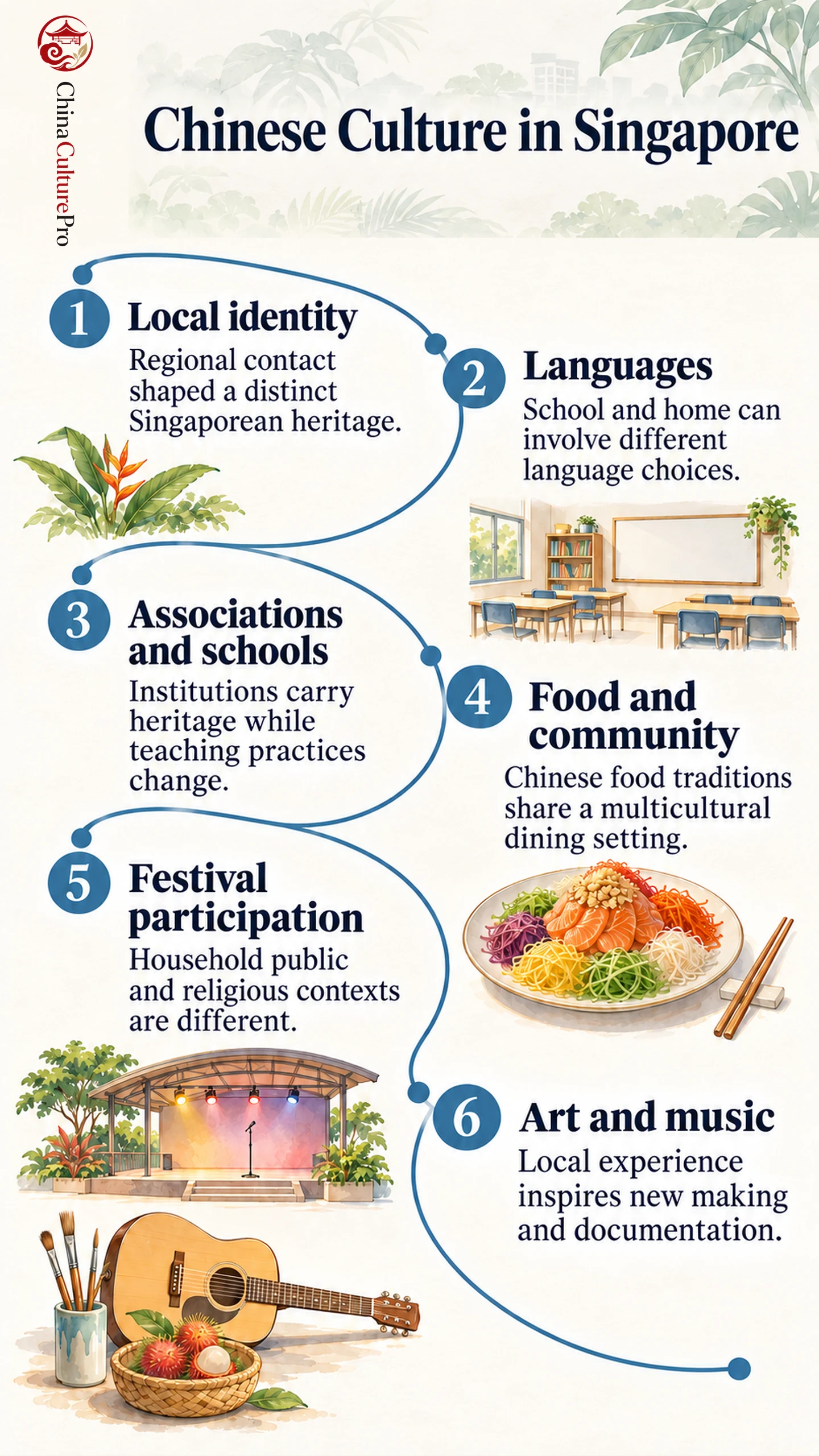
A hawker meal, a community language and a festival performance tell different stories about Chinese life in Singapore. Looking at how people learn, gather and create reveals a heritage shaped by local experience and continuing contact, within wider Chinese diaspora histories.
Local Identity in a Multicultural Society
Singapore’s Chinese heritage developed through settlement and interaction in a Southeast Asian port society. Local conditions and contact with other communities shaped languages, food and customs over time. National belonging and ethnic heritage therefore need to be understood together, while remaining distinct.[6]
Chinese Peranakan traditions form one part of this picture, alongside other community and migration histories.
Filial piety (孝, xiào), care and respect for parents, is one heritage value emphasized in local cultural presentations. Such themes are interpreted in everyday relationships; they are not a requirement that everyone follow an identical family pattern or religious doctrine.[1]
Mandarin, English and Community Languages
The Chinese names below have Mandarin readings; familiar local names are retained. Language heritage includes Hokkien (福建话, Fújiànhuà), Teochew (潮州话, Cháozhōuhuà) and Cantonais (粤语, Yuèyǔ). These communities have different regional and linguistic histories.[2]
Hakka (客家话, Kèjiāhuà) and Hainanese (海南话, Hǎinánhuà) are also prominent heritage varieties. Other varieties are present too. The local umbrella word “dialects” should not be mistaken for different accents of Mandarin.[2]
Singapore’s bilingual education approach pairs English with an official Mother Tongue Language, including Chinese Language, Malay Language or Tamil Language. The educational label “Mother Tongue” does not establish which language a child first learned or which language a family uses most at home.[3]
A conversation with a grandparent, a classroom lesson and communication among different communities can involve different language choices. The wider guide to diaspora languages explains why schooling and family language should be considered separately.
Associations, Schools and Cultural Transmission
Early migrants built associations, schools and temples as sources of mutual support. As people settled and raised families, these institutions helped carry familiar practices into local life. They also responded to needs created by the new setting.[1]
Tao Nan School (道南学校, Dàonán Xuéxiào) offers a concrete educational history. Established in 1906 as Tao Nan Study Hall by the Singapore Hokkien Association, it initially taught in Hokkien. The school took its present name in 1912 and changed its teaching language to Mandarin in 1916.[4]
This example connects association support, education and language change. Cultural transmission was not only a matter of families repeating customs at home; it also involved institutions choosing what and how to teach. The guide to Chinese associations explores those broader functions.
Food in a Shared Singaporean Setting
Hawker culture belongs to Singapore’s multicultural life. Chinese, Malay, Indian and other food traditions meet in shared dining spaces, with dishes adapted to local tastes. The heritage recognized in 2020 concerns community dining and culinary practices, not exclusive ownership by one ethnic group.[5]
Within this setting, yong tau foo (酿豆腐, niàngdòufu; Mandarin name) illustrates change within Chinese food traditions. Associated with Hakka stuffed beancurd, it developed a broader range of ingredients through Cantonese adaptations. The history links beancurd with choices made by different cooks and communities.[1]
Yusheng (鱼生, yúshēng) is a colorful celebratory salad whose familiar Singapore form developed in the 1960s. Lohei (捞起, lāoqǐ; Mandarin reading), the Cantonese name associated with tossing it, brings diners together with auspicious sayings. These express hopes for prosperity rather than a guaranteed outcome.[11]
The guide to yusheng and lohei follows that particular feast tradition. Everyday hawker dining and an occasion-specific shared salad show different social roles for food.
Festivals, Performance and Different Forms of Participation
Chinese New Year (春节, Chūnjié) can involve family reunions, visiting and shared meals. Household New Year traditions have a different setting from large public performances, even when they occur within the same festive period.[6]
The modern Chingay Parade (妆艺大游行, Zhuāngyì Dàyóuxíng) began in 1973. By 1976, its program included different ethnic communities. Its development shows how an event with Chinese festive connections became a shared public presentation of Singapore’s multicultural life.[8]
Getai (歌台, gētái), literally “song stage,” is a live stage-performance tradition. Beginning as amusement-park entertainment in the 1940s, it later moved into neighborhood and temple settings. Mandarin and community-language songs form part of its performances, which became associated with the seventh lunar month and the Zhongyuan Festival (中元节, Zhōngyuán Jié).[7]
In folk-religious settings, performances can serve as offerings as well as entertainment. That context helps explain the relationship with festival offerings, while audiences and individuals may participate for different reasons. Watching a show does not establish a person’s beliefs.[7]
Art and Music Created from Local Experience
Local experience also becomes a subject for art. Georgette Chen (张荔英, Zhāng Lìyīng; Mandarin reading) painted Tropical Fruits in 1969. The oil painting uses different viewpoints to arrange fruit in baskets, on a table and suspended above it. Her earlier experience with European still-life painting informed her engagement with Southeast Asian subjects and compositional experiments.[9]
Music provides another route. Xinyao (新谣, xīnyáo), homegrown Mandarin songs associated with Singapore youth, became prominent in the 1980s. In March 2026, the Singapore Chinese Cultural Centre and Mediacorp announced the seven-part documentary series Encounter Under The Stars, drawing on interviews and archives to revisit the movement.[10]
Making, performing and documenting local experiences gives successive generations ways to take part in Chinese-language popular music. These forms remain connected to wider influences while carrying histories shaped in Singapore.
FAQs About Chinese Culture in Singapore
Is Chinese Singaporean culture the same as culture in China?
No. It has developed through local settlement, institutions and contact within Singapore’s multicultural society, while retaining varied connections with Chinese heritage.
Do all Chinese Singaporeans speak the same home language?
No. Family backgrounds include several Chinese varieties as well as English and Mandarin. School language and home language are separate questions.
Is Singapore’s hawker culture exclusively Chinese?
No. Its recognized heritage brings together Chinese, Malay, Indian and other traditions within shared community dining spaces.
Is Chingay only a Chinese community event?
No. The modern parade began in 1973 and included different ethnic communities by 1976, developing into a multicultural public event.
Are getai and xinyao the same kind of music?
No. Getai is a stage-performance tradition with amusement-park and later neighborhood histories. Xinyao refers to homegrown Mandarin songwriting associated with Singapore youth.
Sources
[1] Singapore Chinese Cultural Centre. Discover a Vibrant Chinese Singaporean Culture
[2] Singapore Chinese Cultural Centre, Culturepaedia. Chinese Dialects in Singapore
[3] Ministry of Education, Singapore. About Language and Literacy
[4] Ministry of Education Heritage Centre, Singapore. Tao Nan School
[5] UNESCO Intangible Cultural Heritage. Hawker Culture in Singapore: Community Dining and Culinary Practices in a Multicultural Urban Context
[6] Singapore Chinese Cultural Centre. SINGAPO人: Exhibition Text
[7] Singapore Chinese Cultural Centre, Culturepaedia. From Amusement Parks to the Heartlands: The Evolution of Getai in Singapore
[8] People’s Association, Singapore. The Chingay Timeline
[9] National Gallery Singapore. A Closer Look at Georgette Chen’s Tropical Fruits
[10] Singapore Chinese Cultural Centre. SCCC and Mediacorp Celebrate Xinyao and the Roots of Singapore Mandarin Pop Music with New Documentary Series
[11] Singapore Chinese Cultural Centre, Festive Fever. The Ultimate Yusheng Guide