

Quick Answer: What Do Tieguanyin Roasting Levels Mean?
For Tieguanyin(铁观音,tiěguānyīn), a roast description concerns heat treatment and its effect on the finished tea. It does not identify every part of manufacture.
- Flavor: additional roasting can shift the balance from floral toward toasted aromas.[1]
- Heat source: charcoal does not automatically mean heavy roast; medium charcoal-roasted examples exist.[3]
- Product style: clear, strong and aged aroma are not three fixed roast intensities.[2]
Treat light, medium and heavy as descriptions to clarify with the seller, rather than a universal numerical scale.
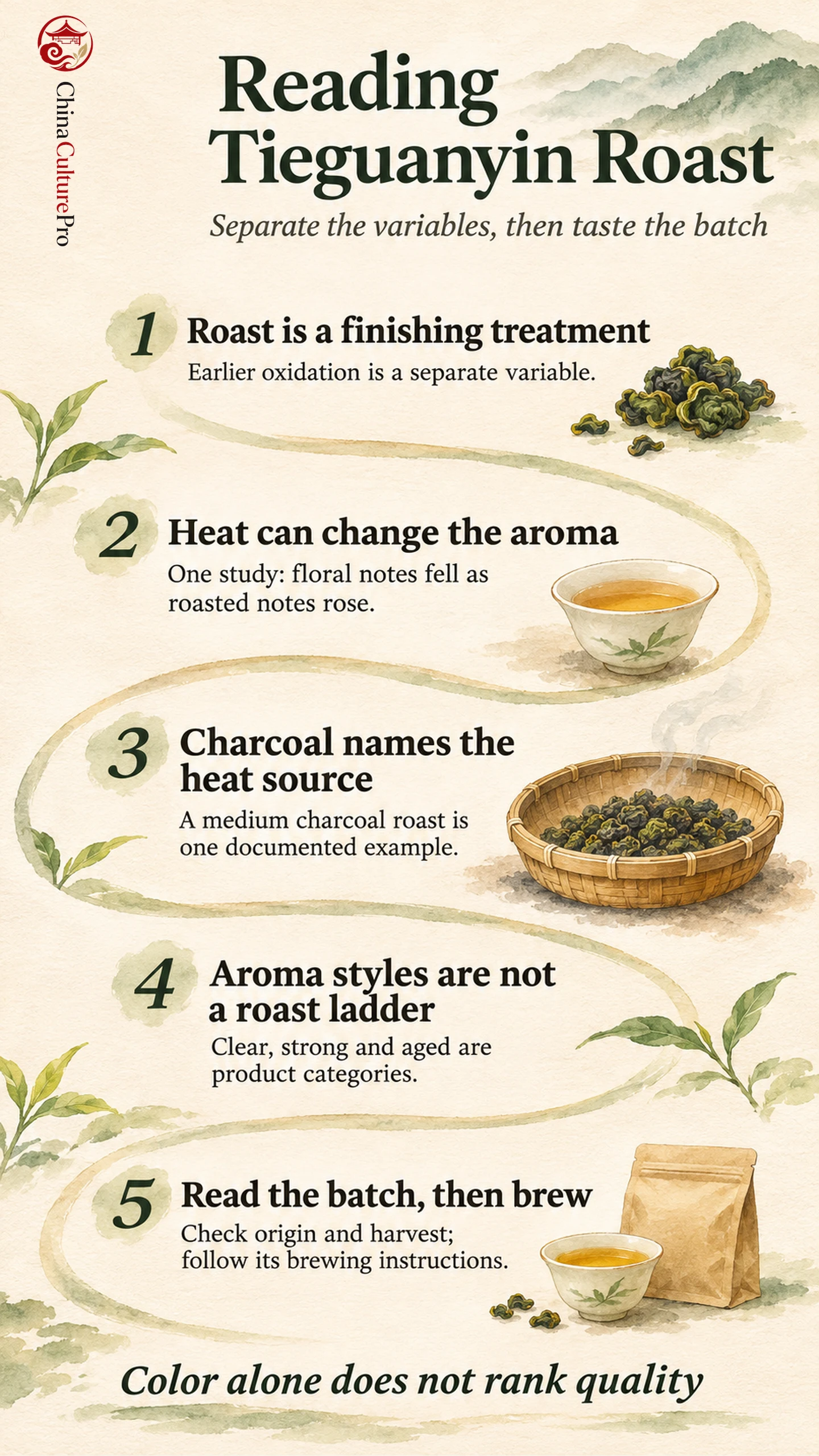
Two packets can share the Tieguanyin name yet offer very different cups. Read the roast alongside the batch’s origin, processing and age.
Roast, Oxidation, Heat Source and Age
A controlled roasting study used the same fresh leaves and manufacturing sequence, changing the final roasting treatment. Earlier leaf handling and later roasting are therefore distinct variables when interpreting a tea’s flavor.[1]
| Terme | Ce qu’elle décrit | Questions à poser |
|---|---|---|
| Roast level | The stated intensity or character of the finishing heat treatment. | What does this seller mean by light, medium or heavy? |
| Oxydation | Leaf changes developed earlier in oolong manufacture; it is not another name for roasting. | How was the tea made before its finishing roast?[1] |
| Heat source | For example, charcoal in a documented medium-roasted batch. | Is the label naming the fuel or the roast intensity?[3] |
| Âge | The tea’s chronology, including harvest and subsequent handling. | Are the harvest date and later roasting date distinguished? |
Tieguanyin can name plant material or a finished tea. Our cultivar and tea-type guide explains that distinction. Regional context matters too: Muzha Tieguanyin deserves its own description rather than being treated as identical to every Anxi example.
How Roasting Changes the Cup
In the controlled experiment, longer roasting reduced floral aroma and increased roasted aroma. Astringency decreased and sweet aftertaste increased, while bitterness remained stable as roasting time lengthened. These results describe those experimental teas, not a promise that stronger roasting improves every batch.[1]
One archived medium-roast Anxi listing describes mahogany-brown leaves, a deep amber infusion and a mellow, roasty character with cocoa-like notes. These are that tea’s reported characteristics, not a universal color chart. Cocoa is tasting language, not a listed ingredient.[4]
Clear, Strong and Aged Aroma Labels
The current Anxi Tieguanyin standard, GB/T 19598-2025, recognizes qingxiang(清香,qīngxiāng), nongxiang(浓香,nóngxiāng)and chenxiang(陈香,chénxiāng)product types: clear, strong and aged aroma. The aged-aroma category was added in this edition. These are product classifications, not substitutes for a light–medium–heavy roasting scale.[2]
Ask for the history behind an aged-aroma claim. A fresh batch does not acquire an aging history simply by becoming darker; “traditional” also needs a process description.
How to Choose and Brew a Roasted Batch
A spring 2025 Anxi example is explicitly described as medium-roasted and charcoal-roasted. Its published first-infusion method provides this starting point.[3]
- Measure 6 g of the medium-roasted leaves into a suitable brewing vessel.
- Add 6 US fluid ounces of water at 205°F, approximately 177 ml at 96°C.
- Infuse for one minute, then drain the liquor completely.
- Taste the cup before adjusting a later infusion; keep changes small enough to compare.
This is one batch’s starting method, not a temperature rule for all roasts. Compare origin-label details when choosing tea, and consider your brewing water before attributing every difference to roasting.
FAQs About Tieguanyin Roasting
Does Charcoal Roast Mean Heavy Roast?
No. A documented medium-roast Anxi tea uses charcoal. Fuel and roast intensity answer different questions.[3]
Is Chenxiang Just Heavily Roasted Tieguanyin?
No. It is the aged-aroma product category in the current Anxi standard, not the top step of a three-level roast scale.[2]
Does Darker Tea Prove a Better Roast?
Color alone cannot tell you which cup you will prefer. Compare aroma, taste and the batch description instead of treating darkness as a quality ranking.
Must Roasted Tieguanyin Be Brewed with Boiling Water?
No single temperature follows from the label. The medium-roast example here specifies 205°F, about 96°C; start with your own batch’s instructions.[3]
Sources
[1] Cao Qing-Qing and colleagues. Sensory and chemical characteristics of Tieguanyin oolong tea after roasting
[2] State Administration for Market Regulation and Standardization Administration of China. GB/T 19598-2025: Quality requirements for product of geographical indication—Anxi tieguanyin
[3] Teance. Tieguanyin Medium Roast Organic High Mountain
[4] Tea Trekker. Tieguanyin Traditional Style