


Quick Answer: What Is Mei Gan Cai?
Mei gan cai(梅干菜,méigāncài)is a dried preserved vegetable ingredient, commonly made from mustard greens(芥菜,jiècài). Salting, fermentation and drying change the fresh leaves into a concentrated ingredient used in cooked dishes. [1][2]
- Appearance: Products may be dark, wrinkled leaves and stems, loose chopped pieces or compact dried bundles.
- Flavor: Preserved greens contribute a savory, fermented vegetable aroma rather than the taste of a fresh leafy side.
- Kitchen role: They flavor pork dishes, steamed preparations and filled breads.
- Preparation: Dried products commonly need cleaning and softening before cooking.
Regional names and methods vary. The term does not guarantee one vegetable variety, one salt level or a ready-to-eat product. [3][4][5][7]
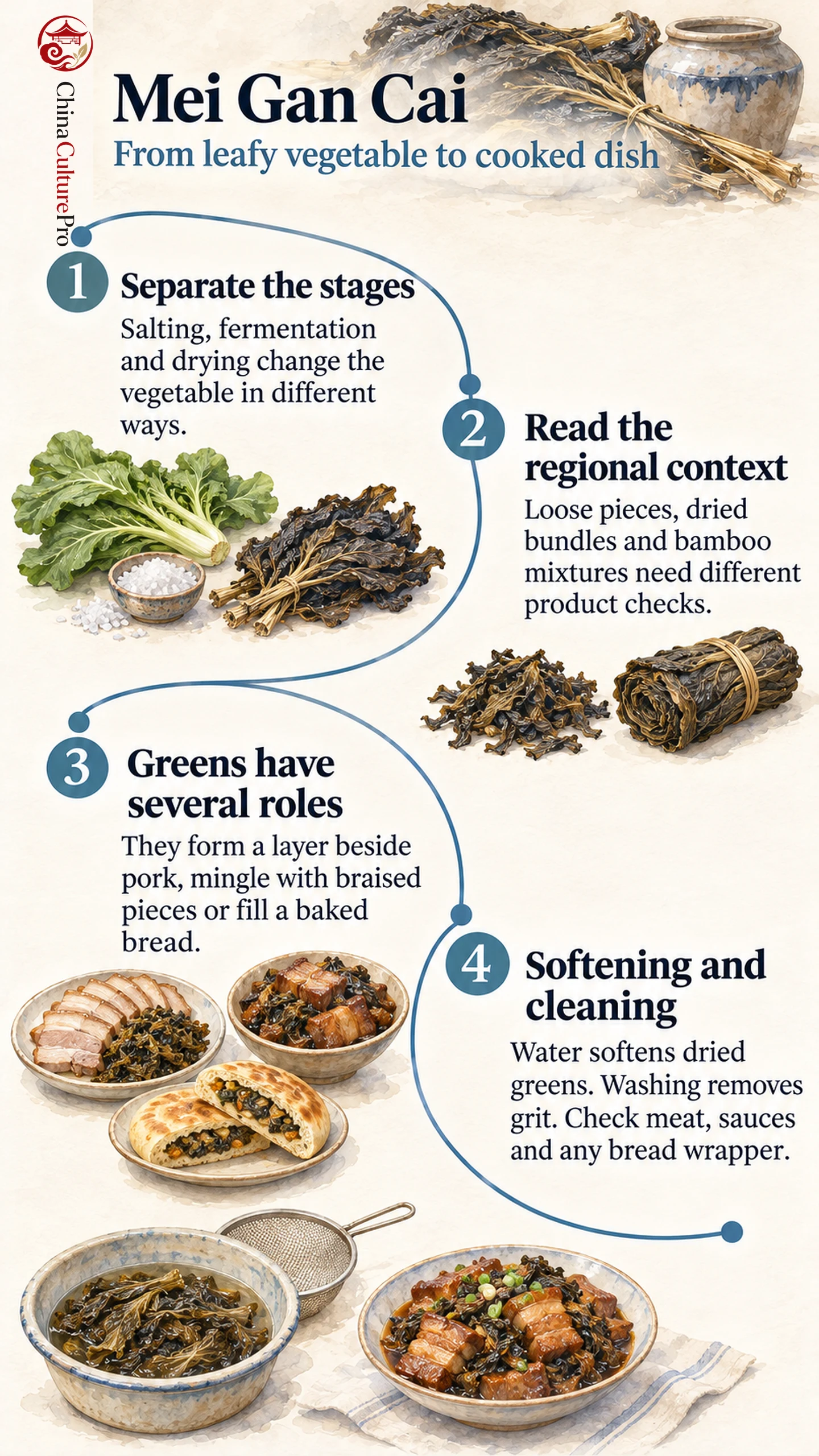
A mound of dark greens beneath pork belly can be as important as the meat above it. Mei gan cai contributes its own aroma while taking on cooking juices. To understand its place in a dish, separate the original vegetable, the preserving process and the final preparation.
Salting, Fermentation and Drying Are Different Stages
The starting point is a leafy vegetable, often one of the mustard greens used for preservation. Salting draws out moisture, fermentation changes flavor, and drying removes more water. Those are related operations, but they are not three names for the same event. [1][2]
A local account from Guanxi, Taiwan, describes a sequence from suancai(酸菜,suāncài)to fucai(福菜,fúcài), followed by further drying to make mei gan cai. In that account, the final dried vegetable can be rolled into compact bundles. That sequence belongs to the local account; other regional products can follow different processes. [2]
The distinction matters at the table. A juicy sour pickle and a deeply dried, wrinkled green do not have the same texture or behave identically in cooking, even if both began as mustard. The wider subject of Chinese food preservation includes several processes that can be combined in different ways.
Regional Names and Product Forms Need Context
Taiwan’s agricultural and dictionary records connect dried salted mustard greens with Hakka cooking. The dictionary identifies the preserved ingredient through its vegetable base and salt-and-sun-drying treatment, rather than by a single finished recipe. [1][3]
Shaoxing provides another important context. A local official report on product standards distinguishes a broad preserved-vegetable category from Shaoxing mei gan cai made with mustard types, and also describes a version combined with bamboo shoots. These categories describe different product scopes. [7]
Loose chopped material, leafier bundles and bamboo-containing mixtures therefore deserve a closer look at the label. A firsthand cooking account also describes buying preserved greens mixed with dried bamboo shoots. That is evidence for a particular product form, not a requirement that every package contain bamboo. [4]
Names on English labels can be broad. “Preserved mustard greens” covers more than one product within the larger family of Chinese preserved vegetables. Check the pictured form, ingredients and preparation directions rather than assuming every bag can be substituted unchanged.
How Preserved Greens Work in Chinese Dishes
Mei cai kou rou(梅菜扣肉,méicài kòuròu)and Jinyun shaobing(缙云烧饼,Jìnyún shāobǐng)show two different uses: a cooked vegetable layer beside meat, and a filling enclosed in bread.
| Dish form | Role of the preserved greens |
|---|---|
| Steamed pork-belly slices | A layer of greens cooks with the meat and takes on its savory juices. |
| Braised pork-belly pieces | Chopped greens mingle with chunks of pork and the reduced sauce. |
| Filled baked flatbread | Preserved greens combine with pork inside a wheat-based shell. |
In the steamed preparation, pork slices and greens are arranged in a bowl and the finished dish is inverted for serving. The greens remain a distinct part of the plate. The braised version uses smaller pork pieces, so meat, greens and sauce are more mixed together. These are different presentations, not competing standards of authenticity. [4][5]
The official description of Jinyun’s flatbread-making tradition identifies a local preserved mustard green combined with pork. Its account includes steaming and drying the vegetable before it becomes filling. That local detail should not be imposed on all mei gan cai production. [6]
Preparing the Ingredient and Reading the Menu
For a dried cooking ingredient, softening and washing have separate purposes. Water helps the vegetable become pliable, while cleaning removes grit that may remain among the leaves and stems. The documented pork preparations emphasize thorough washing before the greens go into the dish. [4][5]
There is no need to attach one universal soaking duration or number of rinses to every product. Follow its directions and the preparation it requires; a seasoned ready-to-use mixture is not automatically handled like a plain, dry packet.
The vegetable’s original saltiness is also separate from soy sauce, sugar, wine or meat juices added during cooking. A dark color does not reveal how salty or sweet the completed dish will be. [4]
For vegetarian Chinese food, check the whole preparation. The vegetable base does not make pork belly or a pork-filled bread vegetarian. Ask about meat, stock, cooking fat and sauces, as well as wheat in any enclosing bread. [5][6]
FAQs About Mei Gan Cai
Does Mei Gan Cai Contain Plums?
Not as its defining ingredient. Mei gan cai is a preserved vegetable product; the word mei in its name should not be read as a recipe instruction to add plums. Check any particular flavored product separately.
Is Mei Gan Cai the Same as Fresh Mustard Greens?
No. Mustard greens can be its starting material, but salting, fermentation and drying change the flavor, moisture and texture before it is used in a cooked dish.
Are Mei Gan Cai Dishes Vegetarian?
Not necessarily. Many familiar preparations combine the greens with pork. A vegetarian version depends on the broth, fat, sauces and other ingredients, not simply the presence of preserved vegetables.
Sources
[1] Taiwan Ministry of Agriculture. How Much Do You Know About Mustard Greens
[2] Guanxi Township Farmers Association. Preserved Vegetable Story Museum
[3] Taiwan Ministry of Education. Hakka Dictionary: Dried Salted Vegetables
[4] Judy Leung. Braised Pork Belly with Meigan Cai
[5] Judy Leung. Mei Cai Kou Rou: Steamed Pork Belly with Preserved Vegetables
[6] China Intangible Cultural Heritage Network (Réseau chinois du patrimoine culturel immatériel). Jinyun Shaobing Making Technique
[7] Shaoxing Release. Shaoxing Mei Gan Cai Product Standard Report