
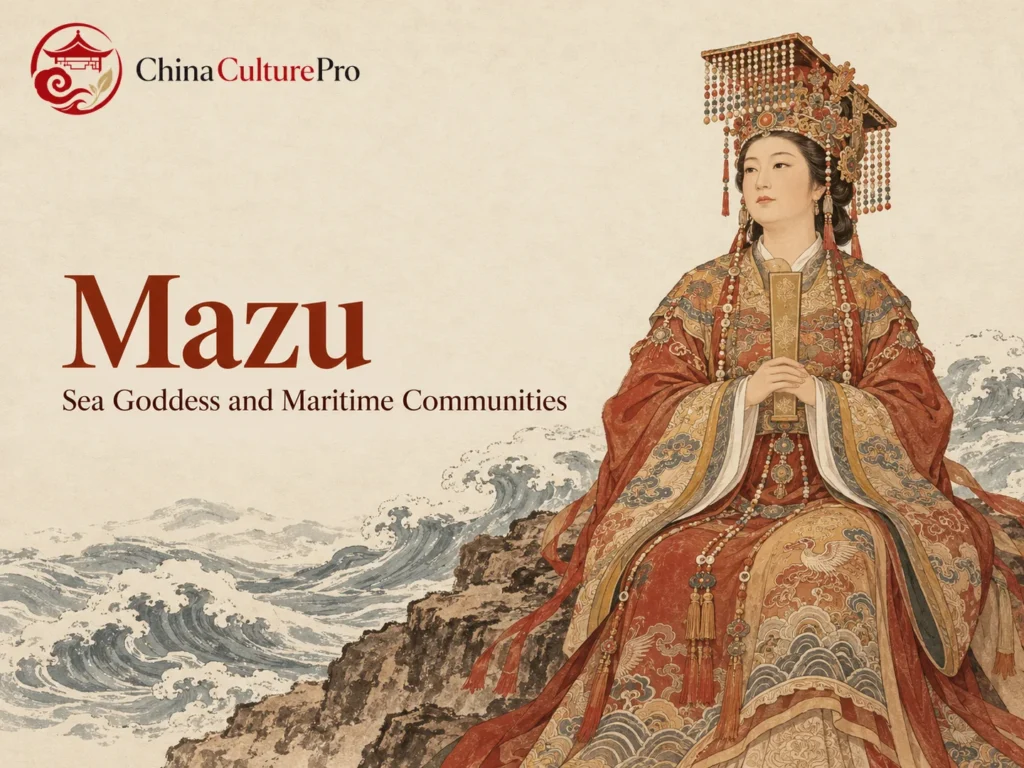

Quick Answer: Who Is Mazu?
Mazu(妈祖,Māzǔ)is a sea goddess especially associated with the maritime communities of southeastern China and their descendants overseas. Worshippers honor her as a compassionate protector, while temples, stories and celebrations also preserve memories of migration and life by the water.
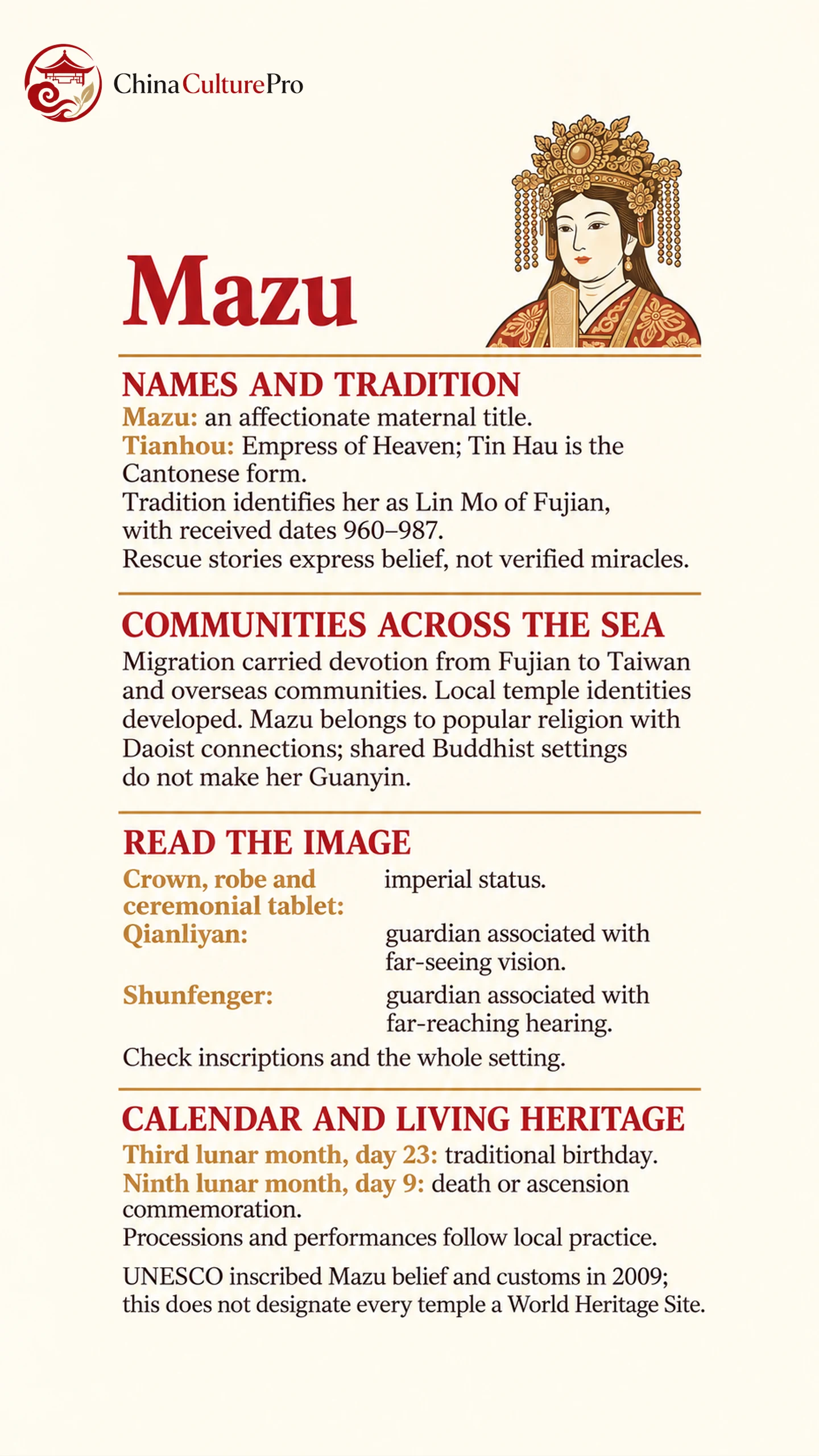
- Identity: Devotional tradition connects the goddess with a woman from the Putian area of Fujian, associated particularly with Meizhou Island.
- Names: Tianhou(天后,Tiānhòu), or Empress of Heaven, is another title; Tin Hau is its familiar Cantonese form.
- Images: An elaborate crown, ceremonial robe and guardian attendants are useful recognition clues.
- Celebrations: Her traditional birthday falls on the 23rd day of the third lunar month.
Mazu’s protective powers belong to religious belief. Traditional life stories, historical developments in worship and present-day community practices are related but different kinds of evidence. [1][2][3]
A crowned goddess in a coastal temple and a statue carried through city streets may both be Mazu. Her importance reaches beyond seafaring: understanding her place in religion in China also means looking at family ties, migration and local belonging.
Mazu, Tianhou and Tin Hau: Understanding the Names
Mazu is commonly understood as an affectionate maternal title, often translated as “maternal ancestor.” Tianhou means Empress of Heaven. On Hong Kong temple signs, Tin Hau represents the Cantonese pronunciation of that same title; it does not identify a different goddess.
Older English texts may write T’ien Hou, while other inscriptions use titles translated as Heavenly Holy Mother or Heavenly Consort. Names changed as worship developed and imperial courts granted honors. A grand title and an intimate maternal name can therefore coexist in the same tradition. [2][3]
Lin Mo and the Boundary Between Biography and Legend
Traditional accounts call the woman Lin Mo(林默,Lín Mò), also respectfully known as Lin Moniang(林默娘,Lín Mòniáng). Meizhou’s temple tradition gives her dates as 960–987. These are received biographical dates within the tradition; they should not be presented as though a surviving contemporary civil record independently establishes every detail. [3]
A widely told rescue story describes her saving members of her family from danger at sea. Other tales concern shipwrecks, weather or later appearances to distressed sailors. Such narratives explain compassion and protective authority. Their importance to believers does not turn a supernatural rescue into a verified historical occurrence. Family background and individual episodes also differ among retellings. [2][9]
The firmer historical question is how worship developed. Devotion grew in coastal Fujian during the Song period and received support and honors from later imperial courts. The history of recognition can be studied separately from the truth of a miracle story. [2][3]
From Fujian Shores to Maritime Communities
Sea travel helps explain the movement of Mazu worship. Fishermen, traders and migrants carried devotional objects and practices with them; shrines established in new settlements connected dangerous crossings with gratitude and a sense of continuity. Fujian remained an important reference point, but receiving communities developed their own relationships with the goddess. [3][4]
In Taiwan, place-linked names such as Dajia Ma and Beigang Ma express attachments to particular temples and communities. They need not be read as biographies of different women. The deity’s local roles could also expand beyond fishing into agriculture, water and wider community concerns. [4]
Singapore offers a concrete overseas example. At Thian Hock Keng, devotion reflects immigrant and maritime histories across more than one dialect group. Mazu occupies the principal hall, while Guan Gong and other deities also have places in the temple. This arrangement shows a particular community setting rather than a compulsory layout for every Mazu shrine. [5]
Recognizing Mazu and Her Attendants
Mazu is often represented with the dignity of an imperial woman. Read the whole setting, including inscriptions and attendants, rather than identifying her from robe color alone. Materials, posture and headdress vary among objects. [6]
| Image clue | Comment l’interpréter |
|---|---|
| Crown, robe and ceremonial tablet | A richly dressed, crowned figure may express Mazu’s status as Empress of Heaven. These features are useful together, rather than an exclusive uniform. [6] |
| Qianliyan(千里眼,Qiānlǐyǎn) | The guardian associated in devotional stories with seeing across great distances; the name is commonly rendered Thousand-Li Eye. [5][6] |
| Shunfeng’er(顺风耳,Shùnfēng’ěr) | The companion associated with far-reaching hearing, often translated as Favourable-Wind Ear. Their supernatural capacities describe the traditional story world. [5][6] |
Birthdays, Pilgrimages and Community Celebrations
The traditional calendar provides two useful reference points. These are lunar observances, not fixed dates in March and September: [7][8]
In Hong Kong, Tin Hau celebrations can include Cantonese opera, community ceremonies and land or water processions. Some districts observe other designated dates. In Taiwan, temple fairs and pilgrimages around the birthday season express strong local attachments; the events are not one identical procession repeated everywhere. [4][7]
- Birthday: the 23rd day of the third lunar month.
- Commemoration of her death or ascension in traditional accounts: the ninth day of the ninth lunar month.
What UNESCO Recognized in 2009
In 2009, “Mazu belief and customs” was inscribed on UNESCO’s Representative List of the Intangible Cultural Heritage of Humanity. The recognized element concerns living expressions: oral traditions, religious ceremonies and folk practices sustained by communities. It is not simply the name of a building. [1]
Intangible heritage recognition therefore does not make every Mazu temple a UNESCO World Heritage Site, certify miracle narratives, or require worshippers everywhere to follow one ritual script. Its value lies in recognizing transmitted practices and the identities they help maintain. [1]
Mazu Within Chinese Religious Life
Mazu is especially important in Chinese popular religion and has strong Daoist connections. Her temples and stories can nevertheless overlap with Buddhist and Confucian settings. Describing that overlap is more accurate than assigning all devotees to a single exclusive religious membership. [2][4]
Guanyin, the compassionate bodhisattva of Chinese Buddhism, is a distinct figure. Thian Hock Keng honors Mazu in its principal hall and Guanyin in the rear hall: sharing a complex does not make them the same deity. [5]
For an observer, the useful questions are local: which title is used, what history the community remembers, and what occasion is being marked? Follow the site’s directions about photography and ritual spaces. There is no need to invent a universal offering count or to perform a ceremony in order to understand its cultural meaning.
FAQs About Mazu
Are Mazu and Tin Hau the Same Goddess?
Yes. Tin Hau is the Cantonese form of Tianhou, a title of Mazu meaning Empress of Heaven. Different English spellings reflect language and transliteration rather than separate deities. [2][7]
Was Mazu a Real Person?
Tradition identifies her with Lin Mo, a woman of tenth-century Fujian. The received dates and miracle-filled life stories require a different evidential footing from the documented development of worship. [1][3]
When Is Mazu’s Birthday?
The traditional birthday is the 23rd day of the third lunar month. Its Gregorian date changes from year to year, and individual communities may schedule celebrations differently. [7]
Is Mazu the Same as Guanyin?
No. Mazu and Guanyin have distinct identities, even where believers honor both or their images share a temple setting. [5]
Sources
[1] UNESCO. Mazu belief and customs, nomination 00227 and 2009 inscription
[2] Academy of Chinese Studies. Veneration of Tianhou (Mazu)
[3] Meizhou Mazu Temple. Global Mazu: names, traditional biography and maritime networks
[4] Bureau of Cultural Heritage, Taiwan. Mazu Worship: migration and local identities
[5] National Library Singapore, BiblioAsia. Mazu Worship in Singapore, Alvin Tan, April 2025
[6] Horniman Museum and Gardens. Female deity figure, probably Tian Hou Sheng Mu, object 2004.282
[7] Hong Kong Intangible Cultural Heritage Office. Tin Hau Festival in Hong Kong
[8] Ministry of Culture, ChinaCulture.org. The Belief in Mazu: folk customs and traditional calendar
[9] Luo Yang, cultural essay republished by Fujian Foreign Affairs Office. The Woman Who Became a Goddess