


Quick Answer: Who Is Wenchang Dijun?
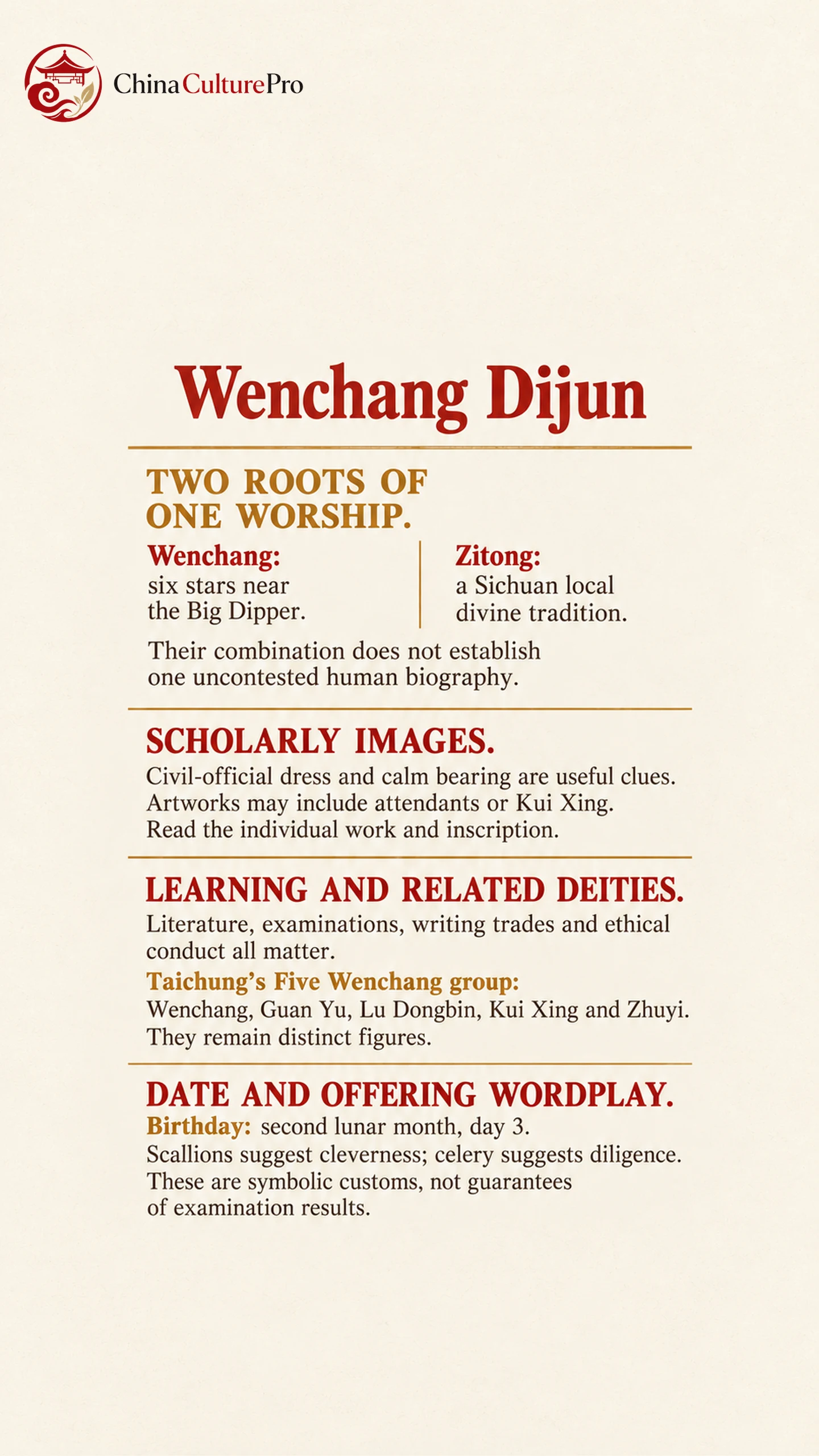
Wenchang Dijun(文昌帝君,Wénchāng Dìjūn)is a Chinese deity associated with literature, learning, official advancement and examinations. His familiar identity brings together stellar symbolism and the worship of a local god from Sichuan.
- Names: Lord Wenchang and Divine Lord of Zitong refer to closely connected aspects of his developed worship.
- Appearance: Images often give him the composed bearing and dress of a civil official or scholar.
- Patronage: Students, writers and people connected with the written word have appealed to him.
- Customs: His commonly observed birthday is the third day of the second lunar month.
He is distinct from Kui Xing(魁星,Kuí Xīng), although both may share a shrine. Temple narratives, historical records and modern devotional practices provide different kinds of evidence. [1][2][4][8][9]
A scholarly figure beside a fierce, brush-bearing companion can belong to the world of examination worship. Wenchang’s story explains how stars, local religious traditions and the prestige of learning became connected within religion in China.
From Wenchang Stars to the Lord of Zitong
Wenchang originally names an asterism of six stars near the Big Dipper. It is not simply another name for the seven-star Dipper or the single Pole Star. Personifying this celestial grouping provided one strand of the god’s authority over literature and scholarly distinction. [1][2]
Another strand comes from Sichuan. Zitong Dijun(梓潼帝君,Zǐtóng Dìjūn), the Divine Lord of Zitong, became associated with the name Zhang Yazi(张亚子,Zhāng Yàzǐ)and Qiqu Mountain(七曲山,Qīqū Shān). Accounts combine local divine identities and stories about a person who died in warfare; they do not yield one uncontested modern biography. [2][3]
Imperial recognition helped elevate the cult. A cultural record gives 1316 as the Yuan court’s grant of the expanded Wenchang imperial title. That dated recognition is different from a claim that the god was born, or his entire worship invented, in that year. Stories of repeated incarnations and miraculous assistance belong to his religious life history. [3]
Recognizing Wenchang in Art
Civil-official dress and a calm, authoritative expression are useful starting points. A Dehua porcelain group made around 1600–1644 seats Wenchang above a smaller Kui Xing holding an open book. Wenchang raises a hand as though writing in it. Relative scale and their shared activity identify a relationship between separate figures. [4]
Other images tell a journey story. A rubbing after an 1854 stone carving shows an elderly Wenchang with attendants Tianlong(天聋,Tiānlóng), “Heaven-deaf,” and Diya(地哑,Dìyǎ), “Earth-mute.” Its Wind Cave setting evokes a legendary passage between his Sichuan base and the distant capital. [5]
The attendants’ names are part of religious iconography. They do not justify assuming that every servant, mount or object has one unchanged appearance: the same rubbing gives familiar roles unusual visual forms. Read the inscription and the individual work before applying a universal portrait checklist. [5]
Wenchang, Kui Xing and the Five Wenchang Deities
The Kui Xing image has its own dynamic, often fierce appearance, unlike Wenchang’s civil bearing. Related responsibilities explain why the figures can appear together; shared patronage does not make them interchangeable. [4]
Five Wenchang(五文昌,Wǔ Wénchāng)is a collective arrangement found in Taiwanese worship. At Taichung Wenchang Temple, the group includes the following figures. This is a named temple’s grouping, not five incarnations of one god or a requirement for every shrine. The separate traditions of Guan Gong and Lu Dongbin(吕洞宾,Lǚ Dòngbīn)explain their wider roles. [6]
| Figure | Identity in this grouping |
|---|---|
| Wenchang / Zitong Dijun | The central literary deity connected with stellar and Zitong traditions. |
| Guan Yu(关羽,Guān Yǔ) | Worshipped here under his literary title Wenheng Dijun(文衡帝君,Wénhéng Dìjūn); also known through Guan Gong worship. |
| Lu Dongbin | The immortal Lu Dongbin, honored as Fuyou Dijun(孚佑帝君,Fúyòu Dìjūn). |
| Kui Xing | A distinct examination deity also included in the collective. |
| Zhuyi(朱衣,Zhūyī) | The Red-Robed deity associated with examination judgment. [6][7] |
Examinations, Literature and Moral Conduct
Examinations linked literary ability with the prospect of office, status and income. A god who watched over scholarly advancement therefore mattered to candidates and their families. Modern requests for success extend this concern into present-day education, rather than preserving the imperial examination system unchanged. [7][9]
His constituency also reaches beyond candidates. A museum print record names lettering workers, printers and paper shops among those who honored him. These occupations show why “God of Literature” is a broader description than “exam god”: the production and handling of writing formed a cultural world of its own. [8]
Moral conduct is another part of that world. The Tract of Hidden Virtue(阴骘文,Yīnzhì wén), attributed to Wenchang, belongs to a tradition of ethical exhortation. Religious attribution does not establish authorship by a historically verified Zhang Yazi. Its ethical emphasis broadens the deity’s association beyond favorable examination rankings. [7]
Birthday Customs and Modern Examination Prayers
The third day of the second lunar month is widely observed as Wenchang’s birthday; Songshan Fengtian Temple explicitly gives that date. It is a lunar observance, with a Gregorian date that changes from year to year. Particular ceremonies depend on the temple and year. [9]
Taiwanese offerings can make learning visible through wordplay. Scallions suggest cleverness, celery diligence, and radish a favorable beginning; steamed buns and rice dumplings can express hopes of passing or being selected. The associations depend on Chinese or regional-language sound patterns, rather than the foods possessing demonstrated effects on exam performance. [7]
A visitor may also encounter lamps, petitions or prayers connected with examinations. Taichung’s temple lists exam-related ceremonies alongside education and cultural activities. Such practices express hopes within a religious community. They are not a replacement for study, and their presence at one temple does not establish a compulsory sequence for all worshippers. [6]
FAQs About Wenchang Dijun
Is Wenchang Dijun the Same as Kui Xing?
No. Wenchang commonly appears as a composed scholarly or civil-official figure; Kui Xing has a separate identity and often a more animated, fierce appearance. They can be shown together. [4]
When Is Wenchang Dijun’s Birthday?
The commonly observed date is the third day of the second lunar month. Check the named temple’s calendar for its actual ceremonies and any Gregorian conversion. [9]
Why Do Students Offer Scallions and Celery?
Their names create auspicious wordplay associated with cleverness and diligence. These are symbolic offerings in local devotional customs, not a claim that eating or offering them determines a result. [7]
Is Wenchang Only a God of Examinations?
No. His patronage also encompasses literature and related occupations, including printing and paper trades, while ethical literature forms another important association. [7][8]
Sources
[1] The Metropolitan Museum of Art. Wenchang, Stellar God of Literature, 65.86.125
[2] Guandu Temple. Lord Wenchang: stellar and Zitong traditions
[3] National Cultural Memory Bank, contribution by Wang Liyi. Wenchang Dijun: traditions and imperial title of 1316
[4] British Museum. Wenchang and Kui Xing porcelain group, circa 1600–1644, 1980,0728.54
[5] Princeton University Art Museum. Wenchang Dijun at the Wind Cave, y1958-257
[6] Taichung Wenchang Temple. The Five Wenchang Deities and associated worship
[7] Taiwan Historica. Wenchang Dijun: folklore, offerings and moral literature
[8] National Museum of History, through TELDAP. Wenchang Dijun: print and literary occupations
[9] Songshan Fengtian Temple. Lord Wenchang: sacred birthday and literary careers