


Quick Answer: What Is Jingshan Tea?
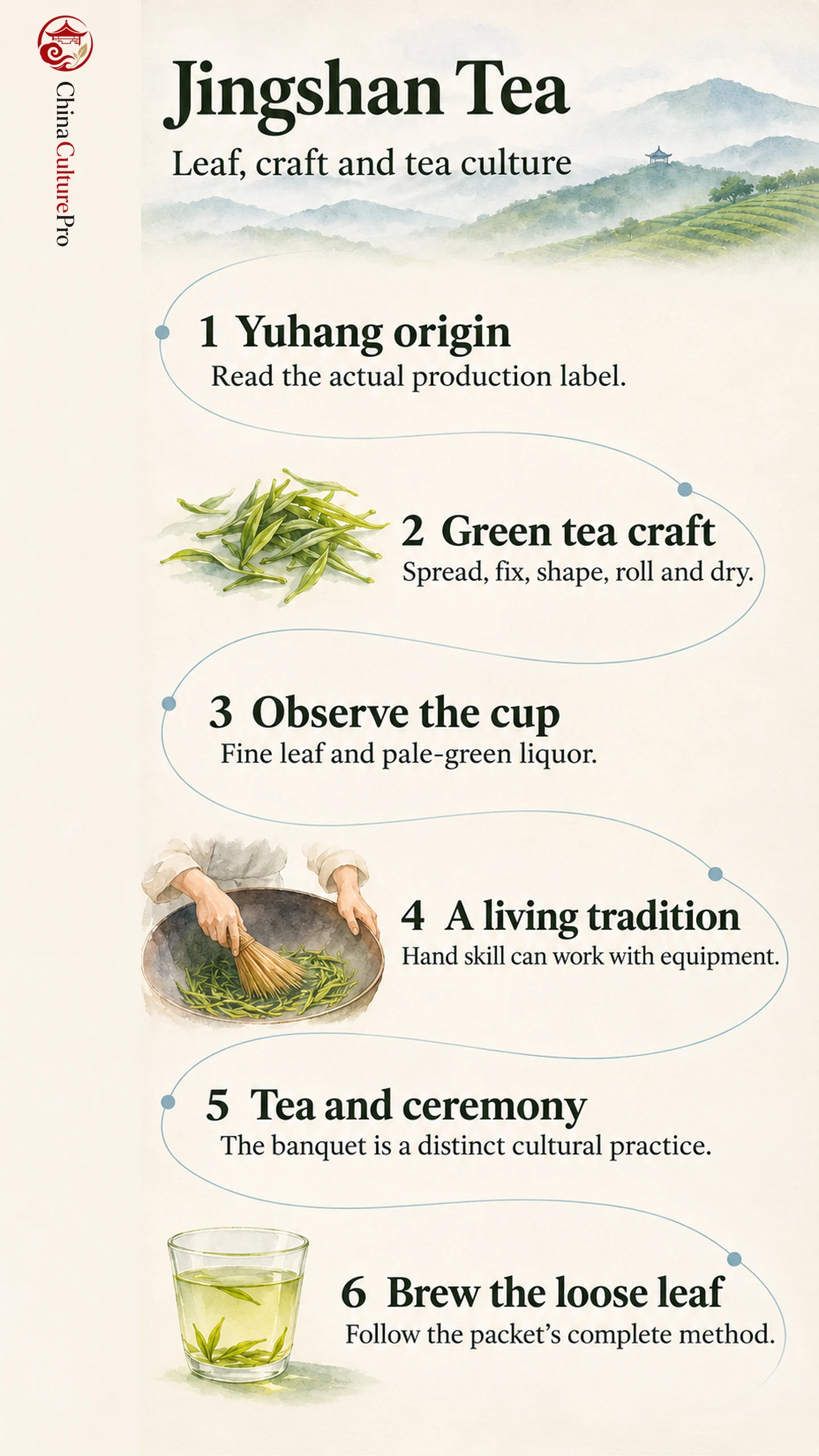
Jingshan tea(径山茶,jìngshān chá)is associated with Yuhang in Hangzhou, Zhejiang. Its familiar form is a fine-leaf green tea with a fresh, delicate cup.[1]
- Origin: Jingshan and the surrounding protected Yuhang production area.[2]
- Craft: Fresh leaf is spread, heat-fixed, shaped, rolled and dried.
- Drinking: Infuse the loose leaf rather than assuming it must be ground or whisked.
The local tea, the temple’s tea-banquet tradition and a packet of powdered tea are different things. A cultural connection does not make their preparation identical.
A glass of Jingshan green tea reveals the unfolding shoots. Fresh leaf character and a distinctive regional tea culture meet in this everyday drink.
Where Jingshan Tea Comes From
Jingshan lies northwest of Hangzhou, in the Tianmu mountain foothills. The tea’s regional identity extends beyond the temple grounds.[1] The published geographical-indication requirements name nine Yuhang towns or subdistricts, including Jingshan, Zhongtai and Pingyao. “Jingshan” on a packet should therefore be read as a production identity, not proof that monks grew or processed its leaves.[2]
Several suitable plants are used: cultivar and finished tea type are separate fields.[1] Check the producer and specific origin rather than using the tea name to infer an individual garden.
How Jingshan Green Tea Is Made
A traditional account describes ventilated spreading, high-temperature fixation, shaping the strands, rolling and charcoal drying. The result is the slender, curled green-tea form, with the original shoots still recognizable.[3] Fixation is an early treatment of the fresh leaf, not the later act of brewing a cup.
The living craft also includes adaptation. In one documented workshop, maker Liu Wei uses controlled mechanical assistance for fixation, followed by hand work with a tea broom for turning, shaping and setting the leaf. His drying proceeds in stages, with cooling between treatments.[4]
Leaf, Liquor and Flavor
Fine green leaf with down, bright pale-green liquor and a lasting delicate fragrance characterize the tea. Freshness can coexist with slight bitterness, astringency and sweetness.[1] “Green tea” does not promise complete absence of bitterness, nor does leaf down establish one exact grade.
Observe the dry strands, cup and opened shoots separately. Read a seller’s specific aroma notes as a description of its selection.
Tea, Temple and the Jingshan Tea Banquet
The Jingshan Tea Banquet(径山茶宴,jìngshān cháyàn)is associated with Jingshan Temple and the formal welcoming of guests. Its procedures include receiving visitors, paying respects, preparing tea and sharing it. The tradition is connected with the temple’s Buddhist setting and developed ceremonial life during the Song period.[5]
The banquet entered China’s national intangible-cultural-heritage list in 2011. In 2022 it formed part of the inscription of China’s traditional tea-processing techniques and associated social practices. That recognition concerns a cultural practice; it does not certify every retail tea packet or prescribe its brewing method.[5]
Whisking belongs to the ceremonial presentation, while loose-leaf brewing serves a different everyday task.[3] The Buddhist context helps explain the hospitality and ritual without turning a modern glass of tea into an unchanged ancient ceremony.
Choosing and Brewing Jingshan Tea
Check the category and origin label first. Then read the harvest description: spring harvest labels indicate timing, while the producer’s grade and leaf selection provide different information. None replaces tasting the actual tea.
A glass-brewing example uses about 3 g and water at 85°C. Match the water volume and infusion duration to your packet.[1] A separate local account recommends 80–85°C for tea picked around Qingming; that is harvest-specific guidance, not a universal ceiling for every product or method.[3]
- Use the packet’s leaf quantity, water volume and infusion guidance together.
- Infuse in a glass to watch the shoots open, or follow the packet’s stated vessel.
- Taste the cup and adjust the next preparation, keeping a note of what you changed.
For comparisons, keep the vessel and brewing water consistent. A prolonged steep and a brief infusion are different methods, even when they begin with the same regional tea.
FAQs About Jingshan Tea
Is Jingshan Tea a Green Tea?
The familiar loose-leaf product described here is green tea. Read the category on a locally branded product rather than assuming every tea made in the region is identical.
Must Jingshan Tea Be Whisked Like Matcha?
No. A glass infusion of loose leaf and a ceremonial powdered-tea presentation are separate preparations.
Is Jingshan Tea One Tea Cultivar?
No. It is a regional finished-tea identity; several tea plants are used in its production.[1][2]
Sources
[1] China National Tea Museum Tea Community. 跟着茶日历 学习中国茶——径山茶
[2] China National Intellectual Property Administration. 径山茶地理标志产品保护要求
[3] Fang Lingyue. 在径山与苕溪邂逅陆羽的人生
[4] Chinese Veteran Magazine. 匠心守非遗 茶香助共富
[5] China Daily. Brewing up an event steeped in culture