

Quick Answer: What Is a Jing Erhu?
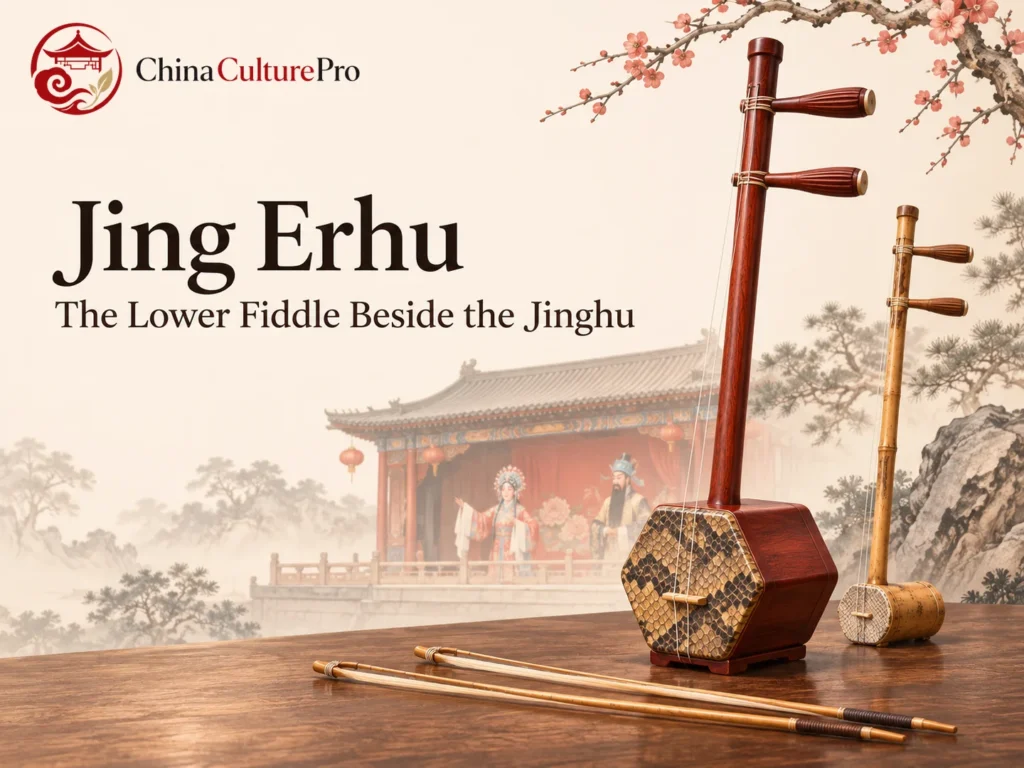
The jing erhu (京二胡, jīng èrhú) is a two-string bowed fiddle used in Peking opera. Its resonator is usually larger than a jinghu’s. It can add a lower and softer bowed sound beside the higher fiddle and the singer.[1][2][3]
- Build: A long neck and two strings sit above a skin-faced resonator.[1][2]
- Bow: The hair runs between the two strings.[3]
- Role: It is particularly associated with some female-role singing in Peking opera.[2][3]
The instrument can support a line led by the higher jinghu.[2][3]

When two small fiddles are seated beside each other, watch their bows and compare the size of their bodies. That can help you connect a higher ringing line and a lower one to the players you are hearing.[1][2][3]
A Bigger Resonator Than the Jinghu
The China National Peking Opera Company describes a jing erhu with a wooden or bamboo resonator about eight or nine centimeters across, covered at one end with snake skin. A Bowling Green State University study describes a hexagonal wooden example, compared with the round bamboo body of a jinghu.[2][3]
Both are held upright. The bow hair passes between their two strings. The jing erhu can use a larger body and lower tuning. The instrument description matters more than counting the sides on a single photograph. The opera company records more than one body material.[1][2][3]
The opera company’s guide puts the larger fiddle under the heading erhu. It gives about five centimeters across for the jinghu’s bamboo resonator and describes both sets of strings as tuned a fifth apart. The shared interval describes the distance between open strings. It leaves room for the two instruments to sound in different registers.[2]
How the Instrument Entered Peking Opera
The Shanghai Conservatory credits opera musician Wang Shaoqing with early use of the instrument in the 1920s. The national opera company associates its use in accompaniment for qingyi (青衣, qīngyī), a female-role category, with Mei Lanfang. Together the accounts identify the work of both an accompanying musician and a leading performer in changing the ensemble’s sound.[1][2][3]
For a sung line, the higher fiddle can stay close to the voice while the jing erhu adds a lower color. The two players can reverse their bows together. That helps the notes start or turn at the same point in a sung phrase. The museum account describes matching strokes between the jinghu and jing erhu as part of accompaniment practice.[1][3]
How to Hear the Two Fiddles Together
Listen for a high bowed sound carrying the contour of the voice. The lower bowed line can move with it. If the two players use similar strokes, you may hear them as a fuller single line until the lower sound becomes easier to distinguish at the end of a phrase. A plucked yueqin can add an attack that fades while the bows sustain their sound. This combination of bowed and plucked strings is documented in Peking opera accompaniment.[3][4]
If a phrase ends with a percussion cue, the distinct attack helps you find the moment the strings stop or change direction. Compare the clapper and gong sounds in the guide to Peking opera percussion.[2][3]
FAQs About the Jing Erhu
Is the jing erhu the same as the concert erhu?
Both are related two-string fiddles. Jing erhu names the form used in Peking opera, especially as a partner to the jinghu.[1][2][3]
Is it used for every opera role?
The sources especially associate it with some female-role accompaniment. The choice of instruments depends on the production and passage.[2][3]
Sources
[1] Shanghai Conservatory of Music, Museum of Oriental Musical Instruments. Chinese Modern Musical Instruments Exhibition
[2] China National Peking Opera Company. The Instruments of Peking Opera
[3] Isabelle Huang, Bowling Green State University. Study of Peking Opera Instrumentation
[4] Australian National University Open Research Repository. Chinese Musical Instruments