

Quick Answer: What Is the Zhongruan?
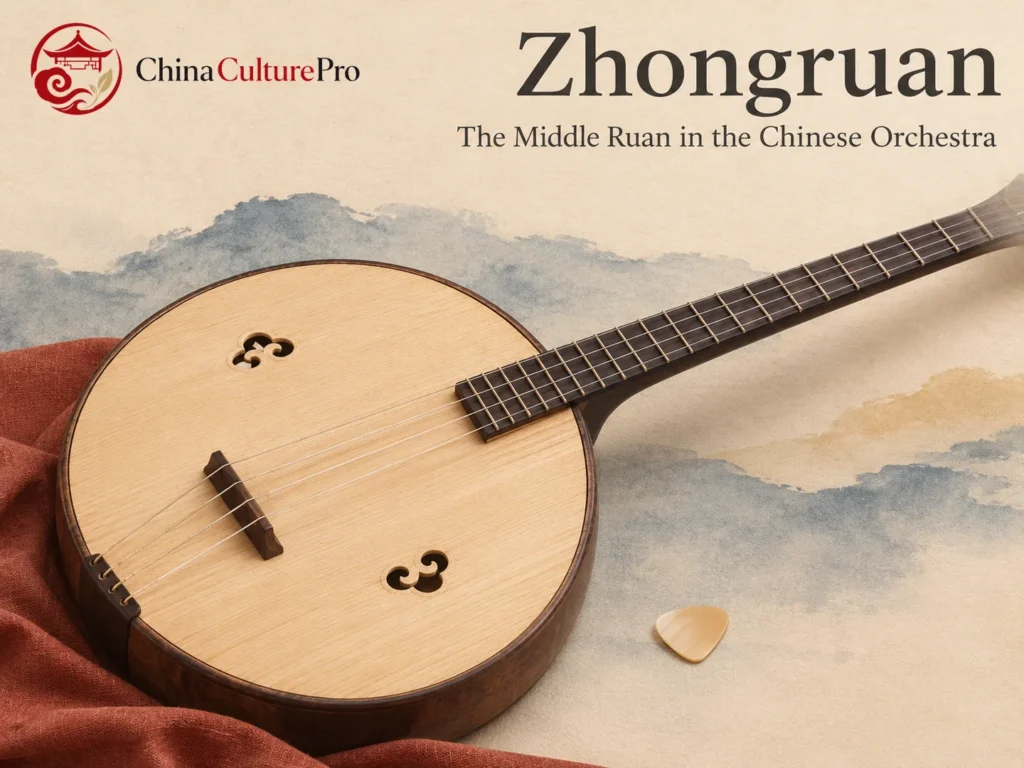
The zhongruan (中阮, zhōngruǎn) is the middle-sized member of the ruan (阮, ruǎn) family of Chinese plucked lutes. It has a round wooden body, a fretted neck and four strings.[1][3]
- Tuning: A common low-to-high order is G2, D3, G3 and D4.[2]
- Ensemble: It often fills the middle of the plucked string section.[1][3]
- Solo: Concert programs also feature it by itself or as a solo voice with orchestra.[5]
Look for the instrument name in the credits when a round lute could be one of several sizes.

The zhongruan can disappear into the plucked section when everyone plays together. A solo or a passage with just a few instruments makes it easier to hear the attack of the pick and the short resonance that follows.
Recognize the Middle Ruan
The name places it between the smaller xiaoruan (小阮, xiǎoruǎn) and the larger daruan (大阮, dàruǎn). The family shares a round sound box and a fretted neck. The ruan guide traces the broader family and its historical names.[1][3]
Check the amount of neck that projects beyond the body. On the yueqin, the neck is generally shorter. For a close-up with no reliable scale, the program’s instrument list is a better guide to which size of ruan you are seeing.
Follow the Four Open Strings
G2–D3–G3–D4 is a common zhongruan tuning, written from lowest string to highest. G and D recur at different octaves. The daruan’s common D2–A2–D3–A3 gives it a lower starting point. A line that begins below G2 may therefore fit the standard daruan without changing its open tuning.[2]
A plectrum releases the string in a quick motion. Individual notes have a clear beginning and then decay. Repeating strokes can make a note seem to sustain. Listen for those separate attacks in a quiet passage.[1]
Hear the Plucked Middle Register
The Light and Shadow on Strings program for the Hong Kong Chinese Orchestra credits xiaoruan, zhongruan and daruan separately. The zhongruan is listed with plucked instruments such as the sanxian. The similarly named zhonghu appears among the bowed strings.[6]
A separate program credits zhongruan and daruan together with orchestra in Zhou Yuguo’s adaptation of Ning Yong’s Camel Bells on the Silk Road. Use those credits to find a version that features both sizes.[4]
Find the Zhongruan in Solo Music
For an unaccompanied example, the Hong Kong Chinese Orchestra lists Ng Kai Hei playing Liu Xing’s Mad Intoxication. The same chamber program credits Ng as the soloist in Under the Neon Light, a movement from Chow Junyi’s ruan concerto. The program labels one piece a solo and the other zhongruan with orchestra.[5]
On a solo recording, listen for a single plucked attack, then a run of notes with different degrees of resonance. The Chinese musical instruments guide puts these sounds in the wider plucked family.
FAQs About the Zhongruan
How is a zhongruan usually tuned?
One common tuning from lowest to highest is G2, D3, G3 and D4.[2]
How do you tell a zhongruan from a daruan?
The daruan is larger and normally has lower open pitches. Both have four strings and a round body.[1][2]
Is a zhongruan a kind of moon lute?
It is a round-bodied ruan. The English label moon lute can also refer to the shorter-necked yueqin, so the Chinese instrument name is more precise.[1][3]
Sources
[1] B.C. Chinese Music Association. Ruan
[2] Qi Yao. An Instrumental Guide to the Chinese Orchestra
[3] Chinese Music Archive. Ruan in the Plucked Instruments Collection
[4] Hong Kong Chinese Orchestra. A Musical Treasure Hunt of Pretty Pearls
[5] Hong Kong Chinese Orchestra. HKCO4U: Echoes Through Time Chamber Concert
[6] No Limits and Hong Kong Chinese Orchestra. Light and Shadow on Strings