

Quick Answer: Who Was Huang Daopo?
Huang Daopo (黄道婆, Huáng Dàopó) was a textile maker and teacher remembered for spreading cotton-working skills in the early Yuan dynasty (元, Yuán). Early accounts connect her to Yazhou (崖州, Yázhōu) on Hainan (海南, Hǎinán) and to Wunijing (乌泥泾, Wūníjīng) in Songjiang (松江, Sōngjiāng).[4]
- Journey: The writer Wang Feng (王逢, Wáng Féng) places her return from Yazhou in the mid-1290s.[2]
- Techniques: Tao Zongyi (陶宗仪, Táo Zōngyí) credits her with teaching people to make and use tools for cotton preparation, spinning and weaving.[1]
- Trade: Tao says households sold the patterned textiles they made to other districts.[1]
The two accounts document her reputation as a skilled teacher. Her early life and the designs of her own tools are harder to recover.
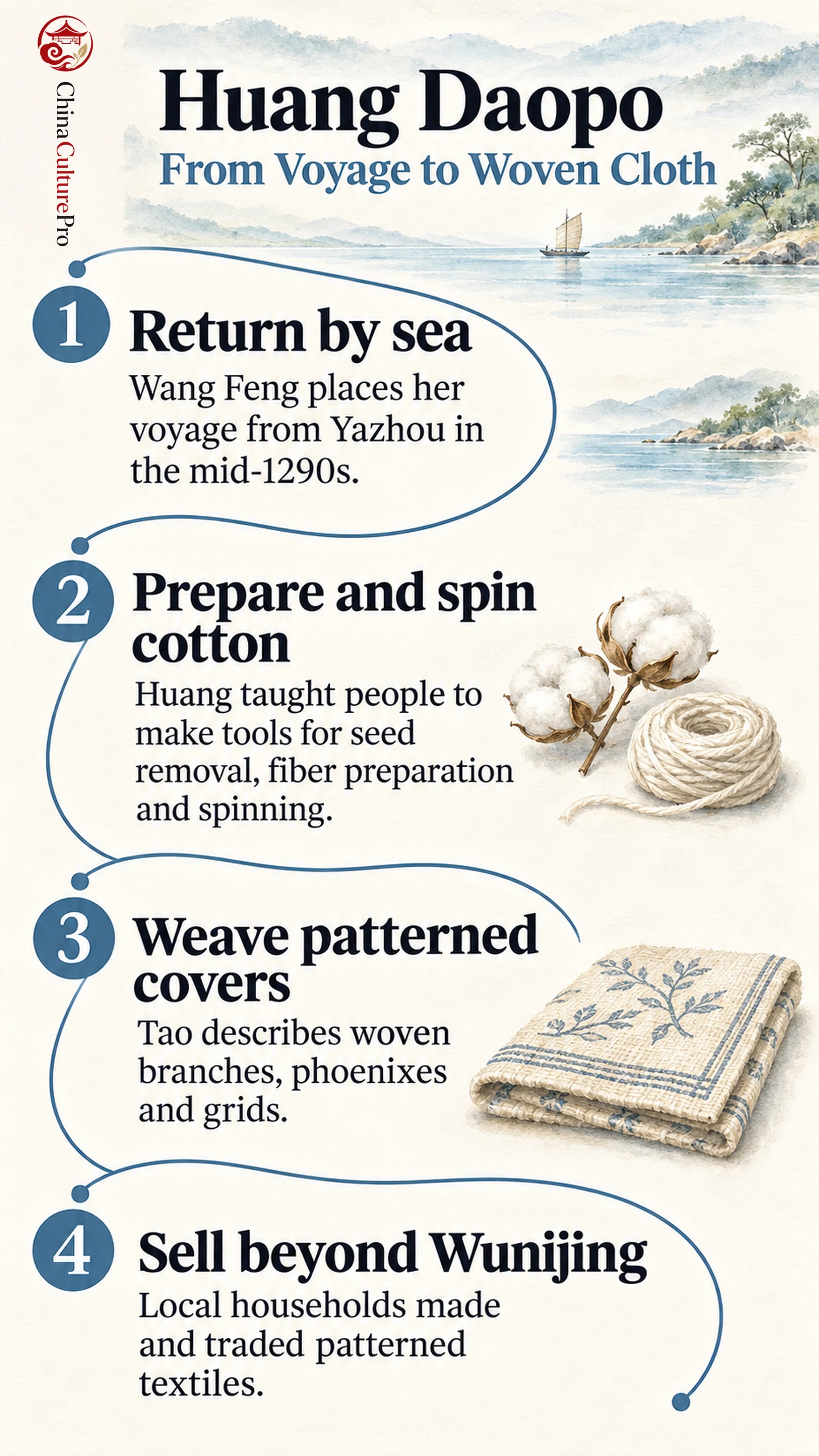
A finished cover was the result of several kinds of work. Wunijing households learned to prepare the fiber, spin it into yarn and arrange that yarn into patterns. The early accounts describe a teacher and the people who put her methods to use.
What the Early Accounts Say About Her Journey
Wang Feng calls Huang a woman of Wunijing who had gone to Yazhou while young. His account says she returned by sea during the Yuanzhen reign period (元贞, Yuánzhēn), in the mid-1290s. She spun cotton and wove Yazhou covers (崖州被, Yázhōu bèi) to support herself and taught local women.[2]
Tao describes an older woman coming from Yazhou. The two short accounts leave much of the journey unexplained.[1][3]
One later story depicts her fleeing a childhood marriage. The traditions connecting her with the textile craft of the Li people (黎族, Lízú) also point to the established weaving knowledge of women in Hainan.[4]
From Cotton Fiber to Patterned Cloth
Tao says people in Wunijing grew cotton before Huang arrived. They removed seeds by hand and loosened the fiber with a small bow. He credits Huang with teaching them how to make tools for those tasks as well as for spinning and weaving.[1]
At the loom, Huang taught people how to arrange threads, combine colors and bring out motifs. Tao describes bedcovers and other goods with flowering branches, round phoenix designs and grids like a game board.[1]
Why the Wunijing Workshops Mattered
In Wang’s account, the women Huang taught helped make Wunijing covers well known.[2]
Tao says local makers sold their work in other districts and earned income for their households.[1]
Together the accounts show how women’s textile work connected household production with a wider market.
Wang wrote his account in connection with a shrine to Huang and describes its relocation in 1362.[2]
Wunijing is now in the Xuhui area of Shanghai, where a memorial hall and textile displays commemorate her.[8]
FAQs About Huang Daopo
Did Huang Daopo invent the three-spindle wheel?
Some researchers credit Huang with developing a three-spindle cotton wheel. Surviving illustrations and objects show how later wheels worked. Tao describes spinning tools but gives no spindle count or drawing.[1][3][7]
Do we know when Huang Daopo was born?
Her birth year is uncertain. The most specific time marker in the early records is Wang’s reference to the reign period when she returned from Yazhou.[2][3]
What textile traditions are recognized today?
Wunijing’s hand cotton textile craft joined China’s national heritage list in 2006. UNESCO added the traditional textile techniques of the Li people of Hainan to its Representative List in 2024.[5][6]
Sources
[1] Tao Zongyi. Record from a Break in Plowing, volume 24, Huang Daopo
[2] Wang Feng. Wuxi Collection, volume 3, Shrine of Huang Daopo
[3] Li Qiang and Li Bin. A Critical Examination of Research on Huang Daopo, Journal of Silk, 2016
[4] Shanghai Municipal Bureau of Ethnic and Religious Affairs. From Shanghai to Hainan, Huang Daopo and Textile Exchange
[5] China Intangible Cultural Heritage Digital Museum. Wunijing Hand Cotton Textile Techniques
[6] UNESCO. Traditional Li Textile Techniques, Spinning, Dyeing, Weaving and Embroidering
[7] Lin Xiaoming. Study of the Three-Spindle Spinning Wheel in Songjiang
[8] Shanghai Municipal Government. Huang Daopo Memorial Park