


Quick Answer: What Does Hani Culture Include?
Hani(哈尼族,Hānízú)culture includes the languages, knowledge, arts and everyday practices of communities concentrated in southern Yunnan. Honghe’s terraced farming landscape is an important example, but Hani life extends beyond one heritage property or county. [1]
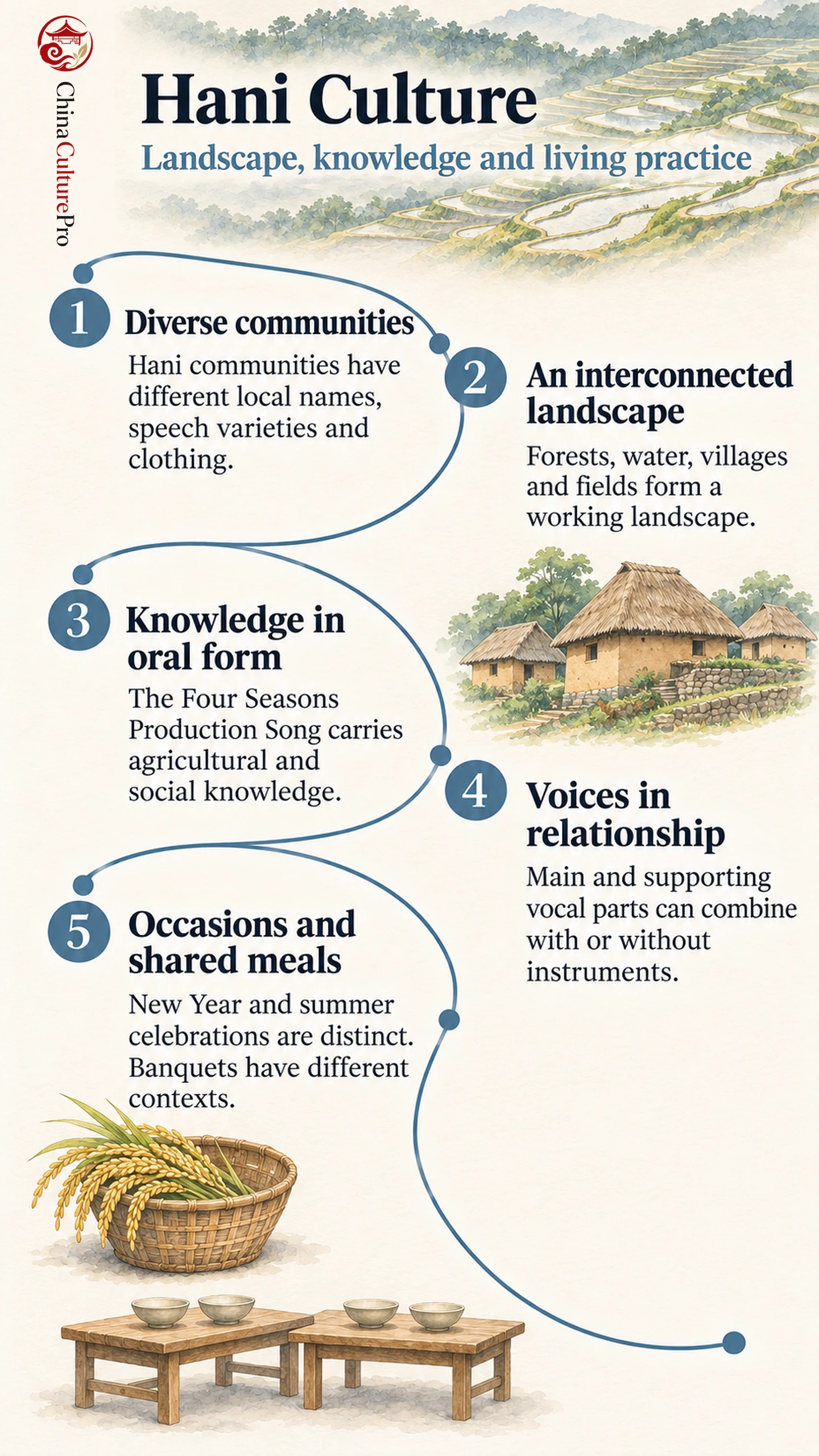
- Community diversity: Local names, speech varieties and clothing differ.
- Farming knowledge: Forests, water, settlement and cultivation work together in particular landscapes.
- Oral traditions: Sung and recited works transmit practical and ceremonial knowledge.
- Music: Different vocal parts can combine with or without instruments.
- Celebrations: Harvest renewal, summer rites and shared meals have distinct contexts.
A landscape designation or heritage performance does not describe every person’s livelihood, beliefs or daily routine.
Terrace photographs show the contours of cultivated hills, but not the work of maintaining water channels or learning a song. Understanding Hani culture means connecting those visible forms with community knowledge, while keeping local examples within the wider diversity of Yunnan culture.
Communities, Language and Local Dress
Hani communities live across Honghe, Pu’er, Xishuangbanna and other parts of southern Yunnan. Local names such as Biyue, Kaduo and Baihong point to internal diversity; a single ethnic category should not erase these community distinctions. [1] The broader guide to Chinese ethnic groups explains why an official category is a starting point rather than a complete description.
The Hani language(哈尼语,Hāníyǔ)includes varieties commonly grouped as Ha-Ya, Bi-Ka and Hao-Bai. Language documentation covers multiple localities, rather than treating one village’s speech as universal. Latin-based writing proposals were approved for trial in 1957 and revised in 1984. Oral transmission and modern writing coexist; they describe different ways knowledge is recorded and learned. [2]
Dress varies too. A 2021 museum exhibition distinguished combinations including short jackets with skirts, shorts or long trousers, and longer garments with trousers or skirts. Textile making includes spinning, weaving, dyeing and decoration. A garment’s cut and provenance tell more than a broad label such as traditional costume. [3]
Honghe Rice Terraces: Forests, Water, Villages and Fields
Honghe’s rice terraces(梯田,tītián)form a cultural landscape inscribed on the World Heritage List in 2013. Its interconnected elements include upland forests, water supplies, villages and cultivated fields. Channels distribute water, and their maintenance involves community work. The designation concerns a particular living landscape, not all Hani territory. [4]
This relationship between terrain, resources and settlement belongs to cultural geography. It explains why the field alone is an incomplete unit of interpretation.
Traditional mushroom houses(蘑菇房,mógūfáng)take their name from their tall thatched roofs above earth-based walls. [4] Regional housing also includes flat-roofed forms around Mojiang and bamboo-and-timber buildings in Xishuangbanna. Rooms, platforms and storage spaces connect homes with household work, but layouts vary. [5]
The Four Seasons Production Song: Knowledge in Oral Form
The Four Seasons Production Song(四季生产调,sìjìshēngchǎndiào)is an oral work organized around agricultural life. Its structure includes an introduction followed by winter, spring, summer and autumn sections. The national heritage record places it in the folk literature category, with a 2006 listing. [6]
Its subjects include cultivation procedures, observations of weather and seasonal change, festivals and rules for social conduct. Singing or reciting thus carries more than an account of scenery: it provides an ordered way to remember knowledge relevant to farming and community life. [6]
The name should not be used as a label for every Hani song. An agricultural oral work can be studied through its words, sequence and transmission, while a multipart performance raises additional questions about how voices enter and interact. Those are related but different subjects.
Multipart Folk Songs and Contemporary Recording
Hani multipart folk songs(多声部民歌,duōshēngbùmíngē)have an important transmission area around Puchun village in Honghe County. Themes include work, love and landscape. Performances may use instruments or vocal support without instrumental accompaniment, so multipart does not mean exclusively a cappella. [7]
The rice-transplanting song provides a concrete musical example. A passage includes an opening, a main vocal line and supporting vocal parts. The main singer carries the theme; other voices enter in support, while repeated musical segments can carry different words. These roles explain the texture without assigning every performance a fixed number of singers. [8]
Documentation has also taken place outside village performance settings. In July 2019, singers from Honghe participated in a professional audio and video recording session. Duets, four-person and larger groups presented labor songs, ritual songs and love songs; a separate rendition of the agricultural oral work was also recorded. [9]
A recording preserves a particular performance for study. Learning timing, words and interaction remains a different task. This distinction helps readers approach performing arts as practice rather than treating an archive as the whole tradition.
Seasonal Festivals and Long Street Banquets
Two celebrations illustrate why season and locality matter:
| Celebration | Main context |
|---|---|
| Tenth Month New Year(十月年,shíyuènián) | Harvest celebration and renewal, with ancestral rites, visiting and gift exchange; names, timing and activities vary locally. [10] |
| Kuzhazha(矻扎扎,kūzhāzhā) | A summer agricultural festival. Yuanyang’s heritage description distinguishes it from the New Year and records communal preparation of ceremonial and recreational spaces. [11] |
Calling the summer occasion another New Year can obscure that distinction. Local names and calendars deserve attention before combining different celebrations into one sequence.
A long street banquet(长街宴,chángjiēyàn)joins household tables into a shared meal. A Honghe account distinguishes banquets associated with village rites, the summer festival and New Year celebrations. The banquet is therefore a form of hosting used in more than one context, not a separate occasion with one universal date. [12]
Food preparation, visiting and sharing the street connect the meal to wider food culture. A public banquet’s program should not be assumed to reproduce every household’s celebration.
FAQs About Hani Culture
Is Hani Culture Found Only in Yuanyang?
No. Yuanyang is an important setting, but communities also live elsewhere in Honghe and in other parts of southern Yunnan. One county cannot represent every language variety, garment or custom. [1]
Are All Hani Songs Unaccompanied?
No. Documented multipart singing includes accompanied and unaccompanied forms. Instrument use, vocal roles and performance setting need to be identified for the particular song. [7]
Is the Tenth Month New Year in Gregorian October?
Not necessarily. The name belongs to a local calendrical tradition; it should not be converted directly into Gregorian October. Timing and duration differ between communities. [10]
Do All Hani People Live in Mushroom Houses?
No. Thatched mushroom-shaped houses are a documented regional form. Other Hani communities use different building materials and roof forms, and people’s contemporary homes are not determined by ethnicity. [5]
Sources
[1] National Ethnic Affairs Commission. Hani ethnic group overview
[2] Minzu University language monitoring center. Hani language documentation
[3] China National Silk Museum. Harmony above the Clouds: Yunnan Hani clothing exhibition
[4] UNESCO World Heritage Centre. Cultural Landscape of Honghe Hani Rice Terraces
[5] National Ethnic Affairs Commission. Hani customs
[6] China Intangible Cultural Heritage. Four Seasons Production Song
[7] China Intangible Cultural Heritage. Hani multipart folk songs
[8] Yunnan Intangible Cultural Heritage Protection Center. Rice transplanting mountain song
[9] Ministry of Culture and Tourism folk arts center. Hani singers meeting and recording, August 2019
[10] Ministry of Culture and Tourism folk arts center. Tenth Month New Year
[11] Yuanyang County Government. Kuzhazha provincial heritage project
[12] Honghe prefecture culture and tourism bureau. Three types of Hani long street banquets