

Quick Answer: Who Was Eileen Chang?
Eileen Chang (张爱玲, Zhāng Àilíng; 1920–1995), also known as Zhang Ailing, was a Chinese novelist, short-story writer, essayist and screenwriter. Her fiction examines desire, family pressure and social position, often through Shanghai and Hong Kong life. Her career also included decades in the United States and work across Chinese and English.[1][2]
- A first reading: Love in a Fallen City (倾城之恋, Qīngchéng Zhī Liàn) offers a compact encounter with her fiction; the English book with that title is a collection, not just the title novella.
- A central tension: Affection exists alongside calculations about money, marriage and security.
- A useful reading habit: Notice what a character wants, what they can afford and what the narrator lets the reader see.
Her stories are particular literary constructions, not a handbook to how all Chinese families or women behave.[3]
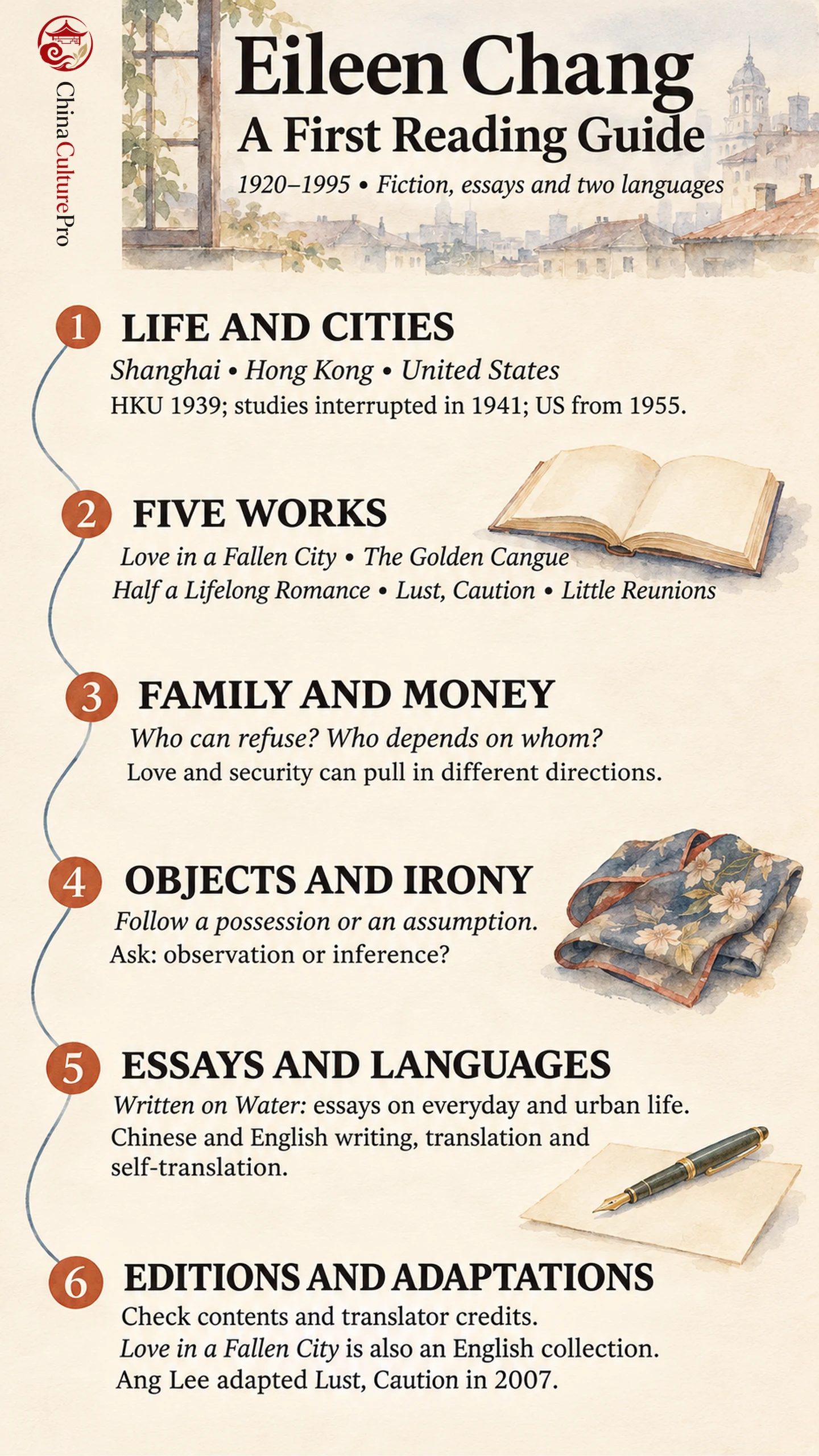
Read Chang for the friction between an intimate feeling and the circumstances surrounding it. A relationship may promise escape while creating another dependency. A polished social surface can make an uncomfortable choice harder to recognize. Her place in modern Chinese literature becomes clearer when the stories, essays and later bilingual career are read together.
Shanghai, Hong Kong and Her Later Life
Born in Shanghai in 1920, Chang grew up with both Chinese and English education. She entered the University of Hong Kong in 1939. The Battle of Hong Kong interrupted her studies in 1941; by the following spring she was back in Shanghai. Her university years exposed her to English, history and Chinese literary study, as well as wartime upheaval.[1][2]
She became known for fiction and essays in 1940s Shanghai. She returned to Hong Kong in 1952 and moved to the United States in 1955, living there for the remainder of her life. She died in Los Angeles in 1995. The later decades belong to her writing career, even when readers first encounter the early city stories.[2]
Shanghai culture and Hong Kong culture offer useful background, but neither city should be reduced to a picturesque backdrop. In Chang’s case, university life, displacement and war connect the two places. Her writing returns to experiences associated with both.[1]
Five Works for a First Reading
These five works offer different routes into Chang. The first two can be read in the same English collection; they are not five required purchases.[3][4]
| Work | À quoi s’attendre | A question to carry into the reading |
|---|---|---|
| Love in a Fallen City | A relationship shaped by the search for security and the upheaval of wartime Hong Kong. | Does a change in circumstances also change what the relationship means? |
| The Golden Cangue (金锁记, Jīn Suǒ Jì) | Marriage, humiliation and control passed into the next generation. | How does suffering become power over someone else? |
| Half a Lifelong Romance (半生缘, Bàn Shēng Yuán) | A longer Shanghai novel in which family interference and violence separate two lovers. | Which choices are possible, and which are blocked? |
| Lust, Caution (色戒, Sè Jiè) | A wartime espionage narrative linking performance, attraction and political danger. | When does acting a role become difficult to separate from feeling? |
| Little Reunions (小团圆, Xiǎo Tuányuán) | A novel of fractured family and intimate relationships, moving through remembered Shanghai and Hong Kong experience. | What does the arrangement of memories reveal or withhold? |
The shorter fiction suits a reader who wants to examine one encounter closely. The longer novels allow more space for separation, elapsed time and the consequences of earlier decisions. Choose by the form you want to spend time with: a concentrated encounter or a relationship developed across years.[4][5][6][7]
Love, Marriage and Economic Power
Chang’s romantic plots often ask a material question: what would this person live on if the relationship failed? Money, housing, family standing and a reputation can affect the freedom to refuse. The word “love” alone does not describe every force operating within a couple.[3][4]
In The Golden Cangue, mistreatment within an affluent household does not end with its first victim. Power is later exercised against a daughter and daughter-in-law. A useful reading question is how an injury can be repeated by someone who understands its pain. Explanation does not require excusing the resulting cruelty.[4]
Half a Lifelong Romance follows the engineer Shen Shijun and his colleague Gu Manzhen in 1930s Shanghai. Family matchmaking, coercion and confinement matter alongside missed communication. Describing their separation as merely bad luck would hide the actions that make it happen.[5]
Keep the literary example separate from a universal cultural claim. Chinese family traditions provide a wider field of practices and values; a fictional household shows a selected configuration of power. The broader history of women’s lives in China also extends well beyond the social worlds of these characters.
Objects, Irony and the View of City Life
Clothes and attractive possessions can do more than establish atmosphere. In the collection’s opening story, a student’s access to beautiful clothing and status comes with obligations to a wealthy relative. The appealing object becomes one way to see the terms of a dependency.[4]
Try following one object through a scene. Who supplies it? Who notices it? Does owning it increase the character’s room to act, or make a relationship harder to leave? These questions connect description to the story’s transactions without assigning every color or accessory a fixed symbolic meaning.
Irony also depends on unequal knowledge. A character may interpret another person’s silence as a judgment that has never actually been expressed. In Half a Lifelong Romance, Shijun projects his own disappointment about leaving his Shanghai job onto Manzhen. Tracking the difference between his assumption and her stated feelings makes the viewpoint worth examining.[5]
A practical margin note is “observation or inference?” Use it when a passage moves from what someone sees to what they decide another person must think. The point is to test the character’s explanation against the scene, rather than turn the novel into a list of lessons about relationships.
Essays, Bilingual Writing and Cultural Memory
Written on Water (流言, Liúyán) opens another route into Chang. Its essays range across literature, war, cinema, fashion, food and urban experience. In these essays, attend to how Chang selects and presents an observation, including when she writes about remembered experience.[8]
Reading an essay beside a story can shift the questions you ask. Instead of treating everyday detail as decoration, consider how an account of dress, entertainment or eating establishes a person’s relation to a city. Shanghai cuisine supplies separate cultural background for a reader curious about the food world; it is not a glossary of every dish in Chang’s writing.
Her later writing also crossed language boundaries. She wrote across Chinese and English, translated other writers and engaged in self-translation. This later activity deserves attention alongside her early literary celebrity.[10]
A reader may encounter Chang through a newly published manuscript, a translated collection or a screen version, each framing the work differently. Posthumous publications and film or stage versions create further encounters with the work. Scholarly discussion also considers the tension between Chang’s concern for privacy and the public fascination with her life.[9]
Little Reunions is especially easy to approach as a key to personal secrets. Its fictional Julie’s family and wartime relationships invite biographical comparison, but it remains a novel. Reading a scene as crafted narrative keeps questions about selection, sequence and perspective open.[7]
Reading Translations and Film Adaptations
Choose the edition by its contents and translator credits, not only the cover title. English collections can share a title with one story, and a familiar title can appear in a differently assembled book.
| English edition | Credits and scope to check |
|---|---|
| Love in a Fallen City, NYRB Classics, 2006 | A short-fiction collection, translated by Karen S. Kingsbury and Eileen Chang; ISBN 9781590171783. |
| Half a Lifelong Romance, Anchor | A novel translated by Karen S. Kingsbury; ISBN 9780307387547. |
| Lust, Caution: The Story, Anchor, 2007 | Translated by Julia Lovell; ISBN 9780307387448. |
| Little Reunions, NYRB Classics, 2018 | A novel translated by Jane Weizhen Pan and Martin Merz; ISBN 9781681371276. |
| Written on Water, NYRB Classics, 2023 edition | Essays translated by Andrew F. Jones, edited by Jones and Nicole Huang, with an afterword by Huang; ISBN 9781681375762. |
These edition details identify the books described here; they do not imply that every English edition has identical contents.[3][7][8][11][12]
Romanized names can also vary across translations. Keep a small character list for the edition you are reading instead of assuming every unfamiliar spelling identifies a new person. The guide to Chinese transliteration systems explains why spellings may differ.
Ang Lee’s film adaptation of Lust, Caution was released in 2007.[6] If you come to the prose through the film, compare one scene’s access to thought, pacing and withheld information. Treat any difference as an adaptation choice to examine, rather than automatically as a mistake. For more help selecting annotated or translated editions across Chinese literature, use the Chinese classic books reading guide.
FAQs About Eileen Chang
Is Eileen Chang the same writer as Zhang Ailing?
Yes. Zhang Ailing is another romanized form of her Chinese name. Eileen Chang is the English name used on the editions discussed here.
Which Eileen Chang book is a good starting point?
The English Love in a Fallen City collection offers several shorter works in one volume. Start with one story and read it closely before deciding whether you want a longer novel or her essays.
Is Little Reunions an autobiography?
It is a novel with autobiographical connections. Those connections can inform a reading, but they do not make every character, scene or remembered event a literal biographical record.
Did Eileen Chang write only in Chinese?
No. Her career included Chinese and English writing, translation and self-translation. Reading only the early Shanghai fiction gives an incomplete picture of that career.
Sources
[1] University of Hong Kong. Portrait of the Artist as a Young Woman
[2] New York Review Books. Eileen Chang: author biography
[3] New York Review Books. Love in a Fallen City
[4] New York Review Books. Love in a Fallen City: Reading Group Guide
[5] Penguin Random House. Half a Lifelong Romance: Reading Guide
[6] Penguin Random House. Lust, Caution
[7] New York Review Books. Little Reunions
[8] New York Review Books. Written on Water
[9] Kam Louie, Hong Kong University Press via University of Chicago Press. Eileen Chang: Romancing Languages, Cultures and Genres
[10] Carole Hang Fung Hoyan, Chinese University of Hong Kong. Reading Eileen Chang as a World Literature Author
[11] Penguin Random House. Half a Lifelong Romance: edition information
[12] Free Library of Philadelphia. Lust, Caution: the story, catalog record