
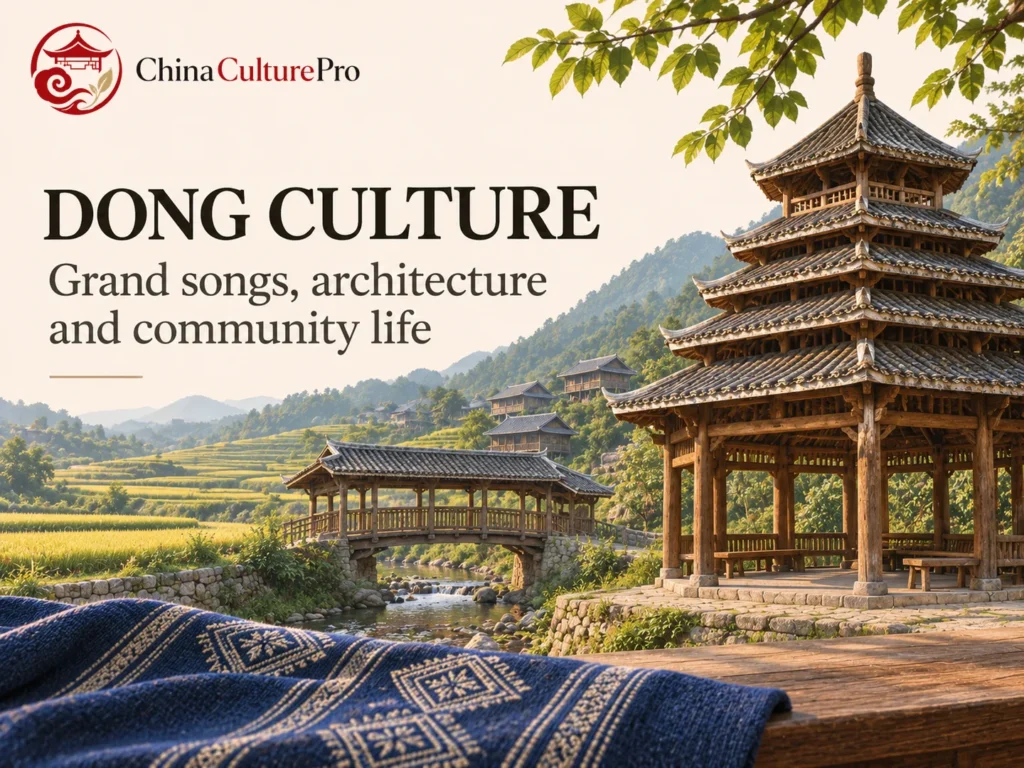

Quick Answer: What Does Dong Culture Include?
Dong(侗族,Dòngzú)culture connects regional languages, multipart singing, timber public buildings, farming knowledge, textiles and community celebrations.
- Communities: Important areas span Guizhou, Hunan and Guangxi. [1]
- Knowledge: Songs preserve and communicate more than musical technique.
- Public space: Towers and covered bridges support different kinds of gathering and movement.
- Livelihoods: Integrated rice, fish and duck farming is a documented regional practice.
- Material traditions: Woven cloth and garments depend on locally learned skills.
A village photograph or concert supplies one view of Dong experience. It cannot establish a uniform lifestyle, religious identity or occupation for everyone. The useful approach is to ask where a practice occurs and what people do with it.
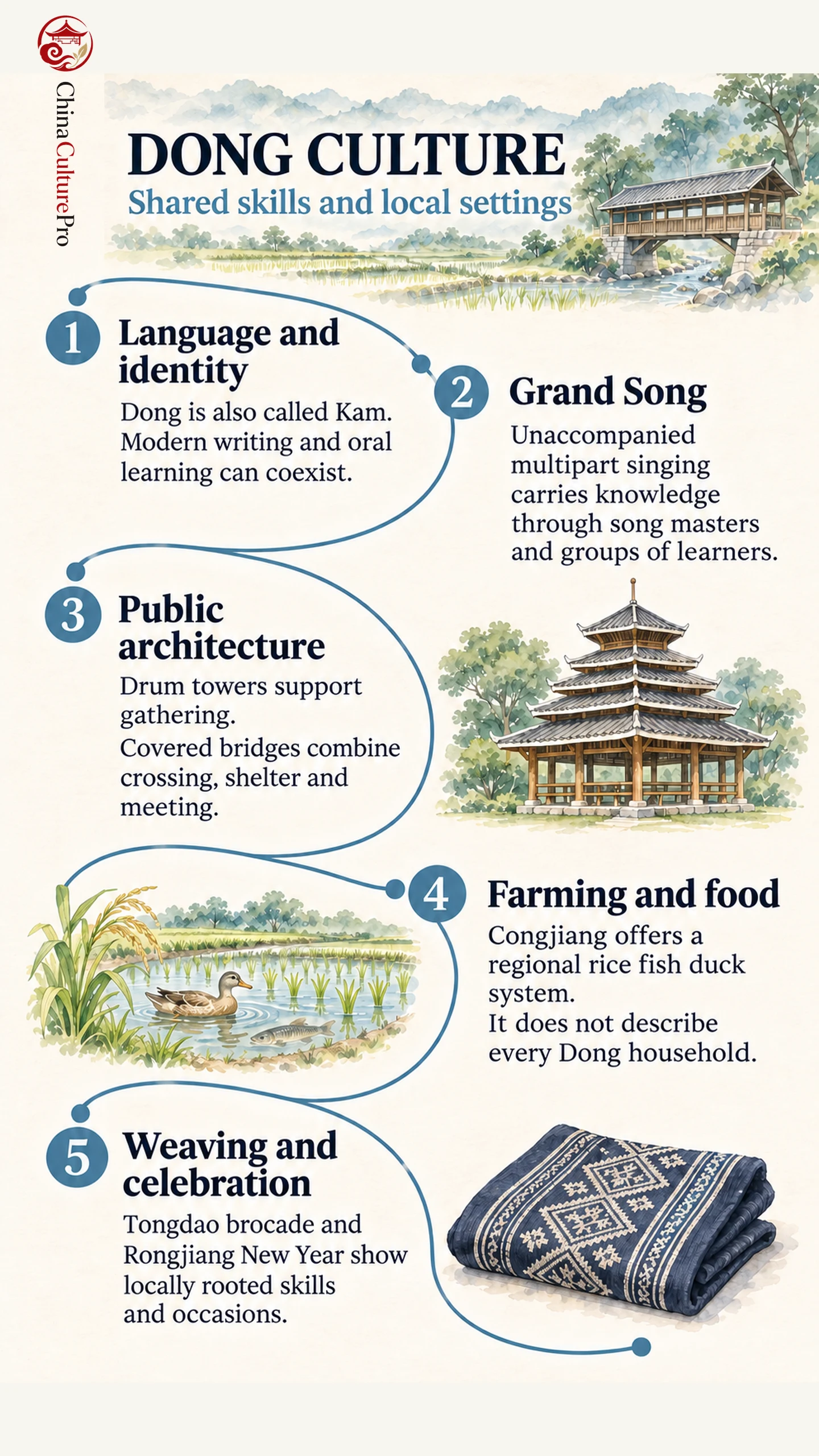
A chorus, a timber tower and a covered bridge are recognizable images of Dong culture. Their significance becomes clearer when sound and buildings are understood as parts of community life: places and skills for meeting, learning, welcoming visitors and passing knowledge between generations.
Dong Communities, Language and Writing
Dong people, also called Kam, live across several adjoining southwestern regions. [1][2] Guizhou culture provides one setting, alongside communities in Hunan and Guangxi. The designation belongs within China’s ethnic categories; it should not be confused with every resident of a particular autonomous county.
The Dong language(侗语,Dòngyǔ)has northern and southern varieties, with further local distinctions. A Latin-based writing scheme approved in 1958 used the southern variety and the speech of Chejiang in Rongjiang as its basis. [1]
That modern writing history matters when reading older descriptions claiming that Dong people “have no writing.” An oral teaching tradition and a writing system can coexist. Likewise, an individual’s language use, schooling or residence cannot be inferred from an ethnic label. Identify the speech community when interpreting a song, recording or written text.
Grand Song as Music and Shared Knowledge
Grand Song(侗族大歌,Dòngzú dàgē)is a tradition of multipart choral singing, performed without instrumental accompaniment or a conductor. The tradition entered UNESCO’s Representative List in 2009. [3] Regional repertoires include narrative, etiquette, children’s and nature-related songs; a chorus can carry knowledge about conduct and social relationships as well as musical patterns. [4]
Teaching traditionally involves recognized song masters and groups of learners. Knowing a part means understanding when to enter, how voices relate and how a text belongs to its occasion. In Sanjiang, documented performances include groups singing during festive visits, around a hearth or in a public gathering space. [4]
This is one tradition within Chinese performing arts, not a description of all Dong music. Pipa songs(琵琶歌,pípágē)use plucked instrumental accompaniment and can take solo or duet forms. [5] A concert program may present several genres together, so the presence of an instrument does not make every item “Grand Song with accompaniment.”
Drum Towers and Wind and Rain Bridges
A drum tower(鼓楼,gǔlóu)is a timber community building, while a wind and rain bridge(风雨桥,fēngyǔ qiáo)combines a crossing with a sheltered corridor. Their roofs may share visual features, but their functions differ. [6]
| Public building | Function and form |
|---|---|
| Drum tower | A gathering place for discussion, rest, storytelling, singing and ceremonial occasions, often with benches around a central ground-level space. |
| Wind and rain bridge | A covered crossing with seating and shelter, connecting routes while also providing a place to pause and meet. |
Stacked eaves should not automatically be counted as occupied floors. Nor does a tower’s pagoda-like outline establish that it is a Buddhist religious building. [6]
These distinctions help explain why architecture belongs in an account of community life. A building is more than a scenic backdrop when its usable space supports repeated social activities. Claims that every structure has identical construction, contains no metal or survives unchanged for centuries require evidence for the individual example.
Rice, Fish, Ducks and Regional Foods
Congjiang’s rice-fish-duck system brings three forms of production into the same paddy landscape. Rice grows while fish and ducks are raised within an integrated farming system. This landscape, recognized as a Globally Important Agricultural Heritage System in 2011, links cultivation with accumulated local knowledge. [7]
The example concerns a particular region, not every Dong person’s occupation. Congjiang is also home to Miao communities and other peoples, so shared surroundings should not be described as ethnically exclusive. [7]
Glutinous rice is important in this agricultural context, but a farming system is not a fixed menu. Regional food practices extend beyond a single crop.
Oil tea(油茶,yóuchá)offers another example. A documented Yuping version combines tea preparation with chicken broth, puffed rice, beans and peanuts. [8] It is a substantial local food tradition rather than simply a cup of plain brewed tea. Its ingredients also show why an apparently plant-based name does not establish a vegetarian dish. Such local examples fit within the wider diversity of Chinese food culture.
Weaving, Dress and Community Celebrations
Dong brocade(侗锦,Dòngjǐn)in Tongdao, Hunan, includes plain-toned and multicolored patterned forms. Hand production brings together preparing thread, dyeing, arranging the warp and weaving the design. The pattern is structurally woven, rather than necessarily embroidered onto finished cloth. [9]
A textile record can identify a technique without establishing how every garment was worn. Cloth, ornament, age and occasion all need context; a performance outfit cannot serve as an automatic portrait of daily dress across different communities.
Dong New Year(侗年,Dòngnián)provides a locally documented example of celebration. The Rongjiang heritage record describes family reunion, harvest celebration and remembrance of ancestors, with village visits and ancestral songs. Elders use the songs to convey expectations about social conduct and family relationships. [10]
This is cultural transmission through participation, alongside the learning of musical and material skills. A heritage designation records the importance of a practice; it does not prove that every village follows one calendar or that contemporary life remains unchanged. Local names, occasions and teaching relationships help explain what participants maintain and change.
FAQs About Dong Culture
Is All Dong Music Sung Without Instruments?
No. Unaccompanied multipart singing characterizes Grand Song. Other genres, including pipa songs, use instruments and different vocal arrangements.
Do Dong People Have a Written Language?
Yes. A Latin-based scheme was approved in 1958. Its existence does not replace the important role of oral learning in particular traditions.
Are Drum Towers Buddhist Pagodas?
Their tiered outlines can look similar, but Dong drum towers function as community buildings. Appearance alone cannot establish a Buddhist purpose.
Does Every Dong Household Use Rice-Fish-Duck Farming?
No. The documented agricultural heritage system is regionally situated. Dong people have varied occupations and live in different rural and urban settings.
Sources
[1] National Ethnic Affairs Commission. Dong: overview
[2] Smithsonian Center for Folklife and Cultural Heritage. From the Mountain to the World: My Travels with the Chinese Yandong Grand Singers
[3] China Intangible Cultural Heritage Network. Grand Song: heritage overview and safeguarding
[4] China Intangible Cultural Heritage Network. Dong Grand Song
[5] China Intangible Cultural Heritage Network (Réseau chinois du patrimoine culturel immatériel). Traditional music and dance showcase
[6] National Ethnic Affairs Commission. Dong customs
[7] Food and Agriculture Organization of the United Nations. Dong’s Rice Fish Duck System, China
[8] Yuping county news service. Transmission of Dong pot oil tea
[9] China Intangible Cultural Heritage Network. Dong brocade weaving
[10] China Intangible Cultural Heritage Network. Dong New Year