


Quick Answer: What Does the Ding Surname Mean?
Ding(丁,Dīng)is a Chinese surname written with the same two-stroke character in simplified and traditional Chinese. The Mandarin reading has a level first tone. In other contexts, 丁 can refer to an adult man, population or a position in an ordered sequence. [1]
- Origin tradition: A major account connects the surname with the title Duke Ding(丁公,Dīng Gōng)of Qi.
- Name variant: Ting is an established Roman spelling of 丁.
- Family identity: Distinct lineages have their own histories; the surname alone establishes neither common descent nor religious affiliation.
A dictionary meaning, an old naming tradition and a particular household’s ancestry answer different questions.
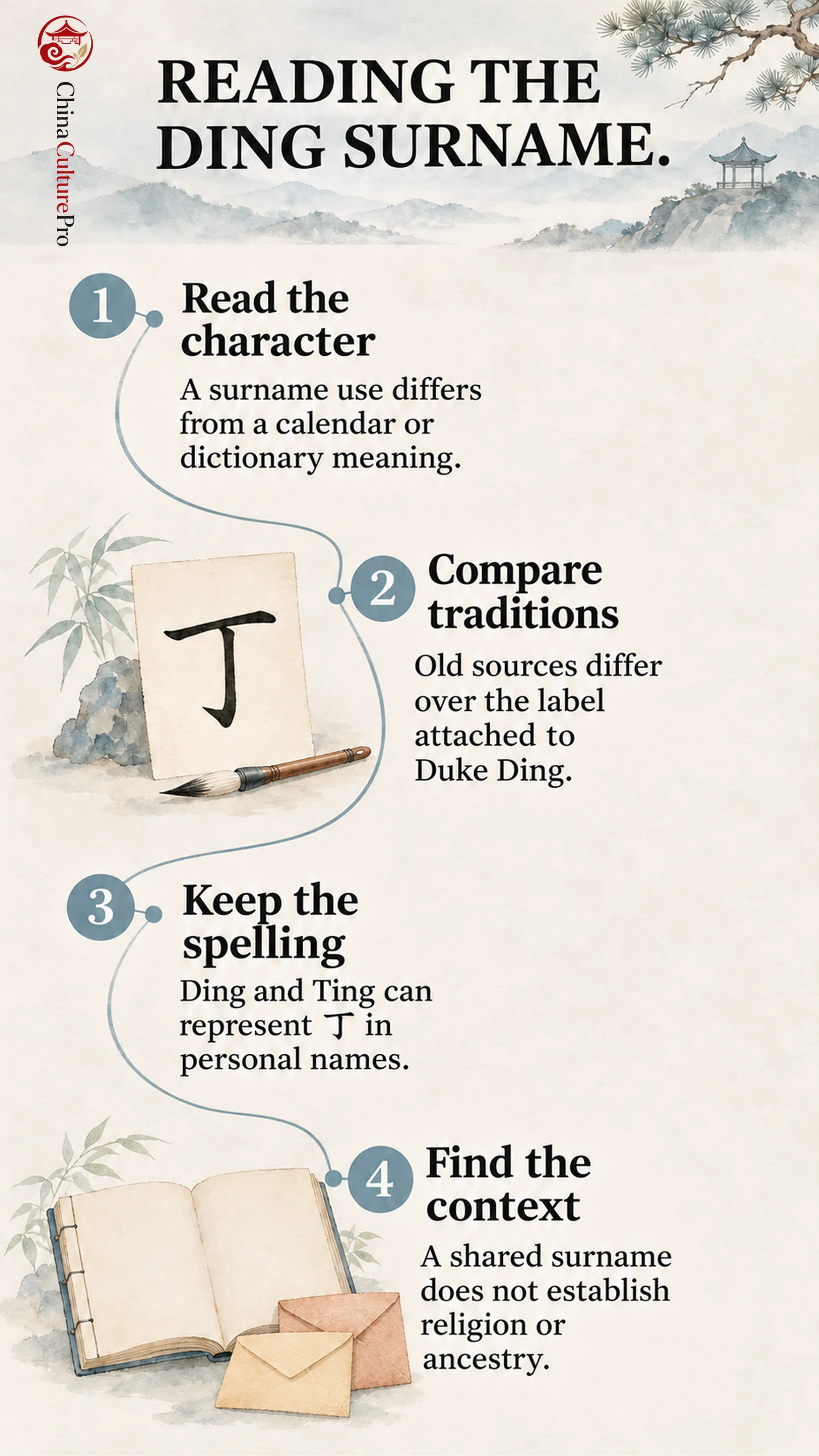
Two strokes can carry a complicated family history. The character 丁 may appear in a calendar, an old description of a household or a personal name, each with a different function. For readers of Chinese surnames, separating those uses makes the histories behind Ding and Ting easier to understand.
The Character 丁 and Its Other Uses
Ding occupies fourth place among the Heavenly Stems(天干,tiāngān). This is a named position in a traditional sequence, not a reason to translate every personal surname as the number four. The Ten Heavenly Stems have their own calendrical and cosmological setting.
The same character can refer to an adult male or to people counted as a population. It can also describe a small cube, as in diced food. These dictionary senses show why context matters: an occurrence in a household description or a food name is not automatically a reference to a family.
Conversely, a person’s surname is not a description of their sex, occupation or age. In an English-language introduction, keep Ding as the name and explain a particular historical connection when it is relevant. A lexical gloss does not explain how a lineage acquired the surname.
Duke Ding of Qi: A Naming Tradition and an Old Debate
The best-known received account connects the surname with Duke Ding, associated with Jiang Ji(姜伋,Jiāng Jí), the son of Qi’s founding ruler. A medieval rhyme dictionary explains Ding as a surname derived from this ruler’s posthumous title. This is the source of the familiar description “a surname taken from an ancestor’s posthumous name.” [2]
That explanation already had a historical critic. The Song scholar Zheng Qiao(郑樵,Zhèng Qiáo)placed Ding in a discussion of surnames arising from order or rank. He observed that Qi’s early sequence included rulers called Ding, Yi and Gui, before a later ruler bearing the title Ai. In his interpretation, the earlier labels belonged to a naming order rather than the developed system of posthumous titles. [3]
The disagreement is narrower than it may first appear. Both accounts retain the connection with Qi’s early ruler Ji; they differ over whether Ding is a posthumous title or an ordering label. Recognizing that distinction preserves the useful historical connection without presenting the “posthumous title” label as an uncontested fact.
It also prevents an overextended conclusion. An account explaining a surname’s association with a ruler does not identify every later household bearing it. The origin tradition belongs to the history of the name. A particular family’s connection to that tradition requires records linking its own generations.
Ding and Ting as Personal Spellings
Ding is the Mandarin pinyin form, usually printed without its tone mark in English-language personal names. Ting is the Wade–Giles form recorded alongside 丁 in a surname index. They can represent the same surname without being interchangeable spellings for every individual. [4]
Use a person’s established spelling. When comparing records, retain the Roman letters found in each document together with the Chinese character where available. Converting an earlier Ting entry to Ding may make a list look consistent, but it can conceal the evidence of how the name actually appeared.
The broader history of regional romanization explains why spellings persist beyond one pronunciation system. The character remains important because Roman letters can also correspond to other names. Understanding Chinese family and given names helps identify which part of a record needs comparison.
The Chendai Ding Lineage and the Limits of a Surname
The Ding Ancestral Hall(丁氏宗祠,Dīngshì Zōngcí)at Chendai in Jinjiang, Fujian, offers a different kind of family evidence. The local lineage preserves an account of Arab ancestry and settlement through Quanzhou. Its hall combines a southern Fujian architectural setting with Arabic Qur’anic decoration. These are features of a particular Hui community’s history, not characteristics automatically shared by all Ding families. [5]
This example connects a surname with a place, a lineage tradition and a communal building. Chinese ancestral halls provide the wider context for such institutions, while Islam in China explains why religious and community histories need regional scope.
The Chendai account should not be merged with the Qi ruler tradition to create one continuous pedigree. They answer different historical questions. Equally, ancestry associated with a religious community does not establish an individual’s present beliefs or practices.
For a specific family, compare its named ancestors, relatives, dates and places. Chinese family genealogy can explain how clan books preserve identity while also requiring careful reading of their particular connections. A shared 丁 is a starting point for that work, not its conclusion.
FAQs About Ding Surname
Are Ding and Ting the same surname?
They can both represent 丁. Check the Chinese character and retain the spelling used by the person or document.
Does the surname Ding mean the number four?
丁 is fourth in the Heavenly Stems, but its use as a family name is not normally translated as “four.”
Are all Ding families Muslim?
No. A particular Ding lineage may preserve Muslim ancestry, but the surname alone does not identify someone’s religion or ethnic community.
Sources
[1] Ministry of Education. Concise Mandarin Dictionary: 丁
[2] Guangyun. The entry for 丁
[3] Zheng Qiao. Comprehensive Treatises: surnames arising from names and order
[4] The Indexer. The hundred surnames: a Pinyin index
[5] Quanzhou Municipal People’s Government. The Chendai Ding Ancestral Hall