


Quick Answer: Who Are the Deang People?
The Deang people(德昂族,Dé’ángzú), also written De’ang, are an officially recognized ethnic group in China with communities in western Yunnan. Tea cultivation, local speech varieties and village religious life shape Deang culture. Chinese records use Deang alongside older names and local self-names, while related communities across the border appear under names such as Palaung and Ta’ang. Those labels need to be read with attention to place. [1][2]
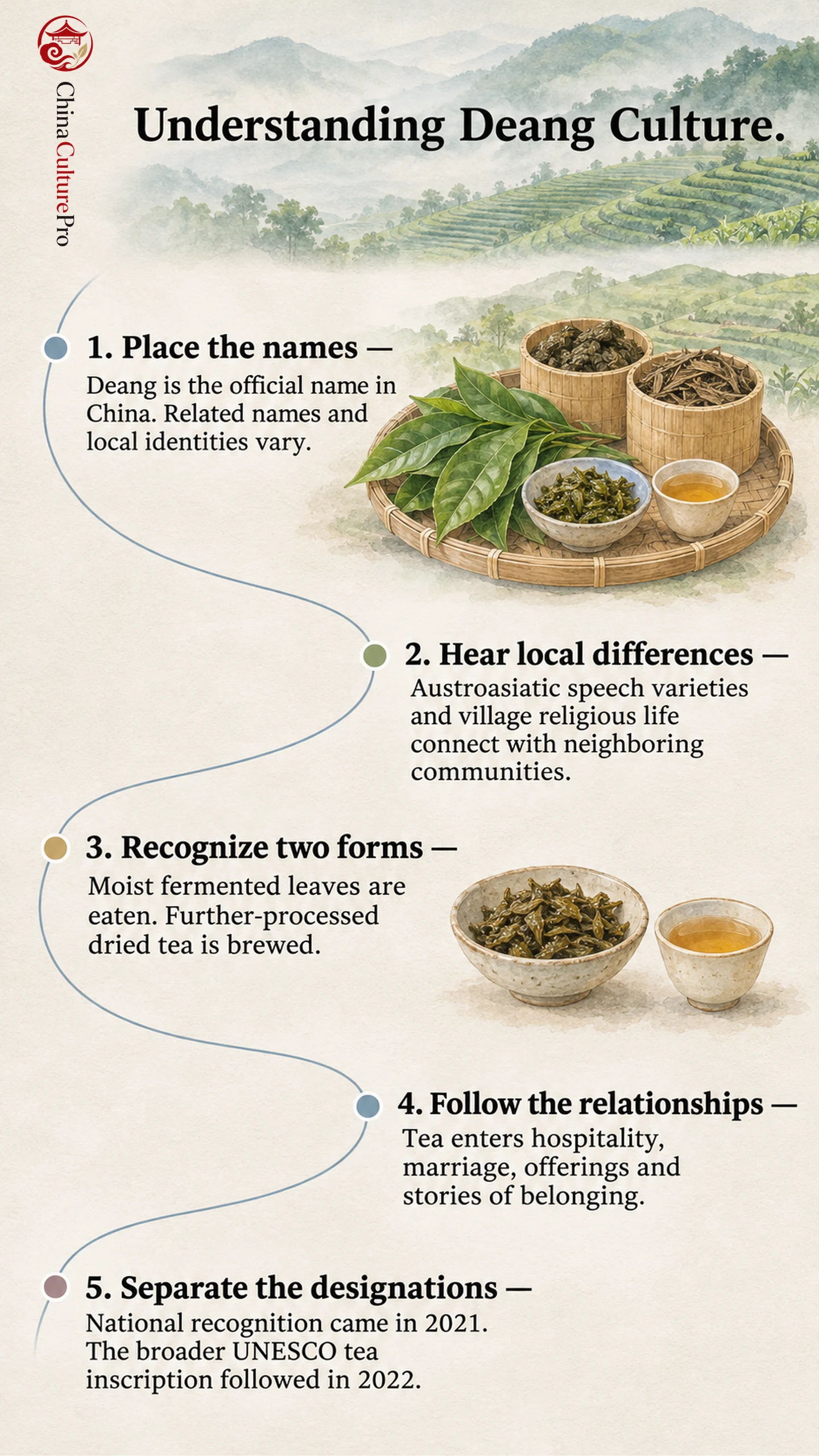
Tea leaves can reach a Deang table in a dish as well as a cup. That difference opens a useful path into the culture. The work of growing and processing tea connects with hospitality, relationships and oral stories, while the language a maker speaks can point to a particular community.
Names, Communities and the Yunnan Borderlands
Deang communities are dispersed across western Yunnan, especially Dehong, Baoshan and Lincang. Santaishan in Mangshi is a significant center of the sour-tea tradition. Regional records sometimes use Mangshi’s earlier name, Luxi, which can make two accounts appear to describe different places. Check the date and place names when reading an older profile. [1]
The official ethnic name changed from Benglong to Deang in 1985, following community preferences. Older classifications also applied color labels drawn from women’s dress. Such labels show how outsiders grouped the communities they encountered. Local self-names offer another way to understand those relationships. [1]
A field survey published in 2011 compared self-names and speech in Yunnan and Kengtung in Myanmar. It found that the boundaries suggested by subgroup names did not always match linguistic differences. This makes Palaung a useful name to recognize in a catalogue or linguistic work, while Deang remains the established official designation in China. [2]
Language, Buddhism and Village Connections
Deang speech belongs to the Austroasiatic language family. Descriptions distinguish several varieties, with spellings and groupings that differ between surveys. The language is therefore best approached through a named locality or a particular speaker. A recording from one village gives evidence of that variety, even when a catalogue places it under a broader language name. [2]
Long contact with neighboring communities has also made multilingual life common. Dai, Chinese and Jingpo can be used alongside Deang speech in different settings. Language choice may reflect who is present and what people are doing. In this setting, a household can participate in wider village and market networks while passing its own speech to children. [1]
Theravada Buddhism is prominent in accounts of Deang religious life, alongside local religious practices. The connection helps place village celebrations within a wider regional setting shared with Dai communities. Religious descriptions still need the village and occasion attached to them, especially when an older ethnic profile uses one short label to cover a varied community. [3]
How Deang Sour Tea Is Made and Used
Deang sour tea(酸茶,suānchá) uses fresh leaves from local large-leaf tea plants. A documented preparation includes steaming, rolling, compacting the leaves in bamboo containers and sealing them for fermentation. These stages alter the leaves before they become a finished ingredient or a tea for brewing. Apprentices learn the handling of leaves and fermented material through direct practice. [4]
| Two Forms of Deang Sour Tea | Finished form | Usage typique |
|---|---|---|
| Edible sour tea | Moist fermented leaves | Combined with ingredients such as tomato, peanuts and salt |
| Sour tea for drinking | Fermented material further processed and dried | Brewed to produce a clear infusion with a gently sour aroma |
A dish of moist tea and a cup brewed from dried tea can share a processing tradition while giving very different experiences at the table. Ask whether the product is prepared for eating or for brewing when identifying what a maker is offering. The broader distinction between tea oxidation and fermentation also helps explain why sour tea has its particular character. [4]
Tea in Social Life and Oral Tradition
Tea carries meaning beyond its taste. Accounts of Deang social life describe its use in welcoming people, relationships, marriage and offerings. The recipient and the occasion help give a gift of tea its meaning. A household visit and a marriage observance may involve the same plant while doing different social work. [5]
Creation stories make that connection visible in another form. A Deang oral epic gives tea a role in the beginnings of people and the world. It places a familiar crop within an account of belonging and ancestry. Treat that story as an oral tradition through which people express their relationship with tea. Its significance can be understood without assigning a verified date to the events it narrates. [5]
These uses give a social setting to a tea ceremony. Attention belongs to the relationship among the participants as much as to the vessel or the manner of pouring.
What Heritage Recognition Preserves
Deang sour-tea making entered China’s fifth national intangible cultural heritage list in 2021. The designated project is associated with Mangshi and identifies the craft as a traditional skill. Its heritage description emphasizes knowledge passed from teacher to apprentice through actual production, as well as the use of tea in community relationships. [6]
In 2022, UNESCO inscribed “Traditional tea processing techniques and associated social practices in China.” The broader inscription covers knowledge of cultivation, processing, drinking and sharing across communities. Deang sour-tea making is one of the component traditions included in that broader inscription. The two dates refer to different levels of recognition, each focused on practices and their transmission. [7][8]
When looking at a workshop demonstration, ask which part of that knowledge is being shown. Preparing leaves, judging the fermented material and explaining an occasion for serving tea answer different questions. This attention to people and learning is central to understanding intangible cultural heritage as an ongoing activity.
FAQs About Deang Culture
Is Deang the same name as Palaung?
The names are related, but their use varies by country, source and community. Deang is the official designation in China.
Can you eat Deang sour tea?
Yes. The moist fermented form is used as food, while a further-processed dried form is made for brewing.
Is Deang sour tea a separate UNESCO inscription?
It is part of the wider Chinese tea-processing and social-practices heritage context. UNESCO’s 2022 inscription has that broader title and scope.
Sources
[1] National Ethnic Affairs Commission. Overview of the Deang People
[2] Sujaritlak Deepadung. Names and Sub-Groups of the Palaung
[3] Embassy of China in Indonesia. Deang Ethnic Profile
[4] Yunnan Intangible Cultural Heritage Protection Center. Public Class on Deang Sour-Tea Making
[5] Journal of Yunnan Agricultural University. A Technological and Anthropological Study of Deang Sour Tea
[6] China Intangible Cultural Heritage. Deang Sour-Tea Making
[7] UNESCO. Traditional Tea Processing Techniques and Associated Social Practices in China
[8] Ministry of Culture and Tourism. Yunnan Heritage Protection Work, Including the Inscribed Tea Traditions