


Quick Answer: What Is the Dai Water Splashing Festival?
The Water Splashing Festival(泼水节,Pōshuǐ Jié)is a major New Year celebration of the Dai people(傣族,Dǎizú)in Yunnan. Dai New Year(傣历新年,Dǎilì Xīnnián)combines religious observances, reciprocal blessings, fairs, performances and public water play, commonly around mid-April.[1]
Water expresses wishes for renewal and well-being, but a temple ceremony and a city-center splashing event have different purposes. Regional programs also differ. Understanding the festival means identifying the community, occasion and year, rather than treating every activity as one compulsory three-day sequence or assuming that everyone nearby wants to participate.
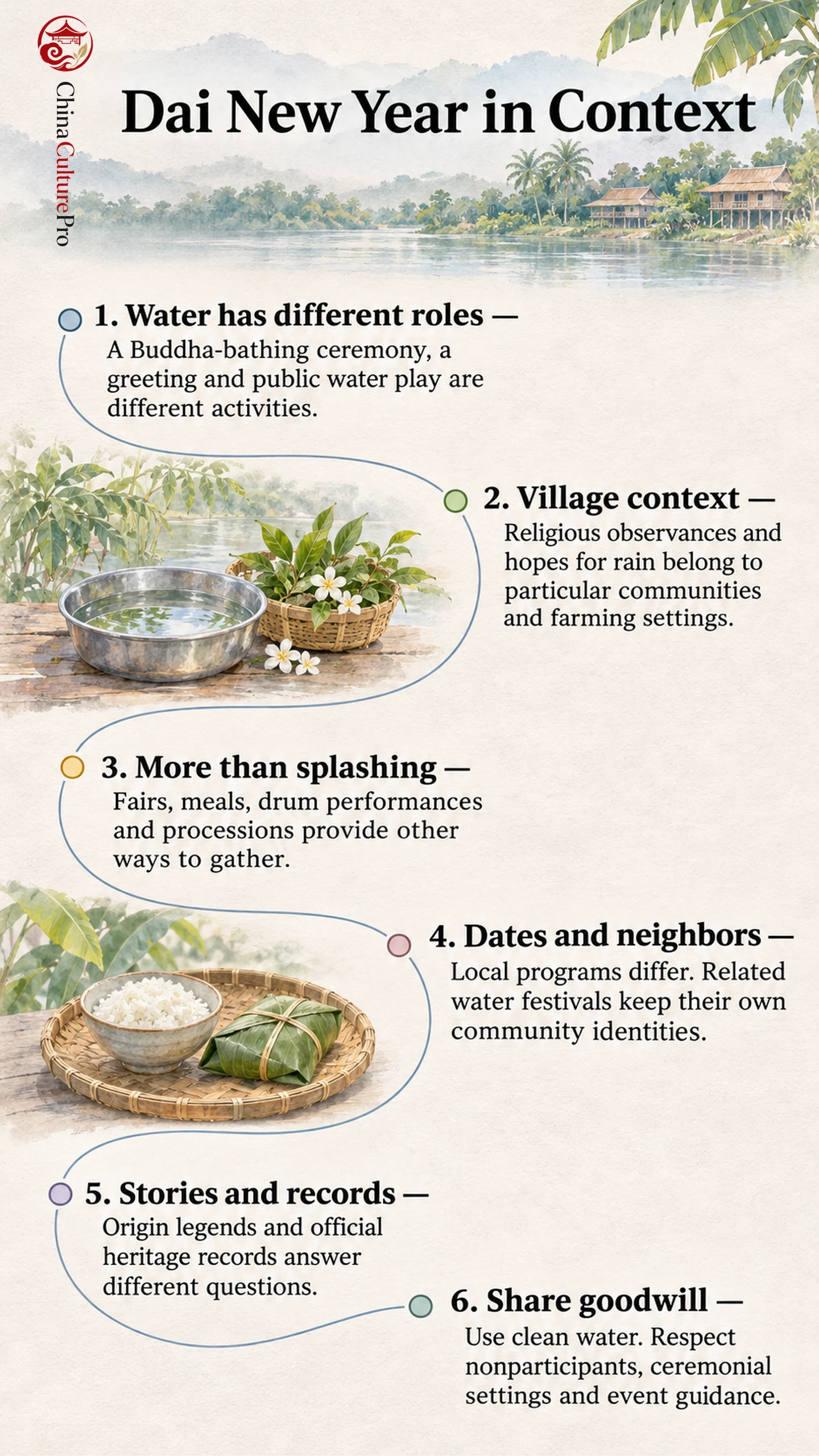
A handful of water can be a greeting, an offering or part of a public celebration. Those actions can occur within the same New Year season while carrying different meanings. This guide follows the festival from religious and village settings to fairs and city events, with local examples showing why context matters.
Dai New Year and the Meaning of Water
Water is associated with purification and the sharing of good wishes. Sprinkling another person can express goodwill for the coming year. That symbolism explains an intention within the festival; it does not mean that receiving a larger quantity of water produces greater luck.[1]
| Water practice | Main purpose | What distinguishes the setting |
|---|---|---|
| Bathing the Buddha(浴佛,yùfó) | A religious act directed toward a Buddha image | A temple or ceremonial context rather than ordinary water play |
| Sprinkling water as a greeting | An exchange of good wishes | The relationship between the people taking part matters |
| Public water splashing | Collective celebration and play | An organized gathering with its own area, timing and participation norms |
These are useful distinctions between activities, rather than a timetable for every community. Their place in a particular celebration depends on the local program and customary setting.
Religious Practice and Village Life
Theravada Buddhism(上座部佛教,Shàngzuòbù Fójiào)is important to many Dai festival settings. A Dehong heritage account describes flower gathering, religious offerings, bathing a Buddha image and water blessings alongside other activities. It also identifies participation by Deang(德昂族,Dé’ángzú)and Achang(阿昌族,Āchāngzú)communities, showing that the regional celebration is not limited to one ethnic label.[2]
Village practice can add a different focus. A 2012 field report from Zhanxi in Yingjiang described a water tree(水树,shuǐshù)made with branches, flowers and other gathered materials. People placed it within a village or beside a river and offered prayers connected with rain and the coming agricultural season. The report linked the observance with local farming concerns, rather than describing it only as entertainment.[3]
The same report recorded differences among villages, including places without a temple-bathing activity. A public celebration organized for a town also did not replace every village’s own observance. The distinction is between particular communities and occasions, not between a single authentic ritual and everything else.
Fairs, Food and Public Performances
Ganbai(赶摆,gǎnbǎi)fairs bring food, goods and social activity into the New Year season. Xishuangbanna’s official 2026 program included fairs on April 13–14, dragon-boat activity on the Lancang River and a public procession. The fair, boat activity and procession offered different ways to take part alongside the main water event.[4]
The elephant-foot drum(象脚鼓,xiàngjiǎogǔ)also appears in documented village dance activities. A drum performance, a procession and a shared meal each allow participation in a different way; the festival cannot be understood through water play alone.[3]
Ethnographic research on Xishuangbanna has examined how processions and public splashing express changing local identities, including relationships among religious life, tourism and public institutions. This helps explain why a modern city celebration can share recognizable traditions with village events while presenting them differently.[5]
Dragon-boat racing also occurs in other festival contexts. Seeing a boat race here does not make Dai New Year the same festival as the Dragon Boat Festival.
Regional Dates and Related New Year Traditions
Mid-April is a useful general reference, but dated local programs provide a clearer comparison. In 2026, Xishuangbanna’s main celebrations ran across April 13–15, with public splashing in Jinghong on April 15. Mangshi in Dehong held its public celebration on April 11–13. Other Dehong towns organized events in succession rather than following Mangshi’s dates as one prefecture-wide program.[4][6]
These are past 2026 examples, not an announced schedule for 2027. For a particular year, distinguish the local festival program from holiday leave arrangements and from events held at a village or commercial venue.
The Dai celebration belongs to a wider regional family of New Year water traditions. Thailand’s Songkran also combines water, respect and renewal, but its communities and national heritage record are distinct. Its UNESCO Representative List inscription dates to 2023; that inscription should not be transferred to the Chinese Dai festival simply because both use water.[7]
The useful comparison is between related traditions with their own names and contexts. It should not turn every Yunnan water event into an interchangeable version of a Thai celebration.
Stories and Documented Heritage
Local origin stories explain the festival through narrative. One Yingjiang version tells of women defeating a demon whose fallen head threatens to set the ground alight. They take turns carrying it and sprinkle water when changing over. This is a folk explanation of the custom, rather than a dated historical account of the festival’s creation.[8]
Modern heritage records answer a different question. The Xishuangbanna Dai Water Splashing Festival entered China’s first national intangible heritage list in 2006, under project Ⅹ-8. Dehong was added as an extension in 2008 under the same project number.[2][9]
Those dates record official safeguarding decisions, not the birth of the festival. Reading intangible cultural heritage alongside community practice keeps the administrative record separate from legend and from the longer development of a living tradition.
Joining the Celebration Respectfully
Goodwill is a useful starting point for participation. Xishuangbanna’s April 9, 2026 guidance called for clean water, avoidance of high-pressure equipment, attention to designated areas and times, and no forced splashing of traffic or people carrying out their work. It also asked participants to avoid vulnerable bystanders and keep routes clear.[10]
These instructions support the social meaning of a blessing: the activity should remain welcome to the people involved. A crowded festival scene does not establish consent from every passerby, and a temple ceremony should be approached according to its hosts’ directions.
For a fuller introduction to Dai culture, the festival is one entry point among language, religious life and everyday community traditions.
FAQs About the Dai Water Splashing Festival
When is the Dai Water Splashing Festival?
It commonly takes place around mid-April. Dates and program lengths differ by community and year, so use the relevant local announcement for a particular event.
Is the Dai festival the same as Thailand’s Songkran?
They are related regional New Year water traditions, but their communities, programs and heritage records are distinct. The names should not simply be substituted for one another.
Is the festival only about water fights?
No. Religious observances, blessings, village gatherings, fairs, food, music and processions also form part of different local celebrations.
Does everyone nearby want to be splashed?
No. Respect nonparticipants, ceremonial settings and the event’s rules. Sharing a public space is not the same as agreeing to take part.
Sources
[1] Visit Colorful Yunnan. Water-Sprinkling Festival
[2] China Intangible Cultural Heritage Network (Réseau chinois du patrimoine culturel immatériel). Dai Water Splashing Festival: Dehong Extension
[3] Qu Yongxian. Field Observations on Water Splashing Festival Transmission
[4] Xishuangbanna Publicity Department, via Xinhua. Dai Year 1388 New Year Festival Program for 2026
[5] Anouska Komlosy. Procession and Water Splashing: Expressions of Locality and Nationality During Dai New Year in Xishuangbanna
[6] Guan Yushu, Yunnan Net. Mangshi’s 2026 Water Splashing Celebration Opens
[7] UNESCO. Songkran in Thailand, Traditional Thai New Year Festival
[8] Yingjiang County Government. Water Splashing Festival
[9] China Intangible Cultural Heritage Network. Dai Water Splashing Festival: Xishuangbanna Record
[10] Xishuangbanna Publicity Department Official Account. Civilized Water Splashing Initiative, April 9, 2026