
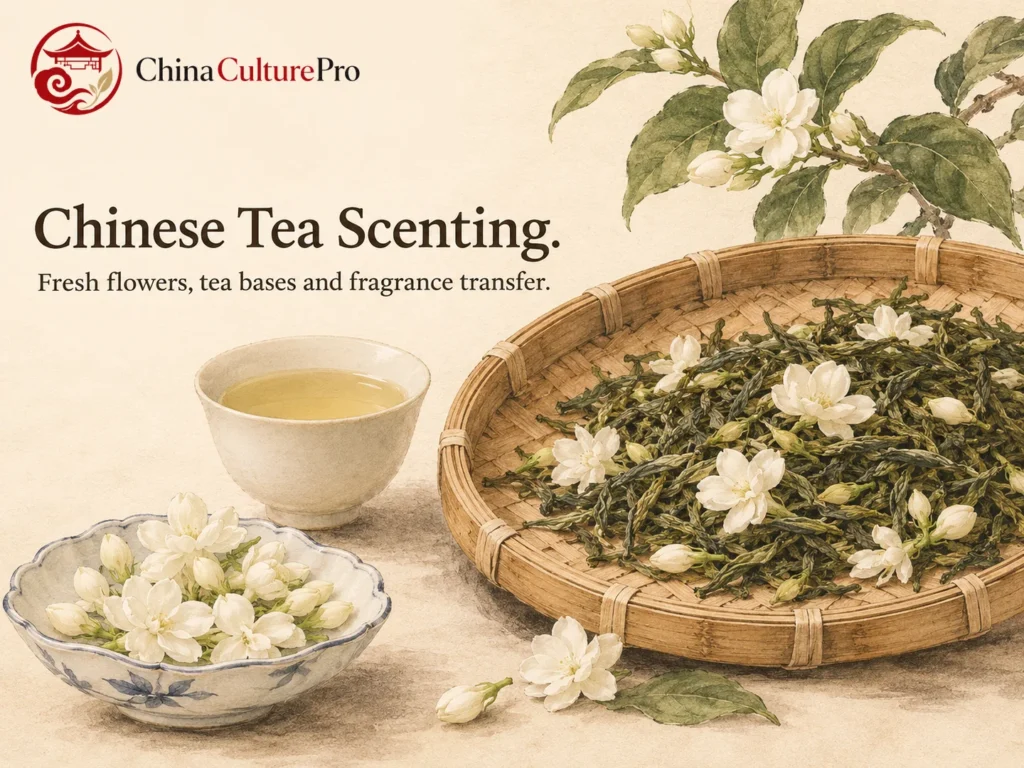

Quick Answer: What Is Chinese Tea Scenting?
Tea scenting(窨茶,xūnchá)transfers flower fragrance into a tea base. The Chinese verb 窨 has this tea-related reading in the Ministry of Education dictionary; the traditional process uses prepared tea and fresh flowers.[1][2]
- Starting point: Tea leaves already processed into a base tea.
- Aroma source: Fragrance released by flowers during processing.
- Finished result: Tea carrying floral aroma, even after the spent flowers are removed.
Scenting differs from leaving dried petals in a blend or adding a flavoring ingredient. A product may combine methods, so appearance alone does not establish how it was made.
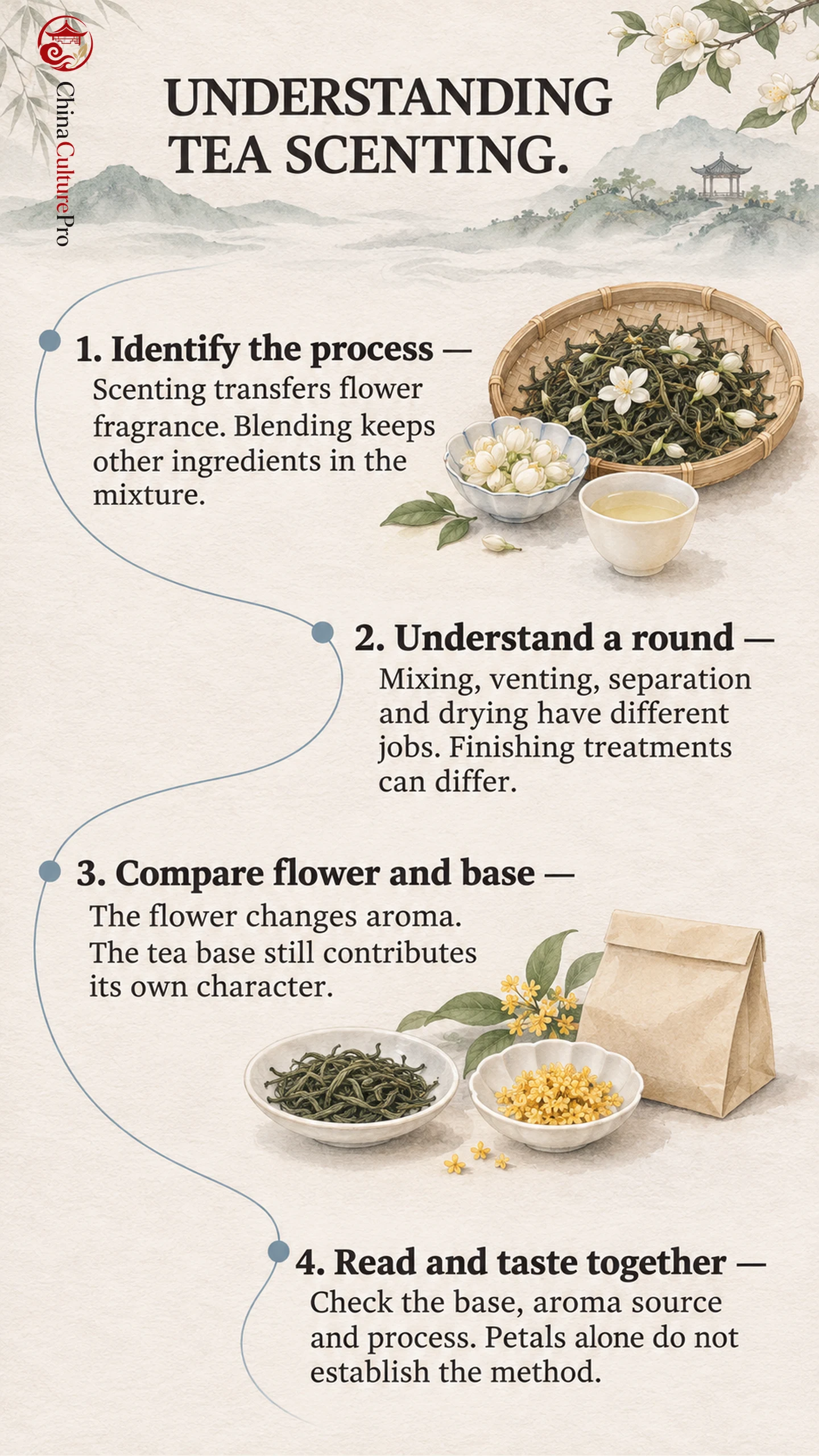
A tin of jasmine-scented tea may contain almost no visible flowers, yet release a distinct floral aroma when brewed. Another packet may be full of petals. The difference is a processing question: how did the fragrance reach the tea, and what remains in the finished product? Those questions are more useful than judging by decoration.
Scenting, Blending and Added Flavor Are Different Processes
These terms describe different ways of building aroma and composition. They are useful questions to ask about a product, rather than a guarantee that every seller uses the words identically.
| Process | Ce qui se passe | Points à vérifier |
|---|---|---|
| Flower scenting | Flower fragrance transfers into a tea base | Which flower and tea base were used |
| Ingredient blending | Tea is mixed with other ingredients that remain in the product | The complete ingredient list |
| Added flavor | An extract or flavoring ingredient is added | How the added aroma is described |
The distinctions can overlap. Scented tea may also contain decorative petals, and a blend may use a scented tea as its base. Conversely, a tea’s naturally floral aroma does not prove flowers were used during manufacture.
A flower-only drink is another case. Infusing dried blossoms without tea leaves makes a floral or herbal infusion, rather than reprocessing a tea base. Check whether the packet contains tea leaves before comparing it with a scented green or black tea.
For a closer look at combining ingredients, see Chinese tea blending. The important distinction here is between transferring fragrance and keeping another ingredient in the mixture.
How a Jasmine Scenting Round Works
The heritage record for Fuzhou(福州,Fúzhōu)jasmine tea(茉莉花茶,mòlìhuā chá)describes a baked green-tea base combined with fresh jasmine flowers, followed by flower removal.[2] That is a documented regional tradition, not a rule that every scented tea must use the same green tea.
A full round commonly involves four connected operations:
- Mixing: Prepared flowers and the tea base are brought together for fragrance transfer.
- Venting: The mixture is spread to release heat, then gathered again as required by the process.
- Separation: Spent flowers are removed from the tea.
- Drying: Moisture taken up during the round is reduced before further handling.[3]
Repeating a round uses fresh flowers. The maker manages flower condition, heat and moisture together; counting the repetitions tells only part of the story.
There is also a finishing distinction. A 2023 study examined four scenting rounds followed by tihua(提花,tíhuā), a final flowering treatment without the subsequent drying used in that study’s preceding rounds.[3] It would therefore be inaccurate to say every scenting treatment always ends with another drying step.
This explains why a finished jasmine tea can carry fragrance without retaining the flowers that supplied it.
Different Flowers and Tea Bases Produce Different Results
Jasmine is one example, not the boundary of the technique. A 2024 experiment scented the same green-tea base with jasmine, osmanthus(桂花,guìhuā), Michelia alba and rose flowers, finding distinct volatile profiles in the resulting teas.[4] Changing the flower can change the aromatic result even when the base remains comparable.
Osmanthus also shows why “scenting” need not mean flowers physically mixed through the leaves. A study of osmanthus Longjing(龍井,Lóngjǐng)compared direct mixing with an isolated arrangement: flowers and tea occupied separate containers that allowed fragrance transfer. Both were flower-scenting treatments.[5] This experimental example broadens the mechanism; it does not mean every producer uses that equipment.
The tea base matters too. Research on osmanthus black tea examined how base-tea characteristics and different scenting treatments affected aroma.[6] Flower fragrance is added to the existing character of the leaf, rather than replacing the base tea’s identity.
When comparing two packets, hold one variable steady if possible. Comparing jasmine and osmanthus on similar green bases asks a different question from comparing osmanthus-scented green and black teas. “Floral tea” alone answers neither question.
Reading a Scented Tea Label and Tasting the Result
Start with three details: the tea base, the flower or added aroma source, and the stated processing method. “Green tea scented with jasmine flowers” communicates more than “jasmine flavor,” but the complete description and ingredients still matter.
Ask what a scenting count includes: a finishing treatment may differ from a full round. Compare the base and flower information too, rather than ranking products by the count alone.
When brewing, begin with guidance for the particular product and its base tea. A lightly processed green base and an osmanthus black tea need not use the same setup. This article explains manufacture, rather than prescribing one temperature or steeping time for all scented teas.
Compare the aromas of the dry leaves, warm infusion and wet leaf. Then compare the floral impression with the tea’s taste, texture and finish. The strongest first smell is only one observation; it does not establish the origin of an added aroma or the number of scenting rounds.
If you want more precise descriptions, our tea aroma vocabulary provides a starting point for recording what you notice.
FAQs About Chinese Tea Scenting
Must scented tea contain visible flowers?
No. Flowers can supply fragrance during processing and then be removed. Visible petals alone do not establish the method or grade.
Is every flower drink a scented tea?
No. A flower-only infusion has no tea-leaf base to scent. Read the ingredients.
Is scented tea always based on green tea?
No. Green tea is common, but other bases, including black tea, can be flower-scented.
Do more scenting rounds always mean better tea?
No. The base, flowers and processing control matter, and a finishing treatment may differ from a full round.
Sources
[1] Ministry of Education. Revised Mandarin Chinese Dictionary: 窨, xūn
[2] China Intangible Cultural Heritage Network (Réseau chinois du patrimoine culturel immatériel). Fuzhou Jasmine Tea Scenting Technique
[3] Foods. Volatilomics Analysis of Jasmine Tea during Multiple Rounds of Scenting Processes
[4] Zhiwei Hou et al. Comparison of Volatile Compounds in Jingshan Green Tea Scented with Different Flowers
[5] Jianyong Zhang et al. Effect of Isolated Scenting Process on the Aroma Quality of Osmanthus Longjing Tea
[6] Food Quality and Safety. Volatiles Profiles and Factors Affecting Absorption of Key Odorants in Osmanthus Black Tea