

Quick Answer: What Is Bowl Tea in Chinese Traditions?
A tea bowl(茶碗,cháwǎn)is a vessel; “bowl tea” describes several ways of preparing or serving tea. Contemporary examples include leaves infused in a personal bowl and tea portioned from a larger bowl into cups.[1]
- Vessel: A bowl may be used for preparation, drinking or both.
- Method: Tea may be whisked, steeped in the bowl or brewed elsewhere and poured into it.
- Flavor: The leaf and preparation matter; the word “bowl” does not identify one tea type.
Historical powdered tea and a modern bowl of loose-leaf tea require different explanations.
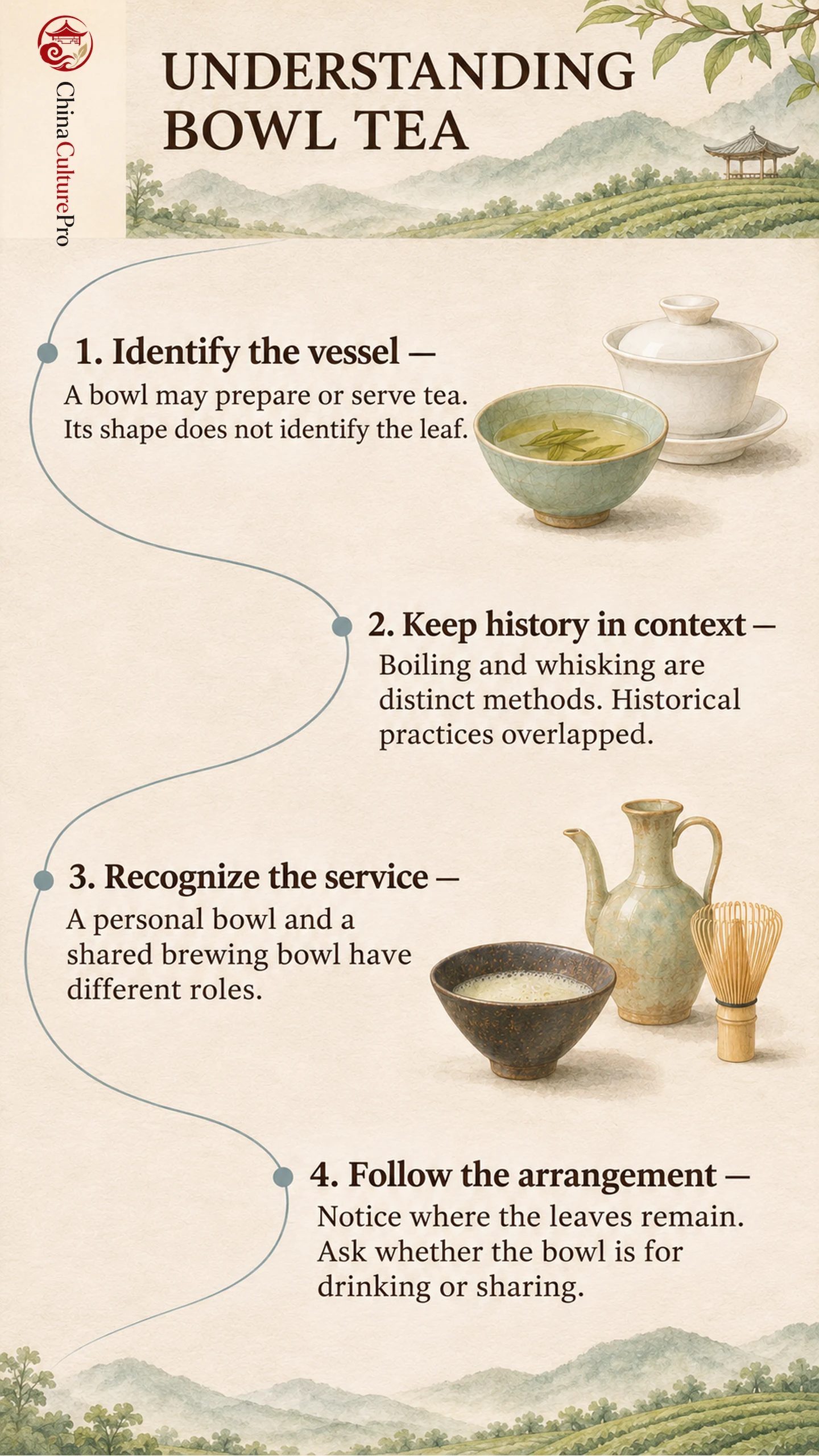
An open bowl can hold floating leaves, a clear infusion or a layer of pale foam. Each suggests a different way of making tea. Looking at what is inside the bowl—and whether the bowl is used for brewing or only drinking—makes Chinese bowl-tea traditions easier to recognize without assuming one fixed ceremony.
A Tea Bowl Describes the Vessel, Not the Leaf
“Bowl tea” is most useful as a description of an arrangement. It is not a processing category equivalent to green, black or oolong tea. A packet still needs its own tea name and production information.
There are two questions to ask when a bowl arrives. First, was the tea prepared in this vessel or poured into it? Second, are whole leaves or fine tea particles still present? The answers tell you more about the next action than the bowl’s size alone.
This is why the choice of brewing vessel belongs beside, rather than in place of, the tea’s identity. A porcelain bowl does not change the tea’s processing category, and a rustic-looking bowl does not establish a lower grade. Judge the leaf, preparation and intended use separately.
Tang and Song Tea Bowls: Boiling and Whisking
The National Palace Museum describes a Tang dynasty(唐朝,Tángcháo)method in which ground tea was boiled in a vessel and then poured into bowls. In the Song dynasty(宋朝,Sòngcháo), diancha(點茶,diǎnchá)put tea powder directly into the bowl for mixing with hot water and whisking.[2]
These are broad historical patterns, not a timetable followed by every drinker. Hong Kong’s Museum of Tea Ware notes that loose-leaf drinking existed during the Tang period, before becoming more prominent in the Ming.[3] Practices overlapped.
Jian tea bowls(建盞,jiànzhǎn)show how a vessel could suit preparation. The Smithsonian’s bowl F1909.369, dated approximately 1100–1200 and attributed to Fujian(福建,Fújiàn), has a dark glaze and flaring form. Its curatorial explanation connects dark glaze with the visibility of white tea froth and the shape with limiting splashes during mixing.[4]
Yet Song tea bowls were not all black. Hong Kong’s Antiquities and Monuments Office identifies a Longquan(龍泉,Lóngquán)celadon tea bowl among finds from Sung Wong Toi Station, alongside a Fujian-ware ewer.[5] The finds show a broader ceramic range than the familiar black-bowl image.
The useful historical connection is between vessel, preparation and visual appreciation. It does not make every modern bowl of tea a reconstruction of Song diancha.
Covered Bowls and Modern Shared Tea
A gaiwan(蓋碗,gàiwǎn)is a covered bowl. In the Chengdu(成都,Chéngdū)teahouse tradition described by the local chronicles office, the familiar set has a bowl, lid and saucer. The lid helps move floating leaves aside, while the saucer supports the bowl.[6] This direct-drinking use differs from a gaiwan used to decant tea into separate cups.
The Taiwan International Tea Bowl Festival’s exhibition presents several contemporary uses, including these open-bowl arrangements.[1]
| Service form | Where preparation happens | How the tea reaches the drinker |
|---|---|---|
| Personal leaf bowl | Leaves infuse in the bowl | The person drinks from that bowl |
| Large shared brewing bowl | Tea infuses in a larger bowl | A serving spoon portions tea into cups |
| Bowl filled from a pot | Tea is brewed separately | The bowl receives the prepared infusion |
The vessel’s role matters more than attaching one elaborate ritual to every example. A shared preparation bowl does not mean guests must drink from the same rim.
How to Approach a Bowl of Tea Today
Follow the host’s arrangement before lifting anything. If you have a personal covered bowl, the lid and saucer are part of its handling. If tea is being portioned into cups, wait for your individual serving rather than treating the large bowl as your drinking cup.
Pinglin Tea Museum’s etiquette leaflet describes lifting a covered bowl’s saucer, uncovering the tea to appreciate its aroma, and observing the liquor’s color.[7] That is one documented approach, not a compulsory sequence for every Chinese household.
With loose leaves still in the bowl, the drink continues to change as you sip. Start with the leaf’s own brewing guidance and an amount suited to the vessel; a drinking bowl and a small decanting brewer need not use the same setup. Let the tea reach a comfortable drinking temperature.
Compare smell, taste and texture separately. A dark bowl makes liquor color harder to assess than a light interior; that visual difference does not by itself establish how the tea tastes. For a clearer comparison, keep the leaf and water consistent when trying another vessel.
Ask a simple practical question if uncertain: is this bowl for drinking, brewing or sharing? The answer usually resolves more than memorizing a supposed universal tea-ceremony rule.
FAQs About Bowl Tea
Is all bowl tea whisked like matcha?
No. Powdered-tea whisking is one method. Loose-leaf infusion and tea poured from a pot are different arrangements.
Is a gaiwan the same as an open tea bowl?
A gaiwan has a lid, often with a saucer. An open bowl lacks that covered-bowl setup.
Does drinking from a bowl mean lower-quality tea?
No. The serving vessel alone does not establish the quality or grade of its contents.
Should the leaves stay in the bowl while drinking?
In some personal-bowl methods, yes. In other arrangements the tea is separated from the leaves before serving.
Sources
[1] Taiwan International Tea Bowl Festival. Four Seasonal Tea-Bowl Settings
[2] National Palace Museum. Tea Culture in East Asia
[3] Hong Kong Leisure and Cultural Services Department. Exhibition Features Chinese Tea Culture and Tea Utensils
[4] Smithsonian National Museum of Asian Art. Bowl with Oil Spot Glaze
[5] Antiquities and Monuments Office. Storm in a Tea Bowl: Tea Drinking in Song Dynasty Daily Life
[6] Chengdu Local Chronicles Office. Covered-Bowl Tea in Chengdu
[7] Pinglin Tea Museum. Chinese and Japanese Tea Etiquette Exhibition Leaflet