
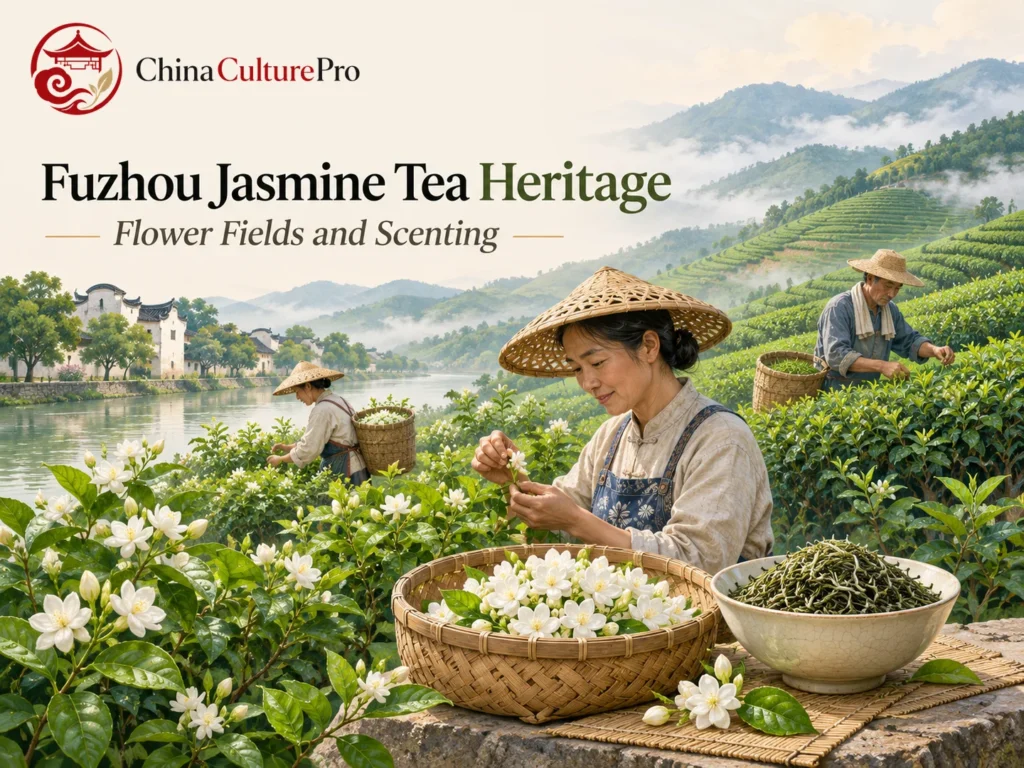

Quick Answer: What Is Fuzhou’s Jasmine Tea Heritage?
Fuzhou’s jasmine tea heritage links jasmine growers, tea producers and workshops that bring the two crops together. In scenting (窨制, yìnzhì), tea leaves take up the aroma of opening jasmine flowers. FAO recognized Fuzhou’s landscape and local knowledge as an agricultural heritage system in 2014. [1][2][3]
- Fields: In the landscape documented by FAO, jasmine grows on lower ground near water, while tea can grow higher on slopes. [1][2]
- Workshops: Growers and scenting workers pay attention to the timing of the buds, including when the flowers open and release fragrance. [3][4]
- Heritage: Growing, picking, trading and scenting give the city a larger story than the contents of one cup. [1][3]
Fuzhou’s story is about the different kinds of work that meet in a scented tea.
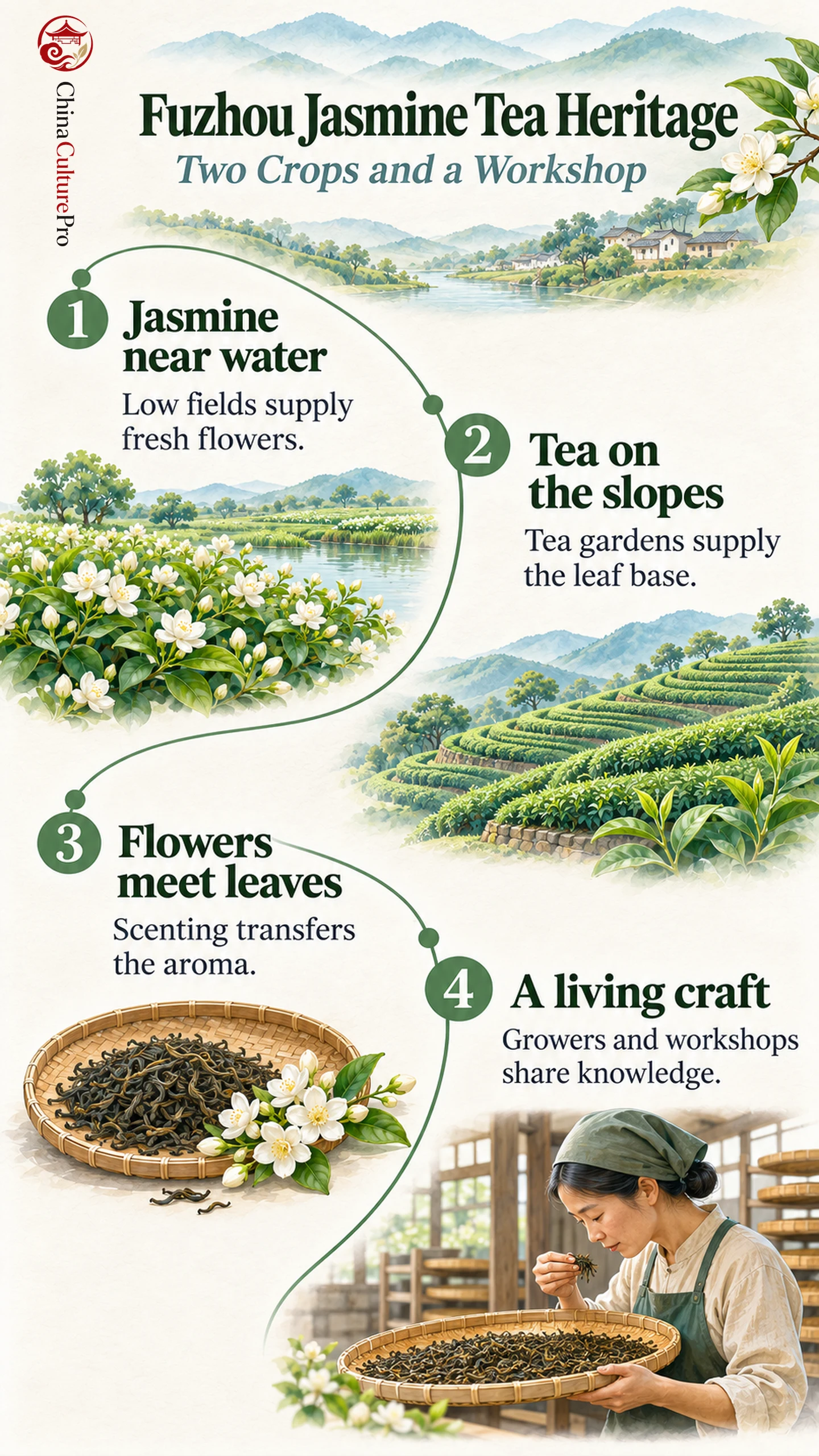
A jasmine bud and a processed tea leaf come from different parts of the production landscape. Following them into a workshop shows where a field skill meets a different skill developed around aroma.
Three Parts of Fuzhou’s Jasmine Tea Landscape
| Place or setting | What people work with | Pourquoi c’est important |
|---|---|---|
| Lower jasmine plots | Flowering shrubs in favorable local growing areas, including land near waterways. [1][2] | Supply fragrant flowers for a craft that depends on when buds open. [3][4] |
| Tea gardens | Tea plants growing in different conditions, including hillside settings. [1][2] | Provide a leaf that can be processed into the tea base. [1][3] |
| Scenting workshops | Prepared leaves and selected fresh jasmine. [3][4] | Workers bring the two products together so leaves take up their aroma. [3][4] |
FAO describes the slopes and river margins as a connected landscape. Town buildings, vegetation and waterside growing areas sit between the higher tea terrain and the water. Flower and tea work need not take place side by side in each grower’s own plot. [1][2]
How Flower Timing Becomes a Workshop Skill
A production study in Fuzhou describes picking flower buds and handling them before scenting. The stage at which the flowers open matters because their fragrance must be available when they meet the processed leaves. Workers can separate the flowers after a scenting cycle. Makers can repeat scenting. The number of cycles depends on the product and the workshop’s practices. [3][4]
In this process, the flowers lend their aroma to processed tea leaves. The result belongs to jasmine tea, and it is one example within the wider range of Chinese flower teas. The documented craft helps explain why a finished leaf can be aromatic even after the original blossoms have been removed. [3][4]
What the Heritage Designations Recognize
FAO’s agricultural listing addresses the growing system, post-harvest knowledge and associated landscape. The Fujian government also documents Fuzhou scenting as a representative national intangible heritage craft. That listing concerns the practiced skill. These frameworks give different ways to understand the same local work. [1][3]
Elsewhere in Fujian, Anxi’s Tieguanyin heritage links its own hillsides and processors to oolong production. The broader guide to China’s UNESCO tea heritage explains the national context of tea skills and social practices. [5][6]
FAQs About Fuzhou Jasmine Tea Heritage
Is Fuzhou jasmine tea simply dried jasmine flowers?
Its defining preparation is scenting tea leaves with jasmine flowers. The finished tea can contain few or no visible flowers. [3][4]
Which agency recognized the farming system?
The Food and Agriculture Organization recognized Fuzhou’s Jasmine and Tea Culture System as a Globally Important Agricultural Heritage System in 2014. [1]
Why do the two crops grow in different places?
FAO describes different growing conditions, with tea at higher elevations and jasmine in lower areas near water in the regional landscape. [1][2]
Sources
[1] Food and Agriculture Organization. Jasmine and Tea Culture System of Fuzhou City
[2] Food and Agriculture Organization. Fuzhou Jasmine and Tea Culture Case Study
[3] Fujian Provincial People’s Government. Fuzhou Jasmine Tea Scenting Technique
[4] PubMed Central. Metabolomics Analysis of Changes During Jasmine Tea Scenting
[5] Food and Agriculture Organization. Anxi Tea Culture System
[6] UNESCO Intangible Cultural Heritage. Traditional Tea Processing Techniques and Associated Social Practices in China