
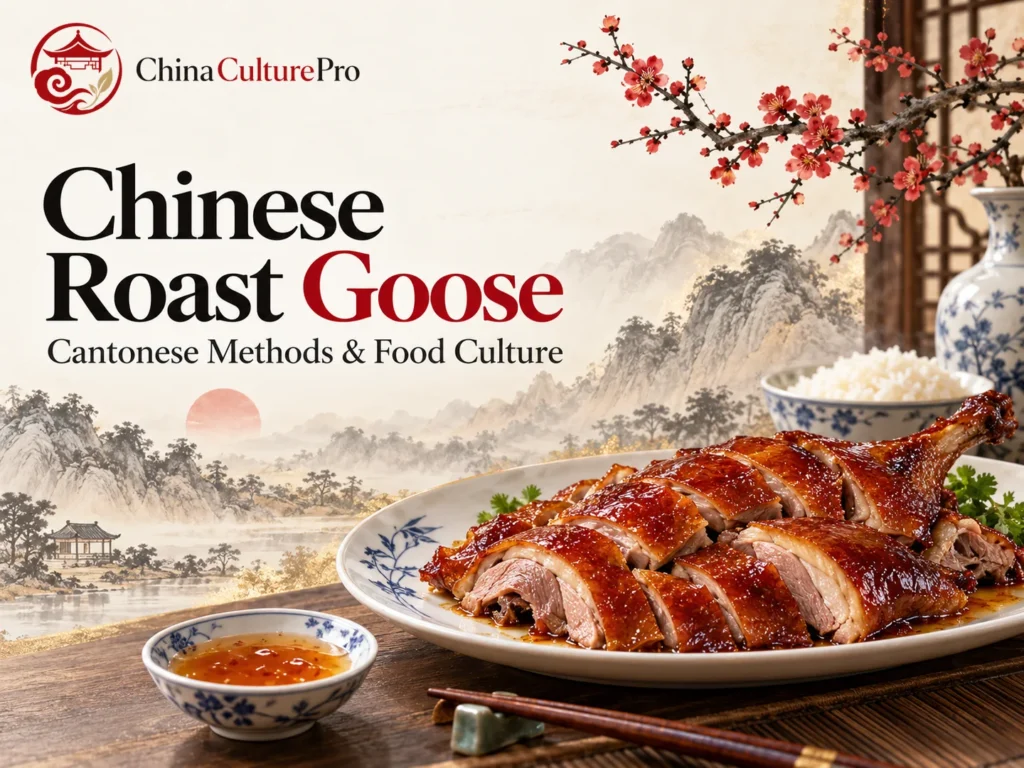

Quick Answer: What Is Chinese Roast Goose?
Chinese roast goose (烧鹅, shāo é), often written siu ngo on Cantonese menus, belongs to the roast-meat tradition called siu mei (烧味, shāowèi).
- Bird: Goose is the main ingredient; roast duck uses a different bird.
- Method and texture: Roasting produces reddish-brown skin, rendered fat and richly flavored meat. Crisp skin is a defining attraction.
- Serving: The bird is usually chopped into manageable pieces, often with bones, for rice, noodles or a shared plate.
This Cantonese cuisine specialty has regional variations in seasoning, goose selection and roasting equipment. No single fuel or marinade defines every version.
Roast goose and roast duck can look remarkably similar behind a restaurant window. A glossy skin also tells you little about how it became crisp. This guide explains the Cantonese dish within Chinese food, from its preparation and regional traditions to serving styles and useful ordering checks.
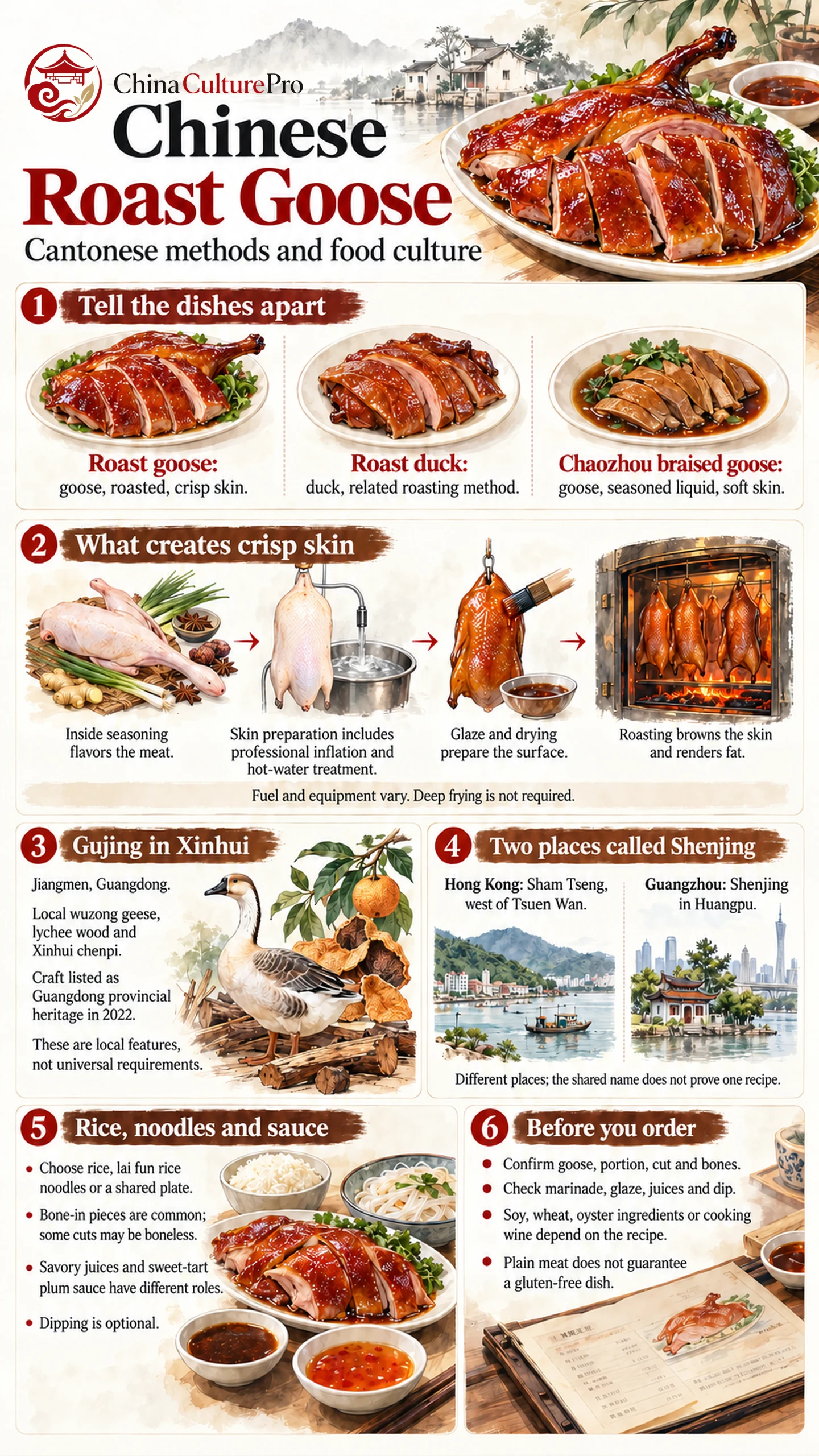
Roast Goose, Roast Duck and Braised Goose Compared
Two separate questions help identify the dish: which bird is used, and how is it cooked? The Chinese name is more dependable than a photograph, especially once the poultry has been chopped and covered with sauce.
| Plat | Main ingredient | Cooking method | Useful identification clue |
|---|---|---|---|
| Cantonese roast goose | Goose | Roasted whole; professional kitchens commonly hang the bird in a roasting oven | Glossy, crisp skin over a layer of fat and substantial meat |
| Cantonese roast duck (烧鸭, shāoyā) | Canard | A related roast-poultry method | Similar presentation, but a different bird; the menu distinguishes it from goose |
| Chaozhou braised goose (卤鹅, lǔ é) | Goose | Cooked in seasoned braising liquid | Soft, seasoned skin rather than a deliberately crisp roast surface |
Chaozhou braising liquid can include fish sauce, soy sauce, galangal and other spices. Its flavor develops through cooking in that liquid.[2] A dark, shiny finish alone cannot tell you whether goose has been roasted or braised. Confirm the method when a menu gives only a generic goose description.
How Cantonese Roast Goose Gets Its Crisp Skin
The meat’s seasoning and the skin’s finish have different jobs. The following stages explain the cooking methods, rather than provide a home recipe.
- Seasoning inside: Cavity seasonings may combine salt, aromatics and spice mixtures; some kitchens also use fermented bean sauces. Ginger, shallots or spring onion can add aromatic notes. The exact mixture belongs to the kitchen’s recipe.[1]
- Preparing the skin: Professional techniques can include inflation to separate skin from flesh and a hot-water treatment that tightens the surface. Those operations prepare the outside for subsequent drying and roasting; the precise order and equipment differ between kitchens.[1]
- Glazing and drying: A maltose-and-vinegar glaze gives the surface its characteristic color and gloss. Drying helps the skin crisp. Interior seasoning and this later surface treatment are distinct operations in documented professional preparation.[3]
- Roasting: Heat cooks the bird and renders fat while the prepared skin browns. Hanging roasting is familiar in professional kitchens; other oven setups also exist. Deep frying is not required.[1][7]
A sweet glaze cannot supply all the flavor of the finished goose: the cavity mixture, meat, fat and roasting each contribute. Equally, a glossy surface is not proof of crispness or doneness. Professional drying conditions should not be copied as a room-temperature raw-poultry routine at home.
Regional Roast Goose Traditions in Guangdong and Hong Kong
Gujing in Xinhui: Local Ingredients and a Living Craft
Gujing is a town in Xinhui district, Jiangmen, Guangdong. Its documented roast-goose craft uses local wuzong geese (乌鬃鹅, wūzōng é), lychee wood and Xinhui dried tangerine peel, or chenpi (陈皮, chénpí), with a distinctive wet seasoning mixture inside the bird. These details explain a particular local tradition; they are not compulsory ingredients for every Cantonese roast goose.[4]
The craft has a documented history of more than a century and continues through family businesses, trade practice and apprenticeship.[4] In 2022, it entered Guangdong’s eighth provincial list of representative intangible cultural heritage projects. That designation applies to the Gujing production craft at provincial level.[5]
Gujing’s combination of a named goose type, local citrus seasoning and wood roasting gives its craft a specific regional identity. These recorded features are more useful for understanding the food than an unverified story about a single inventor or a palace recipe.
Hong Kong: Sham Tseng and Siu Mei Dining
Hong Kong’s Sham Tseng, west of Tsuen Wan, is particularly associated with roast goose and restaurant dining.[6] Elsewhere in the city, siu mei shops also serve roast goose with rice or noodles, making it accessible as an individual meal.[8]
The place names need care. Gujing (古井) in Xinhui is different from Sham Tseng (深井) in Hong Kong. Guangzhou’s Huangpu district also has a Shenjing (深井) roast-goose tradition, described locally with a well-style roasting method.[7] Matching Chinese characters or a similar English spelling does not establish that two shops share the same location, recipe or a proven sequence of invention and transmission.
How Roast Goose Is Served: Rice, Noodles and Plum Sauce
Roast goose is commonly chopped before service, with skin, meat and bone together. Some kitchens also prepare boneless breast pieces.[3] Take manageable bites and check for small bones as you eat.
For one person, roast goose over white rice is a straightforward meal. Another Hong Kong pairing is lai fun (濑粉, làifěn), a rice-noodle accompaniment. These belong within the broader range of Chinese noodles; lai fun should not be confused with wide, flat chow fun.[8] A separate plate can instead accompany other shared dishes and rice, whether at a family meal or a Chinese banquet.
Savory juices may be spooned over the meat. Plum sauce provides a separate sweet-tart contrast to its richness.[9] Try a little on one piece before adding more. Dipping is optional, and the plum sauce does not replace or explain all of the goose’s internal seasoning.
Ordering Roast Goose and Checking Ingredients
Use three checks before ordering:
- Dish and portion: Confirm goose rather than duck, then choose a rice or noodle meal, or a separate meat portion. Whole-bird, half-bird and smaller orders depend on the menu. Portion names do not guarantee a specific cooked weight. Ask how much a serving contains and whether rice is included.
- Cut and bones: Ask about breast, leg or mixed pieces if you have a preference. A request for boneless meat is worth making, but the available cuts and preparation service vary. Do not assume a small portion contains only your preferred part.
- Seasonings and restrictions: Check the cavity marinade, skin glaze, savory juices and dipping sauce separately. Sauce soja and compound sauces can introduce soy or wheat; some recipes also use oyster sauce and cooking wine.[1] Ask specifically about any ingredient you avoid, rather than assuming every kitchen uses the same formula.
Interprétation Chinese food names helps identify the dish, but the name cannot disclose its complete recipe or whether the kitchen can accommodate an allergy.
FAQs About Chinese Roast Goose
Is Chinese roast goose the same as Peking duck?
No. Cantonese roast goose uses goose; Peking duck uses duck and belongs to a different culinary tradition. Peking duck is commonly served sliced with pancakes and condiments, unlike the usual chopped-goose presentation. Both can feature crisp skin.[10]
Is Cantonese roast goose always cooked over charcoal?
No. Charcoal and wood-fired roasting are documented approaches, including lychee wood in Gujing, but oven recipes also exist. Fuel affects the preparation and flavor; charcoal alone does not determine whether a dish qualifies as Cantonese roast goose.[1][4]
Is roast goose served without bones?
Usually expect bones in chopped portions. A breast serving may contain boneless pieces, while leg portions commonly retain the bone. Confirm the specific cut and ask whether deboning is available instead of assuming the whole plate is boneless.
Is Chinese roast goose gluten-free?
Plain goose meat contains no gluten, but the marinade, glaze, gravy or dip may contain wheat ingredients. Ask about the complete recipe and cross-contact from shared equipment. Soy allergy and gluten avoidance are separate requirements; explain whichever applies to you.
Sources
[1] Bosch Hong Kong. Roasted Goose
[2] China Chaozhou City of Gastronomy. 《潮州卤鹅及其制品》团体标准正式发布
[3] Bon Appétit. We Tried Hong Kong’s Legendary Whole-Roasted Goose
[4] Xinhui District People’s Government. 烧腊制作技艺(新会古井烧鹅制作技艺)(省级非物质文化遗产)
[5] Ministry of Culture and Tourism of China. 广东·岭南古韵 非遗美食之旅
[6] Hong Kong Home Affairs Department. 深井
[7] Guangzhou Development District People’s Government. Sham Tseng roast goose
[8] Hong Kong Tourism Board. Yat Lok Restaurant
[9] MICHELIN Guide. 10 Essential Cantonese Sauces Explained
[10] Visit Beijing. Beijing Roast Duck