


Quick Answer: How Do You Read Chinese Numbers?
Read a Chinese number according to its job. Quantities use place units; telephone numbers and many other identifiers use individual digits.
- Quantities: Build the amount around tens, hundreds and larger units.
- Zero (零, líng): In whole quantities, an internal gap is not read as a separate zero for every empty place.
- Two: Choose the form that fits the counting or quantity expression.
- Context: A year, decimal and telephone number need different reading patterns.
The examples below use Mandarin. Pinyin shows basic reference tones, rather than every change heard in connected speech.
Knowing the digits is only the first part of reading a number. The next question is what the number represents. A string on a telephone display and an amount in a report may use the same Arabic digits while requiring different spoken forms.
Build Quantities from Digits and Place Units
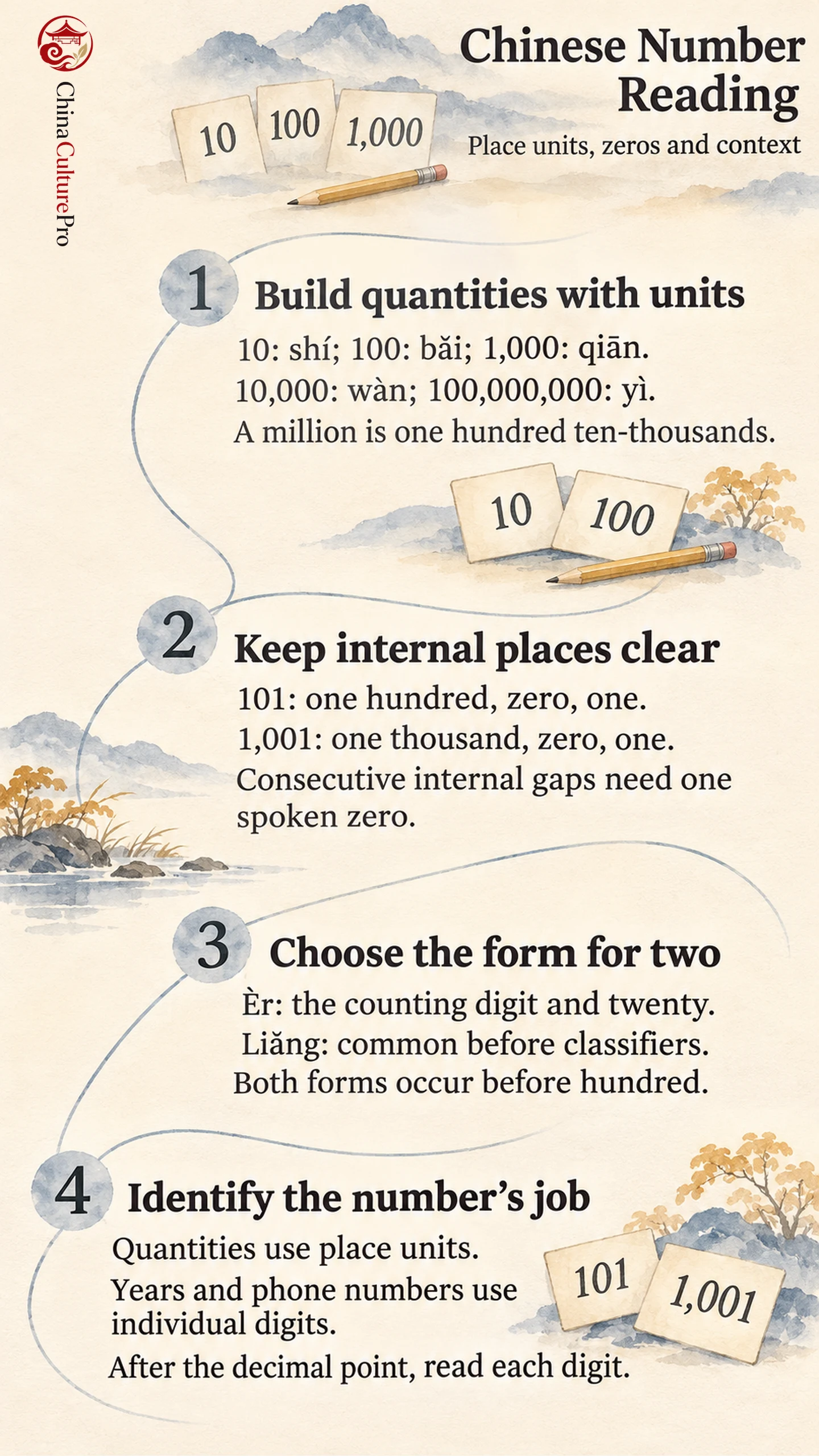
Start with the digits: zero to nine are líng, yī, èr, sān, sì, wǔ, liù, qī, bā and jiǔ. The unit ten (十, shí) builds the next range: 11 is 十一, shí yī, and 23 is 二十三, èr shí sān. [4]
Larger place units include hundred (百, bǎi), thousand (千, qiān), ten thousand (万, wàn) and hundred million (亿, yì). Mandarin builds a million around ten-thousands, rather than using an independent everyday root equivalent to English “million.” [2]
| Value | Full reference form |
|---|---|
| 100 | 一百, yī bǎi |
| 1,000 | 一千, yī qiān |
| 10,000 | 一万, yī wàn |
| 1,000,000 | 一百万, yī bǎi wàn |
For larger figures, work with the wan and yi units explicitly. Do not attach a Mandarin unit to an English three-digit group without checking the resulting value. [2]
Read Internal Zeros Without Losing a Place
Zero (零, líng) marks a missing internal place in a whole-number quantity. Compare 101, 一百零一, yī bǎi líng yī, with 110, 一百一十, yī bǎi yī shí. In 1,001, 一千零一, yī qiān líng yī, the consecutive empty places need only one spoken zero. [1]
Trailing zeros in the full quantity forms shown here are accounted for by the final named unit. Learn the full forms first: 1,100 is 一千一百, yī qiān yī bǎi. Colloquial shortened readings exist, but 1,001 and 1,100 must remain distinct. [1]
When checking an unfamiliar amount, write the Arabic value beside its spoken form. This makes an omitted place visible before it becomes a misunderstanding.
Choose Er or Liang for the Job
Er (二, èr) is the familiar counting digit two. Liang (两, liǎng) commonly expresses two before a classifier: 两本书, liǎng běn shū, means two books. Twenty is 二十, èr shí; it is not formed with liang. [5]
Before larger units, usage needs a narrower explanation than “always er” or “always liang.” Two thousand commonly uses 两千, liǎng qiān; both 二百, èr bǎi, and 两百, liǎng bǎi, occur for two hundred. Learn the whole expression rather than replacing every written 2 with one word. [1]
Switch Between Quantities, Decimals and Digit Strings
The decimal point (点, diǎn) separates the whole-number part from digits read individually: 0.25 is 零点二五, líng diǎn èr wǔ. After the point, the digits two and five are read separately. [5]
| Contexte | Exemple | Reading approach |
|---|---|---|
| Quantity | 2,026 | 两千零二十六, liǎng qiān líng èr shí liù |
| Année | 2026 | 二零二六年, èr líng èr liù nián |
| Telephone digits | 1, 3, 8 | Read each digit; one may be yāo |
Telephone readings in mainland usage commonly use yāo for one. Preserve the digit order, including zeros. The dedicated telephone pronunciation guide covers that narrower task. [3]
For practice, label an example “quantity,” “year,” “decimal” or “identifier” before reading it. Confirm its unit or function, then check the resulting Arabic value. Use pinyin audio study for the sounds; use the written value to check the arithmetic.
FAQs About Chinese Number Reading
Is 2026 read the same way as a year and a quantity?
No. A year uses digit-by-digit reading before the year word. A quantity uses place units. Identify the context before choosing the reading. [3]
Do I pronounce every zero in a whole number?
No. Consecutive internal empty places can take one spoken zero; trailing zeros are represented by the final place unit. This differs from reading a digit string. [1]
Are er and liang freely interchangeable?
No. Their use depends on the expression. Learn counting, classifier phrases and larger-unit quantities separately. Different written styles are addressed in the Chinese numeral forms . [5]
Sources
[1] Tokyo University of Foreign Studies. Chinese Grammar: Saying Numbers
[2] Julian K. Wheatley, MIT OpenCourseWare. Learning Chinese, Unit 8
[3] Julian K. Wheatley, MIT OpenCourseWare. Learning Chinese, Character Lesson 1
[4] The Open University. Beginners’ Chinese: Basic numbers
[5] China Daily, via ECNS. Basic rules to use 二 and 两