
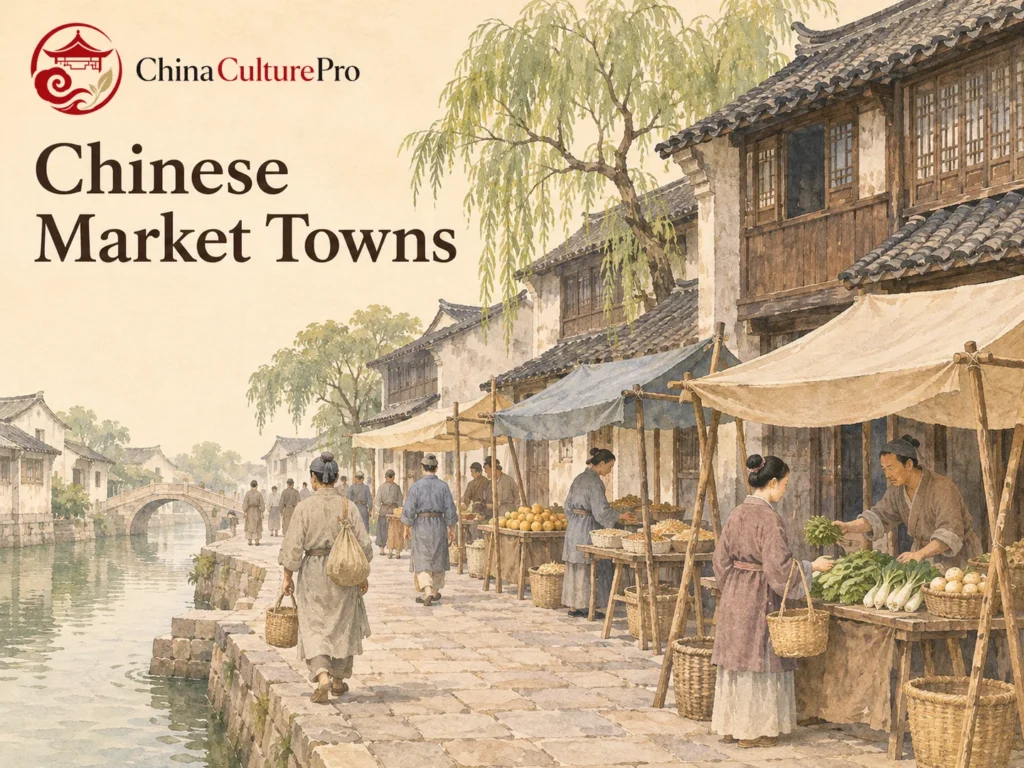

Quick Answer: What Was a Chinese Market Town?
A Chinese market town (市鎮, shìzhèn) was a settlement where people from the surrounding area came to buy, sell and obtain services. Some towns held markets on fixed days. Others supported permanent shops and workshops, or combined regular trading with periodic gatherings. Commercial activity could grow separately from government rank. [1][3][5]
- Schedule: A periodic market brought sellers and buyers together on known days.
- Settlement: A town might have year-round workshops, stores or services beyond market-day stalls.
- Authority: A busy market town did not automatically have its own magistrate or county-level administration. [1][3][5]
Read its market calendar, economic role and official status as separate clues.
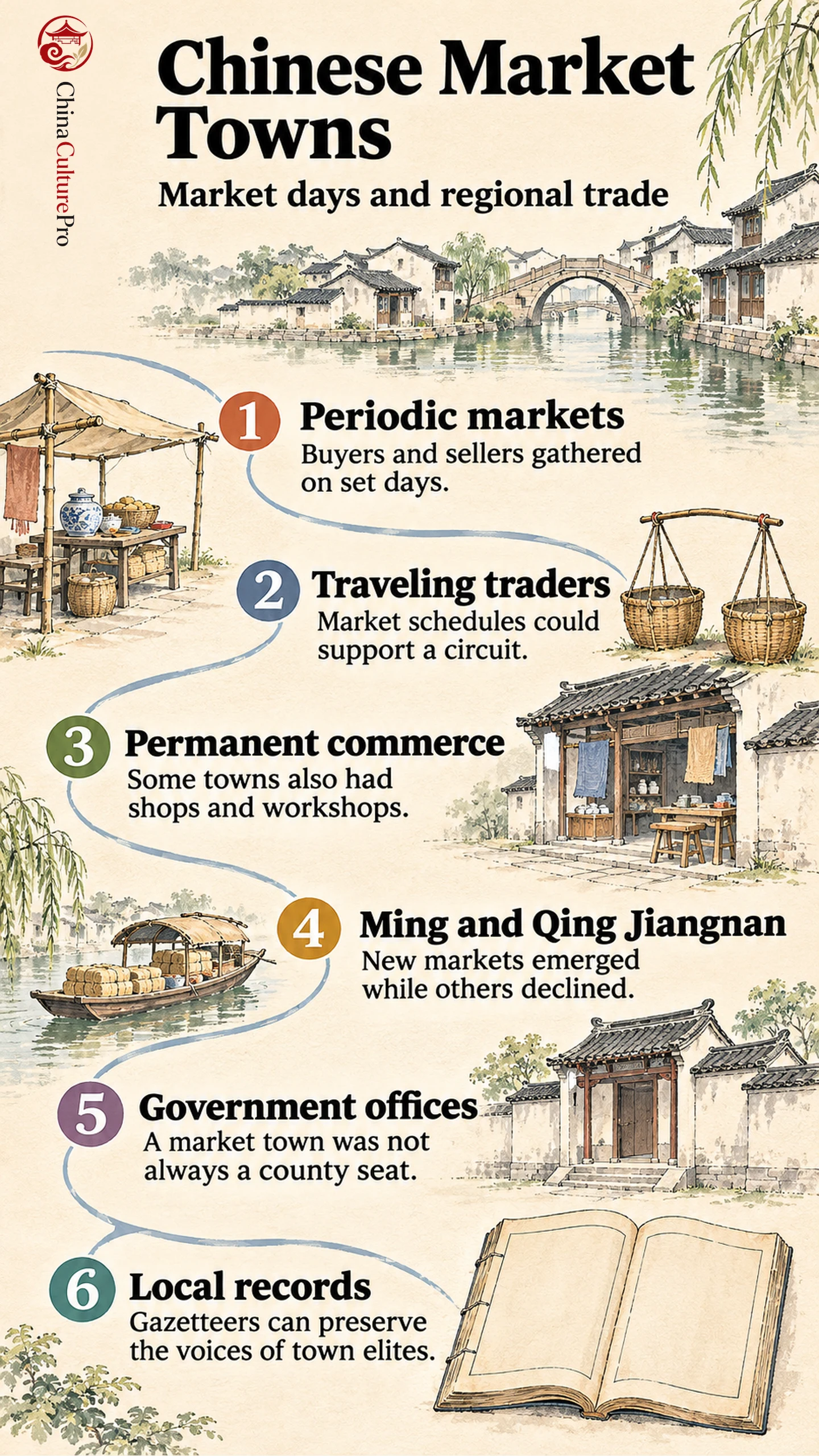
A vendor might spend one day selling in a nearby town and the next carrying the remaining goods to another market. A county official, meanwhile, could administer the whole area from a different place. Trade routes and administrative boundaries give us two different views of the same landscape. [1][5]
How Market Days Connected Towns and Villages
Periodic trading concentrated customers and sellers in one place on a regular schedule. This helped buyers obtain goods for which there might be too little demand to support a full-time seller in each village. It also let traveling merchants move among markets. An artisan could spend time producing goods between market days and then sell directly when customers gathered. [1]
The timing mattered. A 1–4–7 schedule, for example, could mean a market met on the first, fourth and seventh days of each ten-day division. A merchant who wanted to buy at a larger center and sell at a smaller market needed days that allowed both visits. Neighboring markets at the same level could still meet on the same days. A trader might also move between a village-facing market and a larger center where merchants bought or sold in bulk. Market networks could therefore organize social contact and travel as well as exchange. At larger markets, facilities such as historical Chinese inns could support travelers doing business away from home. [1]
A historical comparison of four counties in the Ningbo area counted twenty-six rural markets in 1227 and about 170 during the Guangxu reign, more than six centuries later. Those figures concern the same group of counties as compared in that study. They show expansion in one area, rather than the growth rate of market towns across China. For a separate look at long-distance trade from the region, see Ningbo merchants. [2]
What Ming and Qing Jiangnan Reveals About Market Towns
Jiangnan (江南, Jiāngnán), the lower Yangtze region south of the river, included districts with dense waterways, commerce and handicraft production. Research on the Shanghai–Suzhou area has used population estimates and mapped locations to compare towns over time. Those variables help distinguish a small trading center from a settlement that drew trade from farther away. [3][4][6]
The total number of places can rise even as some older markets disappear. Studies of Ming and Qing Jiangnan find both new centers and places that declined. Counting each town equally can hide changes in scale. A network with more small centers may make trade more accessible without turning every settlement into a large city. [3][4]
Market Town, County Seat and Administrative Town
The place where people traded and the place where the government sat could coincide. But a commercial center’s economic role did not determine its formal rank. Under the Song, some towns had appointed administrative personnel even though they were not county seats. Many market settlements in later Ming and Qing China lacked a permanent official presence of that kind. [5]
Shijing, in the Quanzhou area, illustrates how these roles could change. It became an administrative town in 1130 to oversee two markets engaged in overseas trade. Its Song administrator had powers to maintain order. By the Ming it had lost that standing and came under Jinjiang County’s rural administration. The place’s earlier commercial function did not guarantee an enduring government appointment there. [5]
| Place or institution | Distinguishing feature | Éléments à vérifier |
|---|---|---|
| Periodic market | A gathering held on specified days. [1] | The calendar and settlements it served. |
| Market town | A settlement functioning as a trading center. [3][4] | Scale, market schedule and whether shops were permanent. |
| County seat | The seat of county government, which could also be a market center. [5] | Offices based there and territory under their authority. |
| Song administrative town | A town assigned administrative personnel below the county level. [5] | Which officials served there and which powers they held. |
The duties of Chinese magistrates explain what county-level administration involved, regardless of where trade was busiest.
What Local Gazetteers Tell Us About Market Towns
Local gazetteers (地方志, dìfāngzhì) and anthologies produced in some late Qing and early Republican Jiangnan market towns preserved local names, events and biographies. They could also give editors of county histories material on towns outside the county seat. A town’s appearance in a gazetteer may thus reflect the efforts of people who gathered and supplied records. [6]
Read such a record alongside its date and geographical scope. A later town publication can preserve older information, but the date of publication and the date of the activity it describes belong to different parts of the evidence. Chinese historiography explains why the compiler’s purpose matters. [3][6]
FAQs About Chinese Market Towns
Did Chinese Market Towns Trade Every Day?
Some supported permanent trading, while others depended on periodic gatherings. A market-day schedule does not tell you that all shops closed in between, so check which activity the record is describing. [1][3]
Did Market Towns Always Grow Into Cities?
Many remained small, and some disappeared. Larger centers could develop where commercial traffic and other services supported them, but a market was only one part of a settlement’s growth. [3][4]
How Can We Compare the Number of Markets Across Periods?
Compare the same area and establish what each source counted. A list of periodic markets answers a different question from an estimate of the population of commercial towns. [2][3][4]
Sources
[1] G. William Skinner. Marketing and Social Structure in Rural China, Part I
[2] G. William Skinner. Marketing and Social Structure in Rural China, Part II
[3] I-chun Fan. The Nature of the Expansion of the Jiangnan Market Towns in the Ming-Qing Dynasty
[4] Ta-Chien Chan, Pi-Ling Pai, Shih-Lung Shaw and I-Chun Fan. Spatiotemporal Evolution of Market Towns in the Jiangnan Area During the Ming-Qing Dynasties of China
[5] Yidan Han and Tuan-Hwee Sng. Extending the Reach of State: The Administrative Town in Song China
[6] Seunghyun Han. “We Want to Be Recorded”: Market Town Elites and Town Literature in Late Qing and Early Republican Jiangnan