

Quick Answer: What Is a Chinese Full-Month Celebration?
A Chinese full-month celebration welcomes a baby after the first month of life. It brings relatives and friends into the family’s joy through a meal, a visit or gifts of food, with considerable variation in timing and ceremony.
- Timing: The occasion marks a baby’s first month, rather than a particular full moon in the sky.
- Celebration: A family may host a meal, distribute food or arrange a small gathering.
- Gift exchange: Guests give presents or money; parents may offer eggs, cakes or rice in return.
- Family variation: Haircuts, religious observances and special roles for grandparents belong to particular traditions.
The invitation and the parents’ preferences are the best guide to participating. A large banquet and a complete set of rituals are not prerequisites for welcoming a child.

An invitation might describe a full-month party, a baby’s first-month celebration or a Manyue (满月, mǎnyuè) banquet. Behind those names is a family occasion: people acknowledge the arrival of a child, congratulate the parents and renew relationships through visits and gifts.
Understanding who gives what helps a newcomer more than memorizing a supposed national checklist. A box of food sent by the parents and a present brought by a guest travel in opposite directions, even though both express the same happiness. For the surrounding milestones, see the overview of Chinese baby traditions.
What Manyue Marks and When It Happens
Manyue (满月, mǎnyuè) means the completion of the first month in this context. The same Chinese characters can refer to a full moon elsewhere, which explains the sometimes confusing English wording “full-moon party.” A baby’s birth date, rather than the moon’s phase, gives this celebration its meaning.
| Terme | Meaning here |
|---|---|
| Manyue | The completion of a baby’s first month |
| Full-month banquet | A celebratory meal marking the baby’s first month |
A Hakka cultural guide places the occasion at one month and describes both a banquet and gifts distributed to relatives. This is a cultural milestone, not a statement that the mother’s recovery finishes on a fixed day. The related postpartum confinement tradition has its own history and family expectations.[3]
If you are invited, use the date on the invitation. If you are helping organize the event, ask how the family wants to count the month before printing cards or ordering food. Do not impose a “must be exactly day 30” rule on a family using another convention. A hundred-day gathering is a different milestone, even when some of the food and presents overlap.
How Families Celebrate the Full Month
The full-month banquet, Manyue Jiu (满月酒, mǎnyuè jiǔ), can be a way of introducing the baby to a wider circle. The word for liquor in the name points to the celebratory meal; it does not mean every person must drink alcohol.
The Teochew Federation’s handbook distinguishes older birth rites from present practices. Its full-month account includes family gatherings, gifts from the maternal grandmother, clothing and cash presents. It also records infant hair shaving, making clear that the occasion can bring together several family actions rather than one isolated party.[1]
An account in USC’s folklore archive describes a Chinese family in which friends and relatives brought money or presents and received celebratory eggs. The contributor’s memories of infant loss gave the event particular emotional weight. That is a valuable family testimony, rather than evidence that every household follows the same restrictions or hosts an elaborate feast.[4]
For a guest, the practical distinction is whether the invitation is for a meal, a brief visit or simply a gift exchange. Arrive at the agreed time and let the hosts manage introductions. Receiving a food box does not by itself create an invitation to visit the newborn at home.
Food Gifts and Returning the Kindness
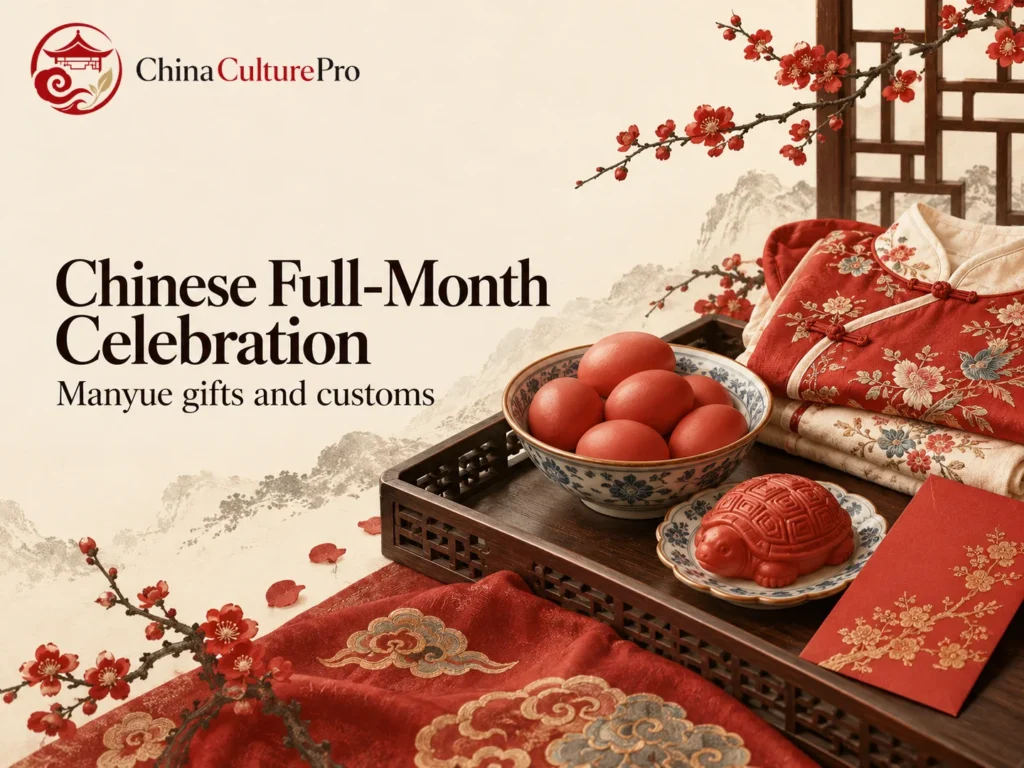
Parents may share the birth announcement through food. Red eggs and ginger celebrations belong to this wider practice, although ginger is not present in every full-month gift package.
In the Hakka guide, modern parents distribute savory rice or cake, while recipients may respond with a red packet or baby supplies. The exchange joins announcement, thanks and congratulations. It should not be read as a price list in which the value of the return must equal the food.[3]
A museum docent’s account of Peranakan customs describes red tortoise cakes being offered at family altars and distributed to relatives and guests. The article also records conflicting conventions for cake shapes associated with boys and girls. A turtle, peach or cone therefore cannot reliably tell an outsider the baby’s gender without local context.[2]
Ask the hosts about ingredients if you have dietary restrictions. Thank them for the gift whether or not you can eat it. Food intended for adult relatives should not be treated as a menu for the newborn; the cultural symbolism concerns the family celebration.
What Guests Can Give and Say
Choose a gift with the parents’ needs and your relationship in mind. The following are options to discuss, rather than a required shopping list:
- A red packet: Ask a trusted relative about local expectations if you are unsure. There is no single amount appropriate to every country, currency and family.
- Practical supplies: Check sizes and preferences before buying clothes or equipment. A requested item is easier for parents to use than an impressive duplicate.
- A keepsake: Confirm that the family wants jewelry or another lasting object. Historic accounts of baby bangles describe gifts, not instructions to leave jewelry on a baby.
- Support for the parents: Offer a specific, convenient form of help, such as arranging a delivery, and let them accept or decline.
Simple congratulations are enough: “We’re so happy to welcome your baby” or “Wishing your family happiness as you begin this new chapter.” There is no need to invent a Chinese phrase or comment on the child’s future wealth, intelligence or appearance.
Before holding the baby, taking photographs or sharing them, ask the parents. These are considerate participation choices, not tests of whether you understand a ritual correctly.
Regional Customs and Family Choices
Maternal relatives have a prominent place in several documented versions. The Hakka guide describes gifts of clothing, shoes, a hat and other items from the mother’s family. The Teochew handbook also gives the maternal grandmother a role. These examples illuminate relationships between the two sides of a family; they do not assign every modern grandmother a duty.[1][3]
Hair cutting and offerings may be important to one household and absent in another. Treat descriptions of older cleansing practices or protective beliefs as cultural history. Their presence in a heritage record does not establish a medical benefit or require parents to reproduce them.
The full-month event also stands apart from the first-birthday Zhuazhou object-grabbing tradition. A family can keep one milestone, combine a gathering with a convenient visit or choose private photographs instead. A recurring theme in Chinese family traditions is the relationship being acknowledged, with the actual observance shaped by the people involved.
FAQs About the Full-Month Celebration
Is Manyue held on the full moon?
No. Here Manyue refers to the baby completing the first month. It does not require a full moon in the sky.
Is a hundred-day party another name for Manyue?
No. One month and one hundred days are different milestones. Families may celebrate either or both, with some similar gifts and foods.
How much money should a guest give?
There is no universal amount. Consider your relationship, local currency, the invitation and family expectations; a trusted relative can offer context.
Does a full-month celebration require a haircut?
No. Hair cutting appears in several documented traditions, but families decide which customs to observe. A meal or a food gift can still mark the occasion.
Sources
[1] Teochew Federation (Singapore). Teochew Traditions, birth and full-month rites, pages 24–25
[2] Friends of the Museums Singapore. PASSAGE, Issue III 2025, Peranakan full-month celebrations
[3] Hakka Affairs Council cultural guide. Baby’s first month: full-month celebration
[4] USC Digital Folklore Archives. Full Month Party, family account recorded in 2013