


Quick Answer: What Are Common Chinese Baby Traditions?
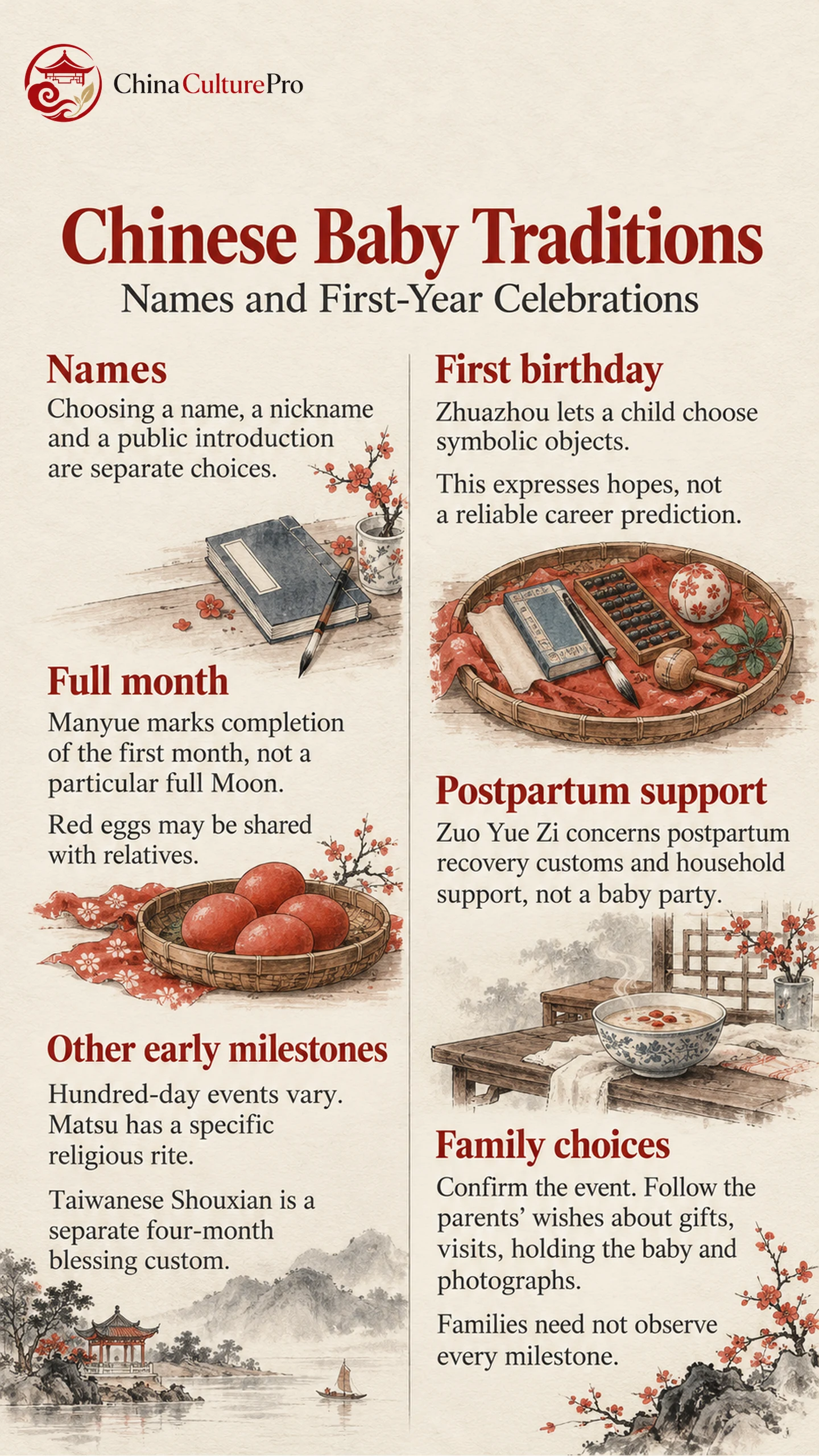
Chinese baby traditions welcome a child through names, family gatherings, symbolic foods and wishes for growth. The best-known examples include a first-month celebration, red eggs and a first-birthday object-grabbing custom, but families choose different combinations.
- Names: A formal name, a family nickname and a public announcement can serve different purposes.
- Early celebrations: One-month, hundred-day and other local milestones are distinct occasions.
- First birthday: Choosing symbolic objects expresses family hopes rather than reliably predicting a career.
- Family support: Visiting and gifts should fit the parents’ wishes and the needs of the household.
These are cultural practices with regional and historical differences, not a required programme for every baby.
An invitation to a baby’s “full month” party can raise several questions: is it a naming ceremony, should guests bring red eggs, and is it the same as a first birthday? Those events can overlap in a family’s celebration, but they mark different moments. Understanding the distinctions makes it easier to join without imposing an unfamiliar ritual.
Naming a Baby and Introducing the Name
Choosing a name and announcing it are separate acts. A family may have selected the name before a gathering, then use the celebration to introduce the baby to a wider circle. A household nickname can also coexist with the name used in formal settings.
One documented Chinese American family account describes the paternal grandfather giving the child a Chinese name at the full-month celebration. It shows how a senior relative can have a meaningful role in one household; it does not establish that every grandfather names the baby or that all families must wait a month.[1]
Parents may consider a character’s meaning, its sound with the surname, a family naming pattern or connections between languages. Such choices express identity and wishes. A name should not be presented as a guarantee of intelligence, health or future success.
For a guest, use the name and pronunciation the parents provide. Ask before choosing Chinese characters or an English nickname on the child’s behalf. The broader Chinese names guide explains naming patterns; a celebration schedule should not be confused with the separate requirements for official registration.
The Full-Month Celebration and Red Eggs
Manyue (满月, mǎnyuè) means celebrating the completion of a baby’s first month. In this context, “full month” is clearer than “full moon”: the event is about the child’s age, not a requirement that the astronomical Moon be full on the party date.
The gathering can introduce the baby to relatives and thank people who have supported the household. In a documented Singaporean family’s celebration in Britain, a small home event and locally prepared red eggs adapted the custom to the relatives and ingredients available.[2] A banquet is one possible form, not a measure of how much a baby is valued.
Red eggs are recognizable birth-celebration foods. Families may distribute them with cakes or other gifts, while regional and diaspora versions use different combinations. The foods are shared with relatives and guests; their presence should not be read as instructions for feeding a newborn.
Some households also keep a small lock of hair or observe a first haircut. These are optional family customs. A keepsake does not require reproducing every older belief about hair, and no ritual should be described as necessary for the baby’s intelligence or growth.
The full-month celebration guide covers the event itself. Red eggs and ginger explains a familiar food-and-gathering tradition without assuming every Chinese family uses ginger.
Hundred-Day and Four-Month Customs
Different milestones should not be merged merely because they celebrate a young baby. Bairi (百日, bǎirì) is a hundred-day milestone, with different local forms of observance. A family gathering at one hundred days is not automatically the same ritual as a religious observance using that date.
In Matsu, a documented hundred-day “passing the gates” rite involves a Daoist specialist and beliefs about protecting the child from difficulties. It is a specific religious custom, not a national requirement or a medical explanation of childhood illness.[3]
Shouxian (收涎, shōuxián) is a Taiwanese four-month blessing custom associated with wiping away drool. A Taipei heritage venue distinguishes it from the first-birthday ceremony and presents the occasions as separate cultural experiences.[4] Its imagery and spoken wishes should not be confused with treatment for a health condition.
Ask which milestone the family is celebrating and what the event means in its own tradition. A hundred days, four months and a year are not interchangeable labels for one Chinese baby party. A family may observe one, several or none of these occasions.
Zhuazhou and the First Birthday
Zhuazhou (抓周, zhuāzhōu) is a first-birthday custom in which a child chooses from symbolic objects. A book or brush can suggest learning, while an abacus can suggest calculation or commerce. The objects turn adult hopes into a playful family scene.[5]
Historical accounts can contain gendered assumptions, with different expectations for boys and girls. They should be explained as features of those accounts rather than repeated as limits on a child’s future. Contemporary families can choose objects representing interests they value without assigning a career from one reach.
The first birthday also differs from traditional age counting that increases at Lunar New Year. Here the milestone concerns the child completing a year of life, even if a family uses a different age number in another context.
If attending, let the parents guide the activity and photograph it only with permission. The dedicated Zhuazhou guide explains objects and their interpretations in more detail; the wider birthday traditions guide covers later celebrations.
Postpartum Customs and Considerate Family Support
Zuo Yue Zi (坐月子, zuò yuè zi), often translated as “doing the month” or postpartum confinement, concerns the mother’s recovery period and household support after birth. It is connected with the context of early baby celebrations, but it is not itself a party for the child.
The museum family account connects the end of the month with welcoming the baby and the mother’s return to ordinary social life.[1] That describes a family’s cultural pattern; it does not set one medical recovery timetable or require everyone to remain indoors until a particular day.
Offer help that the parents actually want. Food, errands, transport or taking care of a practical task can be more useful than an unplanned visit. Ask when they want company, whether to leave a meal at the door and which relatives are coordinating the gathering.
Keep medical decisions separate from inherited explanations about heat, cold, bathing or special foods. Parents can discuss recovery and infant care with their healthcare team while choosing the family practices they find meaningful. The Zuo Yue Zi guide focuses on the history and customs behind the term.
Gifts, Visits and Modern Family Choices
A gift is a way to welcome the child and support the household, not an entrance fee for a ceremony. Ask the parents whether they prefer something practical, a keepsake, a contribution or no gifts. A family may welcome red envelopes, but there is no universal amount a guest must give.
- Confirm the invitation: Check the actual event, date and location rather than counting days yourself.
- Follow the parents’ lead: Ask before holding the baby, bringing extra visitors or organizing photographs.
- Keep wishes open: Celebrate the child’s growth without predicting gender roles, personality or career.
- Make adaptations clear: A smaller meal, a later gathering or a video call can still carry a family welcome.
Language, religion, migration and available relatives all shape the form. What links these choices is the act of recognizing a new family member and caring for the people around the baby. The broader Chinese family traditions place that welcome within relationships that continue long after the first year.
FAQs About Chinese Baby Traditions
Does a Chinese baby have to wait a month to receive a name?
No. A public introduction may occur at a first-month gathering, but choosing the name, using a nickname and completing official registration are separate matters. Families follow different naming patterns.
Is a full-month celebration the same as a full-moon festival?
No. The baby celebration marks completion of the first month of life. It is not a festival tied to a particular full Moon.
Must every family hold all the baby milestones?
No. Naming gatherings, full-month parties, hundred-day events, four-month customs and first birthdays are distinct options. The family decides which, if any, to observe.
Does Zhuazhou predict a child’s future career?
It is a symbolic object-choosing custom, not a reliable career test. Families can enjoy the scene as a playful expression of hopes while leaving the child’s future open.
Sources
[1] Historical Society of Pennsylvania, Balch Institute exhibition. “Doing the Month” and the “Full Month” Party: Chinese Birth Traditions in America
[2] Eileen. Chinese Baby First / Full Month Celebration
[3] National Cultural Memory Bank, Taiwan. 百日關
[4] Lin An Tai Historical House and Museum. 新生兒抓週、收涎祝福禮民俗體驗
[5] Taiwan Historica. 臺灣民俗文物辭典:抓周