


Quick Answer: What Is Chinese Five Spice?
Chinese five spice, or wuxiang fen (五香粉, wǔxiāngfěn), is an aromatic ground spice blend used in Chinese cooking. Star anise, cinnamon, fennel seed, cloves and Sichuan pepper form a familiar reference combination, but packaged blends do not all follow it.[1][2]
- Flavor: Usually warm and fragrant, often with an anise-like or licorice-like character.
- Variation: Different products may replace or add spices, changing both aroma and pepperiness.
- Uses: It can season meat, marinades, braises and selected sweet preparations.
- Identity: It is a blend, unlike the single spice called allspice.
Five spice is not automatically chili-hot, salty or sugary. The name is a useful starting point; the actual ingredient list and the dish determine the result.
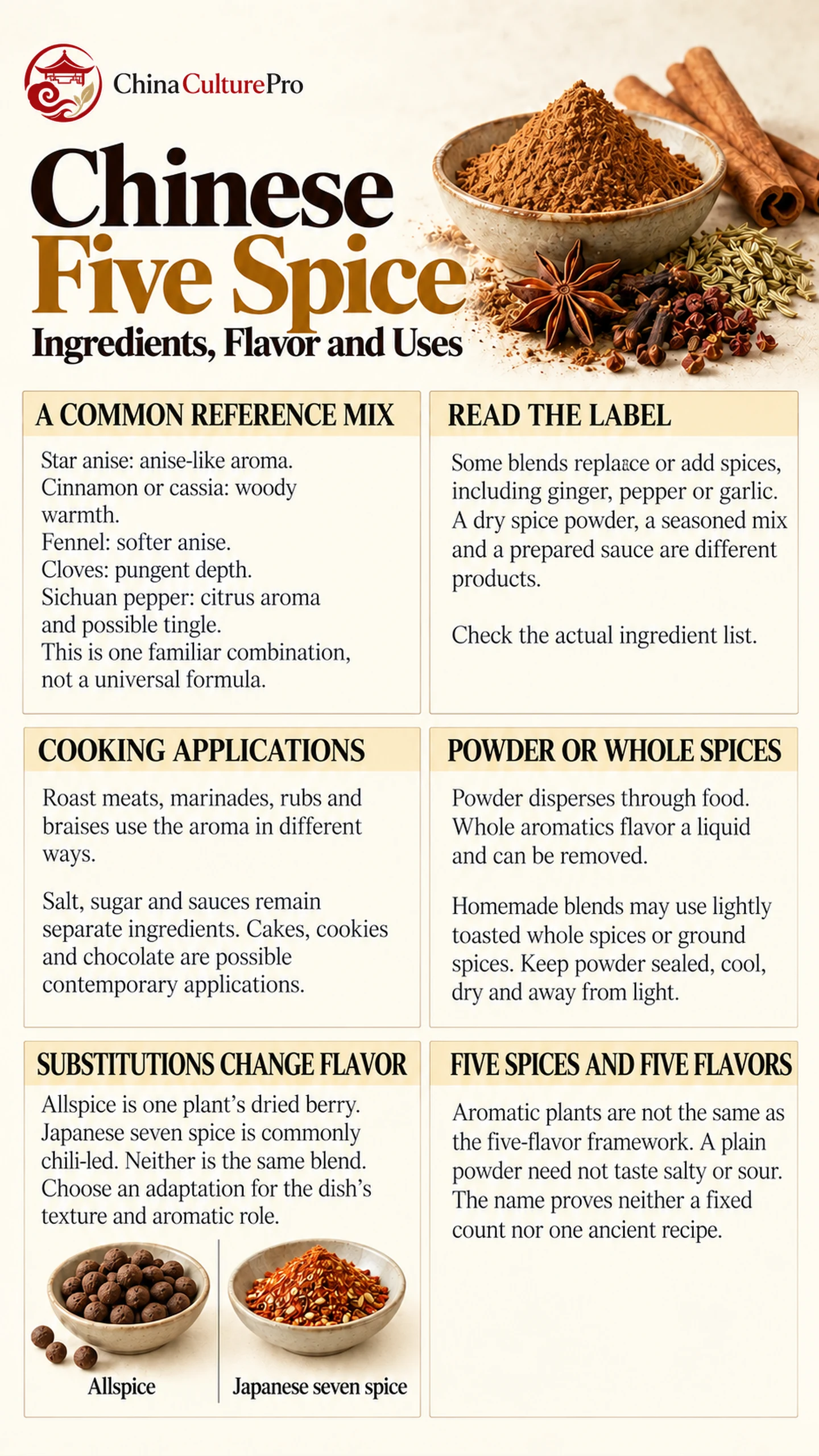
A small amount of fragrant brown powder can give roast meat an anise-like aroma or make a sauce taste warmer. Understanding the ingredients is more useful than treating every jar as the same flavor. This guide separates a familiar blend from the many versions sold under its name.
Five Common Spices and Their Roles
The following combination appears in commercial specifications and home-cooking formulas. It is a useful reference for understanding the blend, rather than a rule that every maker must obey.[1][4]
- Sichuan peppercorns provide a different sensation from ordinary black pepper. A blend without them should not be expected to produce the same tingle.
- Sweet-smelling spices do not necessarily mean sugar was added. Aroma, sweetness from sugar and chili heat are separate features of the finished food.
| Spice | Typical contribution | What changes if it dominates |
|---|---|---|
| Star anise | A clear anise or licorice-like aroma | The blend can become strongly anise-led. |
| Cinnamon or cassia | Warm, woody fragrance | The result may lean toward a familiar baking-spice aroma. |
| Fennel seed | A softer anise-like note | It reinforces the blend’s sweet-smelling character. |
| Cloves | Deep, pungent warmth | A little can become a prominent part of the smell. |
| Sichuan pepper | Citrus-like aroma and possible tingle | Its effect depends on inclusion, quantity and freshness. |
Why Five-Spice Labels Do Not All Match
Direct product labels show the variation clearly. Some list the familiar fennel-and-Sichuan-pepper combination; others use anise, cinnamon, star anise, clove and ginger. Seasonings sold under the five-spice name may include additional ingredients such as black pepper or garlic.[1][2][3]
These differences affect the dish. A ginger-led or black-pepper-containing blend is not an identical replacement for one with a pronounced Sichuan-pepper note. Ingredient order and the manufacturer’s description help explain what you are buying, although they do not reveal every proportion.
Check whether you are buying pure ground spices, a seasoned blend or a prepared sauce flavored with five spice. A sauce can also contain sugar, salt, soy ingredients or other components. Its name does not make it a jar of dry powder, and the same quantity will not necessarily perform the same job.
Using Five Spice in Savory and Sweet Food
Five-spice powder can contribute an aromatic layer to roast pork, chicken, duck and other meat preparations. It appears in versions of char siu and other roast-meat dishes, but that does not mean every recipe for those dishes uses a pre-mixed powder.[4]
- In a marinade or rub, the spice is part of a larger seasoning system. Salt, sugar, sauces and cooking fat still need their own consideration.
- In a braise, the aroma mingles with the cooking liquid and the ingredients. A strongly flavored blend should not be added simply because the liquid looks pale.
- In sweet food, anise, cinnamon, cloves or ginger can work with cakes, cookies and chocolate. This is a useful contemporary application, distinct from claiming that every Chinese dessert traditionally contains five spice.[2]
Ground Powder and Whole-Spice Aromatics
Powder disperses through a rub, sauce or filling. Whole star anise, cinnamon bark and other whole aromatics can instead flavor a cooking liquid and be removed afterward. Both approaches can produce fragrant food, but they differ in texture and how evenly the spices remain in the dish.
For a homemade powder, a cook may use whole spices, pre-ground spices or a mixture. Light dry-toasting of whole spices before grinding is one established approach. Freshness and grind matter; the goal is a usable powder, not a mixture full of hard woody fragments.[4]
A lu shui braising liquid may use whole aromatics rather than a ready-made five-spice powder. Treat that as a distinct cooking system, with its own ingredient balance. Store dry powder tightly closed, cool and dry, away from direct light, and follow its label rather than applying one shelf-life number to every blend.[1]
Five Spice, Allspice and Other Substitutes
Allspice is the dried berry of a single plant. Its aroma can suggest cinnamon, nutmeg and cloves, which helps explain the confusing English name, but it does not contain a complete Chinese five-spice mixture.[5]
Japanese seven-spice seasonings are another different category. A common commercial version is chili-led and includes ingredients such as citrus peel, sesame and seaweed. It is not simply five spice with two more ingredients.[6]
Choose a substitution by the role you need. A whole aromatic can suit a braising liquid; a prepared powder may be more convenient in a rub. Replacing the entire blend with cinnamon or allspice creates an adaptation with a different aroma. There is no universal spoon-for-spoon substitute that guarantees the same result in every dish.
What the Name Can and Cannot Tell You
The Chinese name refers to a fragrant powder. Modern ingredient lists show why the number alone cannot identify a package’s exact composition.[1][2][3]
The Chinese five flavors are a broader cultural framework for discussing taste. They should not be confused with a list of five aromatic plants. A plain spice blend does not have to supply noticeable sourness or saltiness by itself.
For understanding Chinese food culture, the useful tradition is the way cooks combine aromatics with a dish’s other seasonings. That is more informative than assuming a fixed ancient inventor, a universal recipe or a guaranteed balance of every taste.
FAQs About Chinese Five Spice
Does Five Spice Always Contain Five Ingredients?
No. Five is part of the established name, while actual blends differ. Check the package for its specific spices and any additional seasoning ingredients.
Is Five Spice the Same as Allspice?
No. Five spice is a blend of several spices. Allspice is one plant’s dried berry, with its own warm aroma.
Is Chinese Five Spice Hot?
It is usually aromatic and warming rather than chili-hot. Pepperiness or tingle depends on the ingredients; a prepared five-spice sauce can include other sources of heat.
Can You Make a Five-Spice Blend at Home?
Yes. Whole or ground spices can be combined into a powder. Choose an established formula that suits the dish, and remember that changing the spices changes the result.
Sources
[1] Spices Inc.. Chinese Five Spice Product Specification
[2] McCormick. Chinese Five Spice Blend
[3] Schwartz. Chinese 5 Spice Seasoning
[4] Kaitlin Leung. How to Make Five Spice Powder
[5] McCormick. Allspice
[6] S&B Foods. Assorted Chili Pepper