


Quick Answer: What Is a Paiban?
A paiban (拍板, pāibǎn) is a Chinese clapper made from flat slats, usually wood, held together by a cord at one end. The slats hit one another to make a short, dry click. In Peking opera the percussion leader plays the clapper. In a southern Fujian vocal tradition the singer can play it.[1][2][3]
- Material: Hardwood is common, with rarer historical examples in ivory.[1][2]
- Sound: Each click has a clear beginning and fades quickly.[1][2]
- Role: The click can mark the beat against a sustained sung note.[2][3]
The number of slats and the person who plays them depend on the performance tradition.[1][2][3][4]
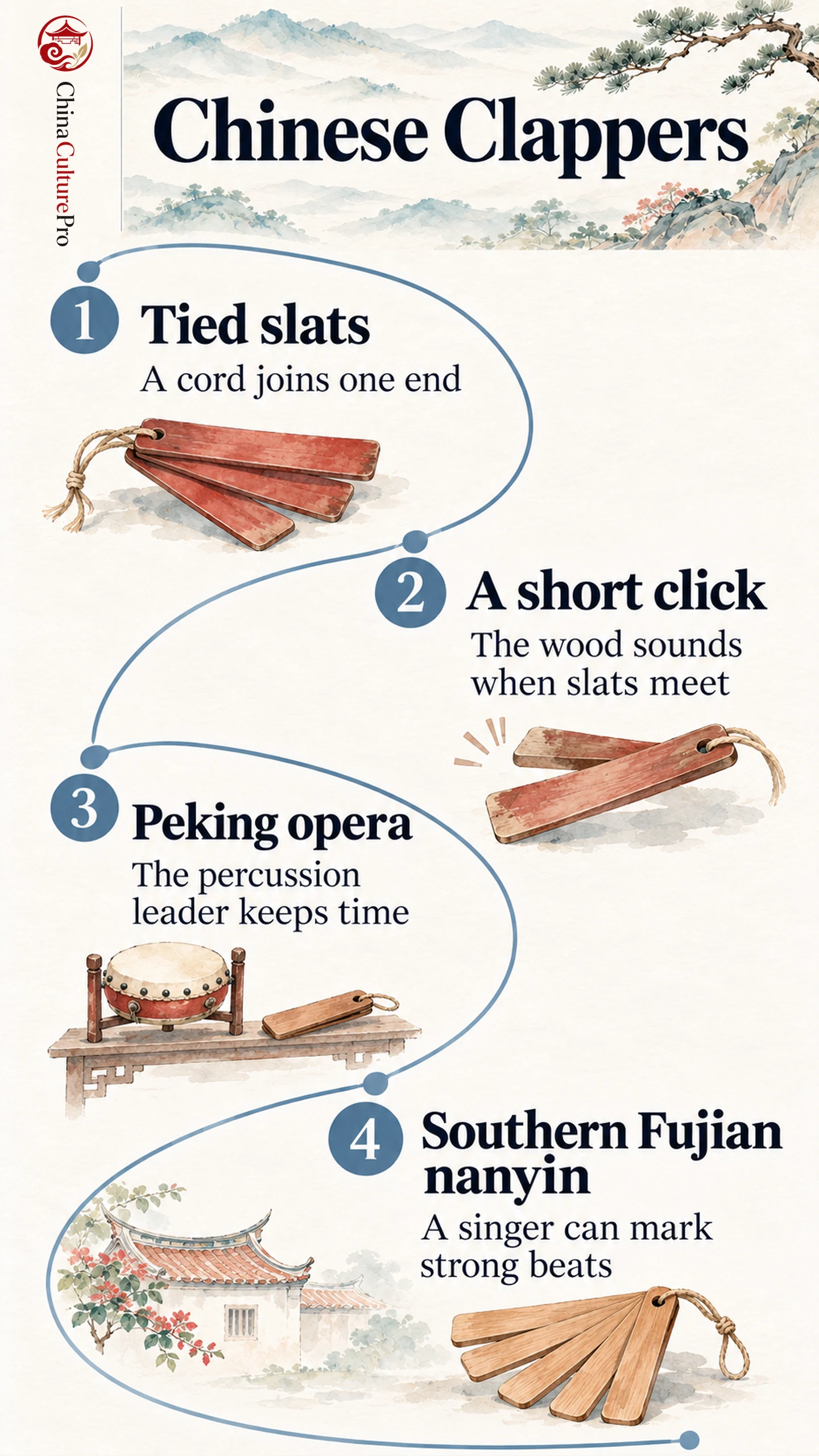
The sound of a clapper can be quieter than a gong and still be easy to hear. Its short attack marks a point in time while a singer or fiddle may be sustaining a note.
How Tied Slats Make a Click
In a common design, a cord holds the slats at one end and leaves the other ends free to move. When the slats meet, the hard surfaces make the click. Museums classify the instrument as a concussion idiophone, meaning that the pieces of material sound by hitting each other.[1][5]
A wooden paiban at the Metropolitan Museum of Art, object 89.4.2948, dates to about 1875 to 1889 and measures 25.4 centimeters long. A separate early fifteenth-century Ming object is a carved ivory section with traces of red pigment. The ivory fragment preserves one slat. The traces of pigment show that its surviving pale surface once carried color.[1][5]
The wooden slats are also worth comparing with Chinese woodblock percussion, where a player strikes a separate wooden body with a beater.
Three Boards in Peking Opera
The China National Peking Opera Company describes its ban (板, bǎn) as three boards grouped into two parts. Two boards are tied tightly together and the third moves against them. The percussionist holds the clapper in the left hand. Its sharp sound helps mark the beat during singing.[2]
The same musician also plays the bangu drum. The drum can signal an entry or add a short roll. The wooden clapper gives the percussionist a separate way to mark the sung beat. When you listen to Peking opera percussion, a short wooden click can be picked out against the brighter tap of a stick on hide.[2]
Five Slats in Southern Fujian Nanyin
In nanyin (南音, nányīn), a musical tradition of southern Fujian and Minnan communities overseas, a singer can accompany a ballad with clappers. UNESCO describes singing in the Quanzhou dialect. A SOAS field study documents five wooden slats in a Minnan example and describes how a singer uses the clapper to punctuate strong beats.[3][4]
A performer marking their own phrase creates a different relationship between voice and click from an opera percussionist marking time for an actor. A close view of the nanyin singer’s hands can show the point in the phrase where the slats meet.[2][3][4]
FAQs About Paiban
Does a paiban always have three boards?
The Peking opera company describes three boards for its clapper. A Minnan nanyin example has five. The Met gives a broader range of two to six for typical wooden examples.[1][2][4]
How does a paiban differ from a woodblock?
A paiban sounds when one slat hits another. A woodblock is a separate body struck with a beater.
Sources
[1] The Metropolitan Museum of Art. Section of a Clapper, Object 2003.166
[2] China National Peking Opera Company. The Instruments of Peking Opera
[3] UNESCO Intangible Cultural Heritage. Nanyin
[4] Sau-Ping Cloris Lim, SOAS University of London. Nanyin Musical Culture in Southern Fujian
[5] The Metropolitan Museum of Art. Paiban, Object 89.4.2948