

Quick Answer: What Is Huaisu’s Autobiography?
Autobiography (自叙帖, Zì Xù Tiè) is a long calligraphic work associated with the Tang monk Huaisu (怀素, Huái Sù). Its wild cursive (狂草, Kuáng Cǎo) combines flowing movement with changes of spacing and scale.
- Main object: The ink-on-paper scroll in the National Palace Museum, Taipei.
- Text: An account of learning and artistic recognition that includes other people’s praise.
- Viewing: Compare connected lines, compact forms, open intervals and isolated dots.
- Date: The text bears 777; the surviving object’s material history raises further questions.
Keep the composition, the present ink scroll and its later reproductions distinct.

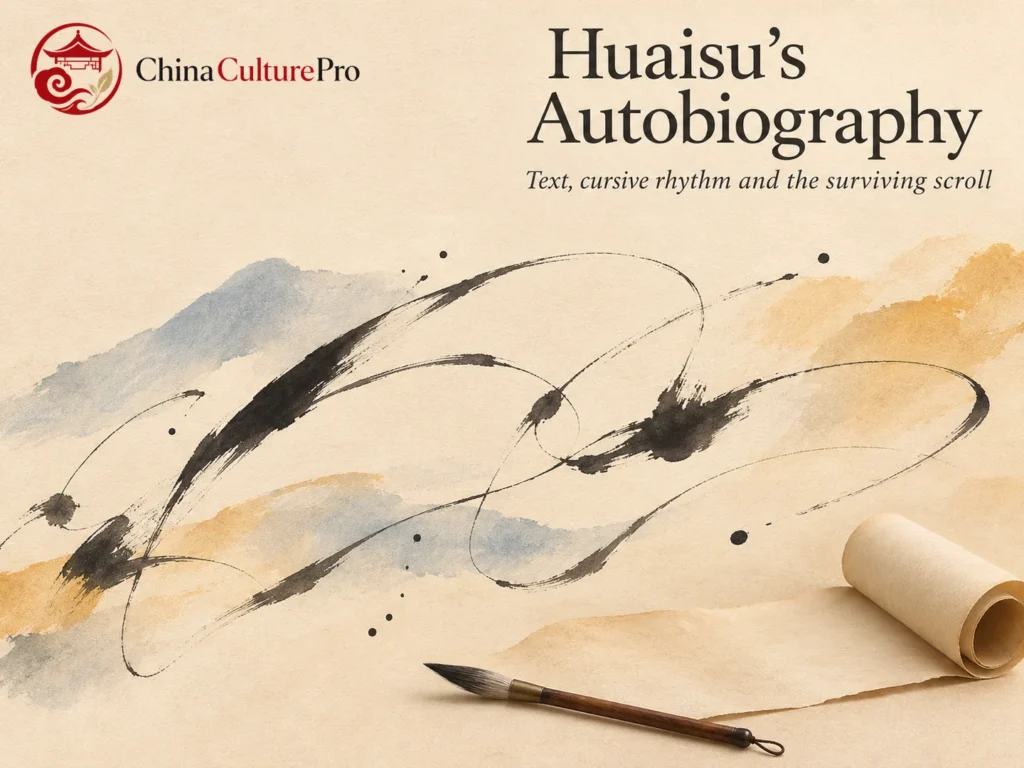
Long curves run into compact knots of ink, then give way to lighter, more open forms. The writing remains organized in vertical columns, but the size and spacing of individual characters vary. A viewer can begin with those visible relationships before attempting to decipher every word.
The title invites another kind of attention. This is a statement about an artistic life, yet much of its language preserves the responses of others. Use a transcription for the words and the image for their changing shapes and placement.
Identify the Taipei Scroll and Its Inscribed Date
The main ink section measures 28.3 × 755 cm, according to the museum’s collection record. Its identifier is 故書000062. The date written at the end corresponds to 777. Later prefatory material, mounting sections and appended comments have separately recorded dimensions; they are not all included in the 755 cm measurement. [1]
The scroll-format guide explains the horizontal handscroll convention. Here, the written columns are read from top to bottom, progressing from right to left. A complete digital panorama and a legible local section serve different purposes: one reveals the larger organization, while the other lets you study the marks.
The museum traditionally catalogues the work under Huaisu and the Tang date. The Tang dynasty guide provides historical background. Questions about the authorship and transmission of the surviving ink scroll belong to a further investigation, discussed below.
Read a Self-Portrait Built from Other People’s Praise
The opening describes a monk devoted to brushwork who seeks access to earlier masters and contemporary connoisseurs. The composition then incorporates a preface associated with Yan Zhenqing (颜真卿, Yán Zhēn Qīng) and verses praising Huaisu’s calligraphy. Their imagery evokes natural forces, energetic movement and extraordinary artistic ability. [1]
This arrangement makes the title less like a modern chronological memoir. Huaisu’s learning and reputation emerge partly through the voices he selects. Praise becomes evidence of recognition within a literary and artistic community.
For the senior calligrapher’s wider place in the tradition, see Yan Zhenqing. The Chinese Buddhism guide supplies context for Huaisu’s monastic identity; this composition concerns calligraphic achievement rather than serving as a Buddhist scripture.
The extravagant comparisons should be read as literary praise. They help explain how admirers presented the art, but they do not measure the writer’s speed or provide a clinical account of his state of mind. Separate what the text says about brilliance from what the surviving marks allow you to observe.
Follow the Cursive Line, Spacing and Pauses
Cursive script (草书, Cǎo Shū) transforms and abbreviates character structures through established writing conventions. In the inspected sections of this scroll, some forms extend into broad loops, while others contract around closely joined turns. A long descending stroke can occupy space that a neighboring character leaves open.
The cursive-script guide explains why these forms can be difficult to read. The broader guide to calligraphy styles helps distinguish cursive from regular and running writing.
The museum describes a fine brush producing large characters, with rounded, forceful strokes and dots that punctuate the flow. Dots and breaks interrupt the connecting strokes. [2]
In a close view, compare the amount of paper enclosed by a loop with the ink concentrated at a junction. Then look between columns. Some spaces remain broad; others narrow as a stroke projects sideways. These variations make the arrangement dynamic without dissolving the vertical reading structure.
- Connection: Find where a narrow line carries the eye toward the next form.
- Compression: Compare a tightly gathered character with a more expansive neighbor.
- Pause: Notice a detached dot or a clear break between strokes.
- Scale: Step back and compare several columns rather than one isolated shape.
The guide to reading calligraphy develops this combination of visual orientation and textual support. A transcription can clarify the words, but matching it to the cursive image still requires attention to the actual forms.
The brush guide adds material context. From a digital image, describe changes in line and spacing before inferring an exact brush movement, writing duration or sequence of ink loading.
Distinguish the Ink Scroll from Copies and Rubbings
The surviving object has prompted debate about autograph status, copying and the relationship between the main writing and later additions. A 2004 museum examination addressed these questions through paper, mounting, repairs, seals and microscopic or transmitted-light photography. Its author argued that accumulated material changes and natural transitions in ink resisted an explanation as a single, mechanically traced fabrication. That argument should be understood as a specific scholarly position. [3]
It does not turn an ordinary reproduction into a reliable authentication tool. The inscribed date, evidence of old collecting and the date of each surviving component are related questions, but they are not interchangeable.
Later transmission also changed the medium. Research on one rubbing documents its restoration and annotation as a thread-bound book by a Qing collector. Such a rubbing belongs to the work’s reception history; it is not the same physical object as the Taipei ink handscroll. [4]
The copybooks guide explains how models circulate through copies and rubbings. The guide to inscriptions and seals addresses another layer of evidence. Label each comparison with its medium, collection and section before interpreting a difference in the writing.
FAQs About Huaisu’s Autobiography
Does Autobiography mean a complete account of Huaisu’s life?
No. The composition focuses on calligraphic learning and recognition, incorporating praise from others rather than providing a complete life chronology.
Is the date 777 the end of the authenticity discussion?
No. It is the date carried by the composition. Attribution, repairs and transmission of the surviving scroll remain separate subjects of research.
Can a viewer appreciate it without reading cursive Chinese?
Yes. Compare line, spacing and scale, then use a reliable transcription or translation for the text. Visual attention and linguistic reading complement one another.
Sources
[1] National Palace Museum. Huaisu, Autobiography: digital collection record
[2] National Palace Museum. Autobiography: selected masterpiece
[3] Ho Chuan-hsing, National Palace Museum. Let the Ink Speak: The Actual Condition of Huaisu’s Autobiography, Palace Museum Monthly 259 (2004), pages 4–15
[4] Liu Yi-hsuan, National Palace Museum. Shen Mingyi and the Shuijingtang Rubbing of Huaisu’s Autobiography in His Collection, Research Quarterly 41:3 (2024)