
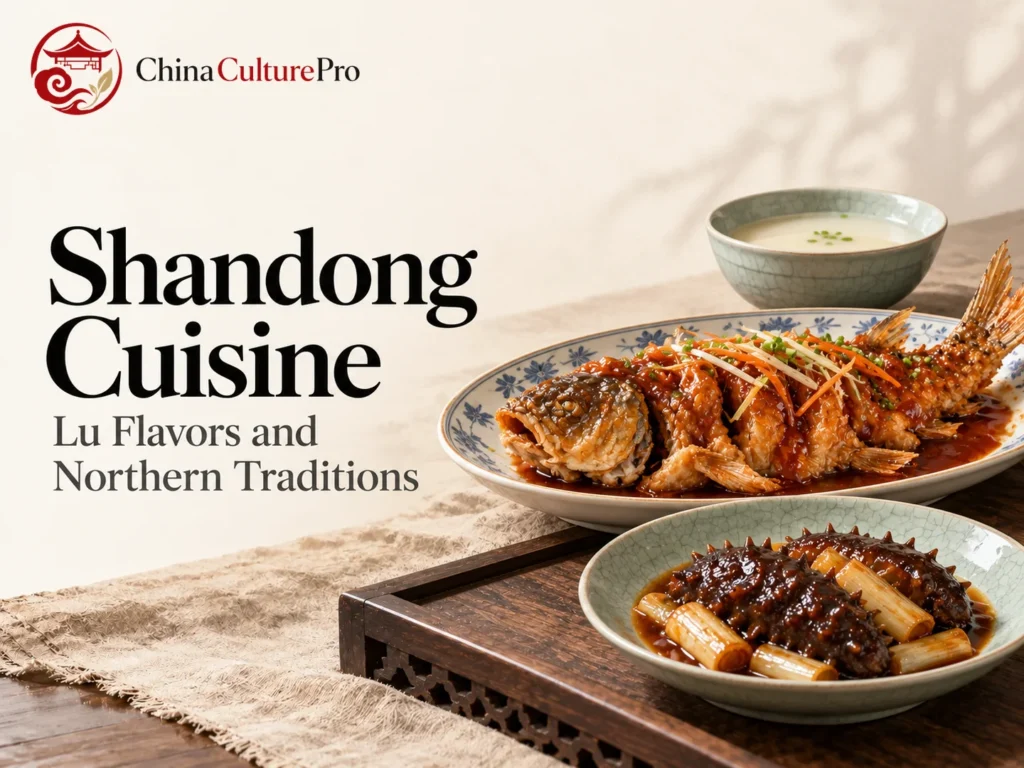

Quick Answer: What Is Shandong Cuisine?
Shandong cuisine, also called Lu cuisine or Lu cai (鲁菜, lǔ cài), is the cooking tradition of Shandong province in northern coastal China. It is one of the Eight Great Cuisines.[1]
- Flavor: Savory depth and aromatic seasonings are prominent, with sweet-sour dishes also part of the repertoire.
- Ingredients: Seafood, freshwater fish, meat and vegetables appear in different local styles.
- Craft: Stocks, precise cutting, quick cooking and braising create contrasting textures.
- Local traditions: Jinan, Jiaodong, Qufu’s Kong family cooking and Boshan offer different perspectives.
Lu cuisine includes everyday meals as well as formal banquets. It is neither uniformly spicy nor limited to expensive seafood, and one famous dish cannot represent the entire province.
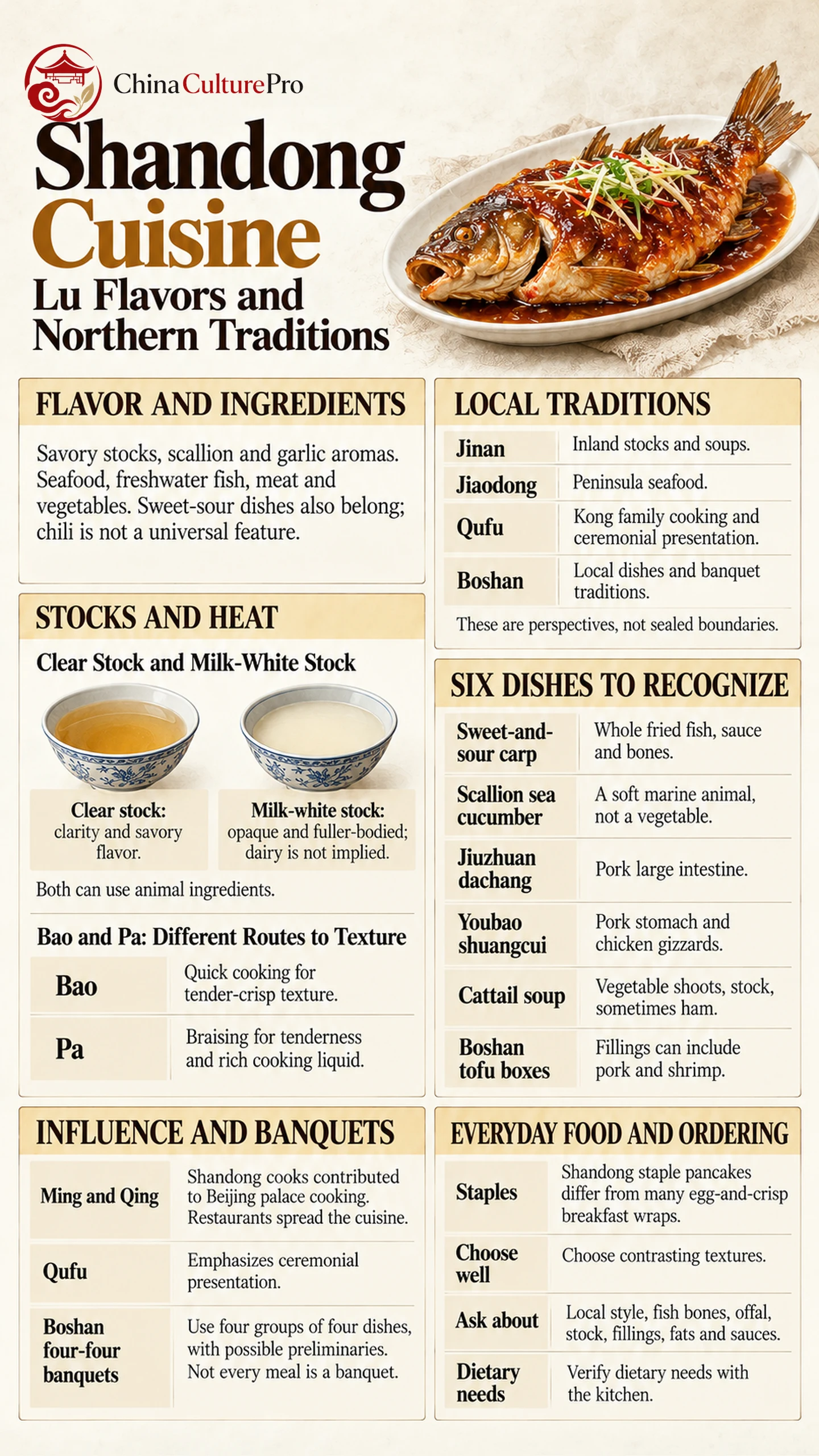
A clear soup, a tender seafood braise and a crisp-textured stir-fry can all express Shandong cooking. Stocks, scallion aroma and deliberately contrasting textures connect these dishes. To understand its place in Chinese food, look at local styles, stocks and the texture each dish aims to achieve.
Flavor and Ingredients: More Than Salty Northern Food
Savory flavor is a better starting point than “very salty.” Scallions and garlic are familiar aromatics, and stocks add flavor to ingredients and sauces. Some dishes are delicate; others have a richer coating. Sweetness and vinegar also appear, particularly in sweet-sour preparations.[1][4]
Shandong’s peninsula and inland areas supply different ingredients. Coastal kitchens are known for seafood, while rivers and lakes contribute freshwater fish. Meat and vegetables matter too. This range helps explain why a seafood meal around Yantai or Qingdao can feel different from a meal built around Jinan’s soups and meat dishes.[2]
Scallions can be cooked as a substantial aromatic ingredient rather than sprinkled on as a final garnish. In a classic sea-cucumber preparation, their cooked fragrance is part of the dish’s identity.[5] Follow the preparation on the menu: a brown sauce alone cannot tell you how salty, sweet or strongly seasoned the dish will be.
Regional Traditions Within Lu Cuisine
Jinan and Jiaodong are commonly described as two major strands. Kong family and Boshan traditions add other useful perspectives. These names do not form an exhaustive set of sealed boundaries; dishes and cooking skills circulate between them.[2]
| Tradition | Geographic setting | Useful focus |
|---|---|---|
| Jinan | The provincial capital and nearby inland areas | Stocks, soups and varied quick-cooked or braised dishes |
| Jiaodong | The eastern peninsula, including Yantai, Weihai and Qingdao | Seafood and attention to the ingredient’s texture |
| Kong family cooking | Qufu | Refined dishes, serving vessels and ceremonial banquet presentation |
| Boshan | Zibo | Local dishes and an established banquet tradition |
A place name is therefore a useful question to ask a restaurant: which local repertoire does its menu emphasize? Use it to ask about the kitchen’s specialties. The wider picture of Chinese regional cuisines includes both these smaller traditions and broader regional groupings.
Stocks and Heat: Two Sides of Shandong Cooking
Clear Stock and Milk-White Stock
Qing tang (清汤, qīng tāng) is clear stock valued for its clarity and savory flavor. Nai tang (奶汤, nǎi tāng) is milk-white stock with an opaque appearance and a fuller body. Cooking and clarification produce the difference between the two stocks.[3]
“Milk” describes the white stock’s appearance; dairy is not implied. Clear stock can also contain chicken, duck or pork. These stocks may season vegetables and braises as well as soups.[3]
Bao and Pa: Different Routes to Texture
Bao (爆, bào) is a quick-cooking technique associated with precise heat control and tender-crisp results. Pa (扒, pá) is a braising technique associated with a rich cooking liquid, tender ingredients and an orderly finished presentation. They aim for different textures rather than competing to be the one defining method of Lu cuisine.[4]
A crisp-textured dish depends on cutting and cooking suited to its ingredients; a braise gives a different kind of tenderness. Neither method literally seals flavor or moisture inside food. Lu cooking also uses steaming, frying and other methods, so recognizing two important terms should make the menu easier to read rather than narrow the cuisine to two techniques.
Six Classic Dishes to Recognize on a Lu Menu
These examples show different ingredients and textures. They are a recognition guide, not a ranking or a menu that must be ordered in full.
| Plat | Description | À observer |
|---|---|---|
| Sweet-and-sour carp (糖醋鲤鱼, tángcù lǐyú) | Whole carp fried and dressed with sweet-sour sauce | The contrast between a crisp surface, tender flesh and sauce; the fish still has bones.[11] |
| Scallion-braised sea cucumber (葱烧海参, cōngshāo hǎishēn) | Sea cucumber cooked with aromatic scallions and seasoning | Soft, yielding texture with some elasticity. Sea cucumber is a marine animal, not a cucumber vegetable.[5] |
| Jiuzhuan dachang (九转大肠, jiǔzhuǎn dàcháng) | A Jinan dish of prepared pork large intestine | A coated, richly seasoned dish with several flavor notes, including sweetness and sourness.[3][7] |
| Youbao shuangcui (油爆双脆, yóubào shuāngcuì) | Quick-cooked pork stomach and chicken gizzards | “Double crisp” describes the two ingredients’ tender-crisp bite, not a breadcrumb coating.[6] |
| Cattail shoots in milk-white soup (奶汤蒲菜, nǎitāng púcài) | A Jinan soup featuring tender cattail shoots | The vegetable and the stock work together; traditional versions may include ham and animal stock.[3] |
| Boshan tofu boxes (博山豆腐箱, Bóshān dòufuxiāng) | Tofu shaped to hold a filling and served with a sauce or topping | A tofu exterior does not reveal the filling: documented versions include pork and shrimp.[8] |
Names can hide important ingredient information. Ask about the animal ingredients in a stock or filling rather than assuming that “tofu,” “vegetable” or an unfamiliar poetic name describes the whole dish.
Northern Influence and Banquet Traditions
During the Ming and Qing dynasties, Shandong cooks contributed to palace cooking in Beijing. Shandong-style restaurants also helped spread their dishes. Stocks, seafood skills and banquet traditions became part of a wider culinary exchange, helping explain Lu cuisine’s lasting northern influence.[4]
That exchange did not erase local identities. Compare the carved meat and pancake serving of Canard laqué de Pékin with a Lu meal centered on stocks and contrasting dishes. Shared northern connections do not make the two meals identical.
Banquets show another dimension. Qufu’s Kong family tradition gives attention to food, vessels, presentation and dining ceremony. Boshan’s “four-four banquet” organizes a meal around four groups of four dishes, with additional preliminaries possible. These are particular traditions, not rules requiring every Shandong household or restaurant meal to follow one ceremonial format.[9][10]
Everyday Staples and Ordering a Shandong Meal
Formal seafood dishes and banquets are only part of the picture. Shandong’s jianbing can be a staple pancake eaten with scallions and other accompaniments, rather than the egg-and-crisp-filled breakfast wrap familiar from many city stalls. Grain foods deserve a place beside the famous plated dishes.[8]
The broader family of Chinese bing and flatbreads helps explain those differences in form. At a Lu restaurant, choose the staple separately from the dishes you plan to share; a famous dish list does not tell you whether a particular meal comes with rice, pancakes or another accompaniment.
- Choose a contrast: A soup or braise, a crisp-textured dish and a vegetable can show different skills without turning dinner into a banquet.
- Check the serving form: Ask about fish bones, whole portions and unfamiliar cuts such as intestine or stomach.
- Ask about seasonings: Clarify chili, sweetness and saltiness. Sauce soja may be one component, not the complete sauce.
- Explain restrictions: For vegetarian meals or allergies, verify stock, filling, cooking fat, sauce and shared preparation, not just the dish’s headline ingredient.
Use Chinese dining customs as a guide to sharing. A simple meal can reveal the cuisine’s texture and seasoning just as clearly as a formal sequence of courses.
FAQs About Shandong Cuisine
Are Shandong Cuisine and Lu Cuisine the Same?
Yes. Lu cuisine and Lu cai are established names for Shandong’s culinary tradition. The names cover several local styles rather than one recipe or a single city’s menu.
Is Shandong Food Always Spicy?
No. Savory stocks and aromatic ingredients are prominent, and some dishes are sweet-sour. Chili use varies by preparation; ask about the dish instead of assuming every northern meal is either hot or mild.
Does Milk-White Soup Contain Dairy?
Not necessarily. The name can describe a stock’s opaque white appearance. It also does not certify a soup as dairy-free. Confirm the kitchen’s ingredients when dairy avoidance matters.
Can Shandong Food Be Vegetarian?
Vegetarian dishes can be available, but vegetable and tofu dishes may contain meat stock, ham, seafood or an animal-based filling. Ask about the complete preparation rather than relying on its name.
Sources
[1] Qingdao Vocational and Technical College of Hotel Management. Cuisine du Shandong
[2] Dazhong Daily, via Shandong Publicity. Explore Shandong Through Confucius and Qilu Culture
[3] Shandong Gazetteer, archived text. Jinan Cuisine
[4] Dazhong Daily, via Shandong Publicity. Tracing Culinary Heritage in a Lu Cuisine Museum
[5] Fushan District Culture and Tourism Bureau. Fushan Noodles and Scallion Sea Cucumber Join Shandong’s Heritage Food List
[6] Office of Chinese Local Chronicles, National Gazetteers Museum. Youbao Shuangcui
[7] Ministry of Agriculture and Rural Affairs. One Hundred Rural Foods
[8] Zibo Culture and Tourism Bureau. Which Shandong Food Is Your Favorite?
[9] Jining Culture and Tourism Bureau. Kong Family Cuisine Cooking Skills
[10] Zibo Municipal Bureau of Commerce. Boshan Four-Four Banquet
[11] Tai’an Agriculture and Rural Affairs Bureau. Dongping Lake Carp and Culinary Development