

Quick Answer: What Is a Chinese Jaw Harp?
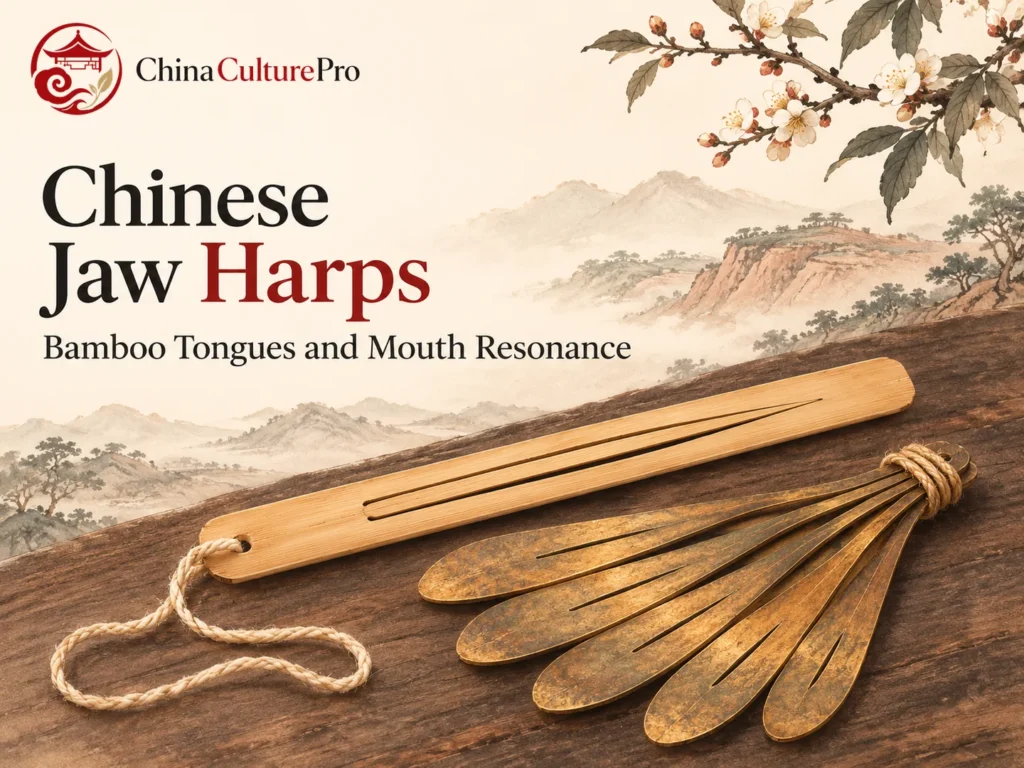
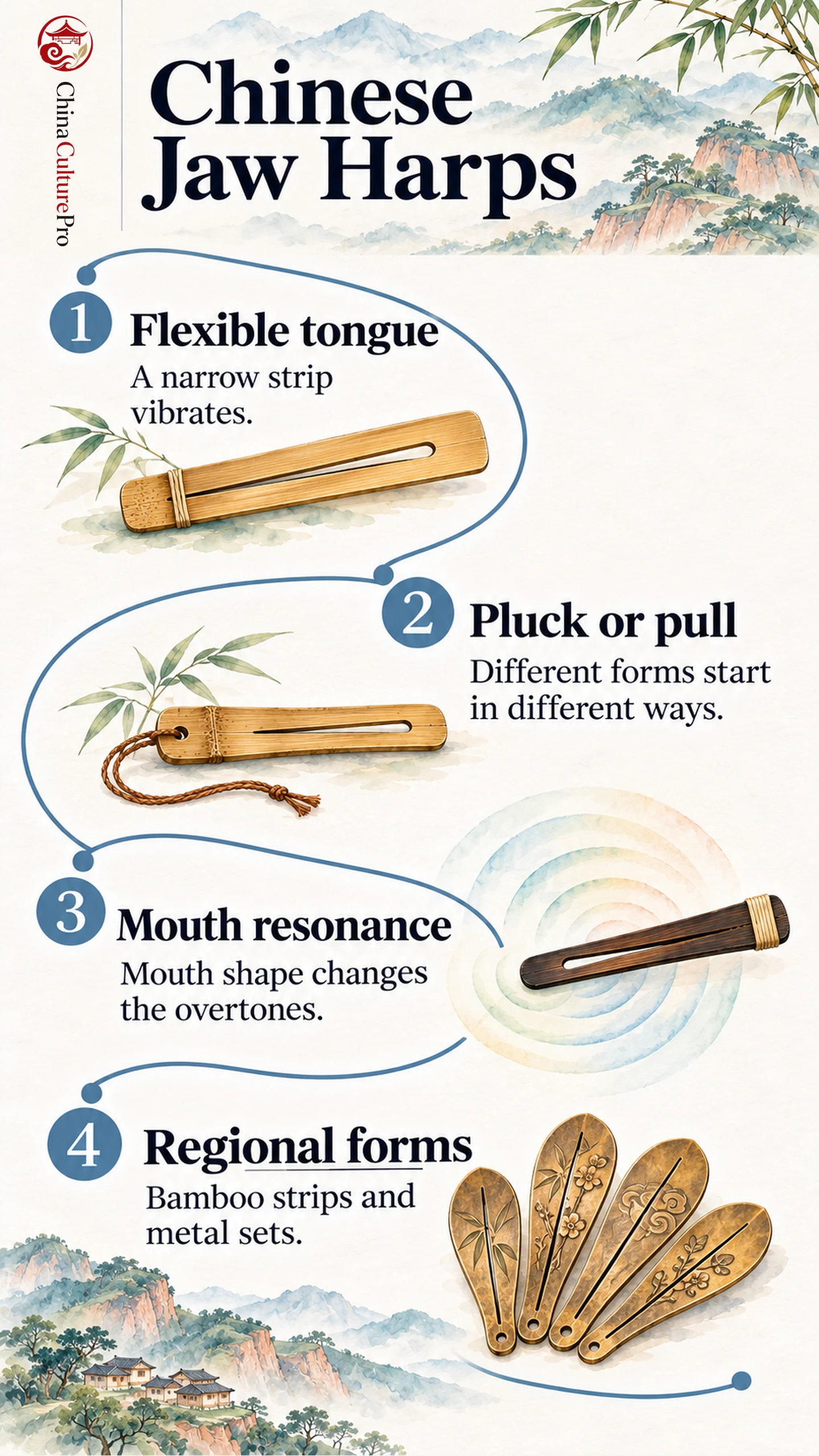
A Chinese jaw harp, often called kouxian (口弦, kǒuxián), has a thin tongue that vibrates beside the player’s mouth. A player can set it moving by plucking it or, on some forms, pulling a cord. Changes in the shape of the mouth emphasize different parts of the sound.[1][2][3]
- Materials: Bamboo and copper-alloy tongues are documented.[1][3]
- Sound: A steady buzz can carry changing overtones.[3]
- Forms: Examples include a single bamboo strip and sets of differently pitched tongues.[1][2][3]
The method of setting the tongue in motion depends on the local instrument.[1][2][3]
A jaw harp can make a phrase that seems to speak. Much of that effect comes from changing the shape of the mouth while a tongue continues to vibrate.[3]
What Vibrates and What the Mouth Changes
In a flat bamboo jaw harp, the tongue is cut into a strip so that its free end can move. A finger flick or pull on a cord starts the vibration, depending on the construction. As the player’s mouth shape changes, the mouth can emphasize different overtones already present in the buzz. Changing the mouth shape can bring a different overtone forward without changing the tongue’s basic pitch.[1][2][3]
A small tongue also vibrates in the bawu and hulusi. In those instruments blown air starts the reed, and the tube and finger holes help determine pitch. In the jaw harps described here, the player’s hand starts the tongue moving.[1][2][3]
Yi and Qiang Instruments in Sichuan
The national intangible heritage entry for Butuo County describes the Yi jaw harp locally called leguo. It describes bamboo strips shaped like narrow blades and copper-alloy pieces shaped like leaves. The documented bamboo examples are around 15 centimeters long. The metal ones are around 8 centimeters. A player can use several tongues in a set. Each has its own basic pitch. The Smithsonian’s National Museum of Natural History also holds an Yi mouth harp from Sichuan that entered its collection in 1929.[1][4]
A separate national entry describes a Qiang bamboo instrument activated by pulling a cord. That action makes the tongue vibrate while the instrument is held near the lips. In a photograph, the cord can be a better clue to the playing mechanism than the outline of the strip.[2]
Hear Two Naxi Forms in One Recording
Smithsonian Folkways documents Naxi performer He Jinhua playing a plucked jaw harp on track 15 and a string-activated one on track 16 of the same collection. The notes describe a single bamboo strip with a cut tongue on the string-activated instrument. A loop of string helps hold it in place while a pull at the other end makes it sound.[3]
The liner notes also document the use of the instrument to imitate aspects of speech in some Naxi settings, including courtship. Compare the pace of the two tracks and listen for the way different overtones stand out within a sustained buzz. The player can shape accents and speech-like inflections without adding strings or finger holes.[3]
FAQs About Chinese Jaw Harps
Is a jaw harp played by blowing into it?
The examples here start with a pluck or a pull on a string. The player’s mouth acts as a resonating chamber and shapes the sound.[1][2][3]
Can a jaw harp have more than one basic pitch?
Some sets contain several tongues. In documented Butuo examples, individual tongues have different pitches.[1]
Sources
[1] China Intangible Cultural Heritage Digital Museum. Yi Jaw Harp Music in Butuo
[2] China Intangible Cultural Heritage Digital Museum. Qiang Jaw Harp Music
[3] Smithsonian Folkways. Naxi Jaw Harp Recording Notes
[4] Smithsonian National Museum of Natural History. Yi Mouth Harp