

Quick Answer: What Was the May Thirtieth Movement?
The May Thirtieth Movement (五卅运动, Wǔsà Yùndòng) was a wave of strikes, protests and boycotts that followed police shootings in Shanghai on May 30, 1925. Police in the foreign-administered International Settlement fired on Chinese demonstrators. Workers, students and businesses organized a general stoppage, and protests spread beyond Shanghai. [1][2][3][4][7]
- May 15: A Chinese worker was fatally shot at a Japanese-owned cotton mill.
- May 30: Settlement police fired on a crowd near a police station on Nanjing Road.
- June: Workers struck, students boycotted classes and shops closed. [1][2][3][4][5]
The shooting gave the movement its name. The wider campaign took different forms in different cities. [1][7][9]
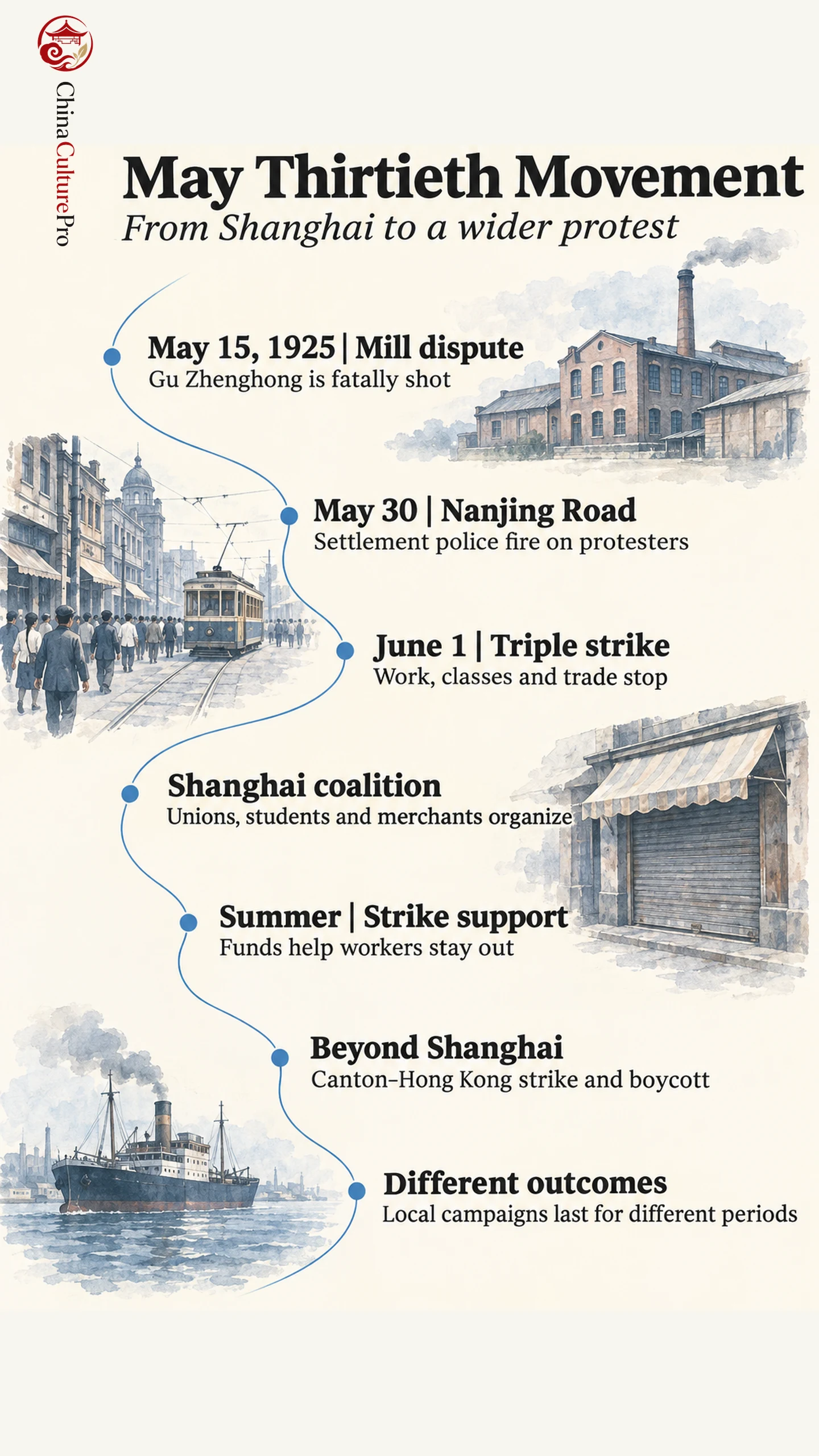
A work stoppage, a boycott of classes and closed shops put pressure on different institutions. For a time, people who used all three tactics could make common demands of the authorities in Shanghai.
Why a Mill Dispute Became a Street Protest
Workers at Japanese-owned cotton mills had already been striking over wages and working conditions. On May 15 a confrontation at the No. 7 mill led to the fatal shooting of worker Gu Zhenghong (顾正红, Gù Zhènghóng). Students spoke in support of workers and protested the treatment of people arrested in connection with the disputes. [1][2][5]
The Shanghai Municipal Council administered the International Settlement and ran its police. Its proposed rules on publishing and wharf charges angered groups with interests beyond the mills. The proposed charges gave merchants their own reason to oppose the Council. They could join a protest that had already drawn workers and students into the streets. [1][2][9]
What Happened on May 30 in Shanghai
On May 30, students and workers distributed leaflets and gave speeches inside the Settlement. Police arrested some demonstrators and took them to Laozha Police Station (老闸捕房, Lǎozhá Bǔfáng), called Louza in a contemporary U.S. report. A crowd gathered outside the station on Nanjing Road. The station’s senior officer, Inspector Everson, ordered the police to open fire. [1][2]
The U.S. consul’s telegram the following day defended the police response. An international inquiry later heard evidence and produced reports that differed in how they assigned responsibility. Two judges blamed the strikers and protesters. The third also assigned some responsibility to foreign residents. No Chinese judge sat on the commission. [2][6]
How the Triple Strike Was Organized
On June 1 the movement took the form of a triple strike. Workers stopped work, students stayed away from class and businesses closed. The Shanghai General Labor Union (上海总工会, Shànghǎi Zǒnggōnghuì) publicly formed that day. Communist organizers helped coordinate the strike, while students and commercial associations acted through their own networks. [1][3][4][5][9]
The coalition called for punishment of those responsible for the shootings and compensation for victims. Demands also addressed rights to organize and Chinese participation in the Settlement’s affairs. The Chinese Chamber of Commerce helped finance strike pay. Foremen and labor contractors helped distribute it to workers who had stopped earning wages. [3][4][5]
The same groups did not share all priorities. The June 3 U.S. telegram describes commercial leaders seeking an early settlement even as shops closed and a bankers’ association demanded compensation. Elizabeth Perry finds that support for the strike fund weakened over time. By late August the labor union moved to end the general stoppage in Shanghai. [3][5][9]
How the Protest Spread and What Lasted
News of the shootings inspired action elsewhere. In southern China the Canton–Hong Kong strike (省港大罢工, Shěng-Gǎng Dà Bàgōng) combined a walkout in Hong Kong with a boycott in the Guangzhou area. It lasted from June 1925 into October 1926. The Hong Kong stoppage targeted work in the British colony, while the boycott targeted goods imported through it. [4][7]
Local outcomes also varied. In Shanghai, a dispute over mourning the victims prompted students and faculty to leave St. John’s University and establish Guanghua University. For organized labor, Perry identifies recognition of the Shanghai General Labor Union as a lasting gain of a settlement that offered workers limited immediate concessions. [5][8]
FAQs About the May Thirtieth Movement
Was the May Thirtieth Movement the same as the May Fourth Movement?
The May Fourth Movement began in 1919 over the Paris peace settlement. May Thirtieth began in Shanghai in 1925 after a labor dispute and police shootings. In Shanghai, political parties had a more prominent role in the 1925 movement. [1][9]
How many people were killed on May 30, 1925?
Counts depend on the source and what it included. An early U.S. telegram reported three deaths at the scene and six more by the night of May 30. Historian S. A. Smith counts twelve deaths across the day’s shootings. One figure came from an early report. The other uses a wider accounting of the day. [1][2]
Did the Shanghai general strike last as long as the Canton–Hong Kong strike?
The Shanghai labor union moved to end the general stoppage by late August 1925. The related Canton–Hong Kong strike and boycott continued into October 1926. [5][7]
Sources
[1] S. A. Smith. The May Thirtieth Movement, 1925, in Like Cattle and Horses
[2] Edwin S. Cunningham, reproduced by the U.S. Office of the Historian. Shanghai Consul General’s Telegram, May 31, 1925
[3] Edwin S. Cunningham, reproduced by the U.S. Office of the Historian. Shanghai Consul General’s Telegram, June 3, 1925
[4] National Museum of China. Shanghai General Labor Union Meeting Records and Draft Documents from the May Thirtieth Movement
[5] Elizabeth J. Perry. The Anyuan Strike of 1922: Lessons in Leadership, in Proletarian China
[6] Johns Hopkins University Libraries, Special Collections. Chinese May Thirtieth Incident Collection
[7] Maggie Clinton. Revolutionary Nativism: Fascism and Culture in China, 1925–1937
[8] Elizabeth J. Perry. Managing Student Protest in Republican China: Yenching and St. John’s Compared
[9] Elizabeth J. Perry. Popular Protest in Shanghai, 1919–1927