


Quick Answer: What Does the Cai Surname Mean?
Cai(蔡,Cài)is a Chinese surname whose best-known origin account connects it with the ancient state of Cai. Its family-name use is more useful than a single English translation.
- Character: 蔡 is used in both simplified and traditional Chinese; the Mandarin surname has a fourth tone.
- Origin tradition: The principal account follows a Zhou-period ruling house and the adoption of its state’s name.
- Name variants: Tsai, Chua and Choy can represent the same character in different naming records.
A shared character establishes a surname connection, not a complete genealogy linking everyone who bears it. [1]
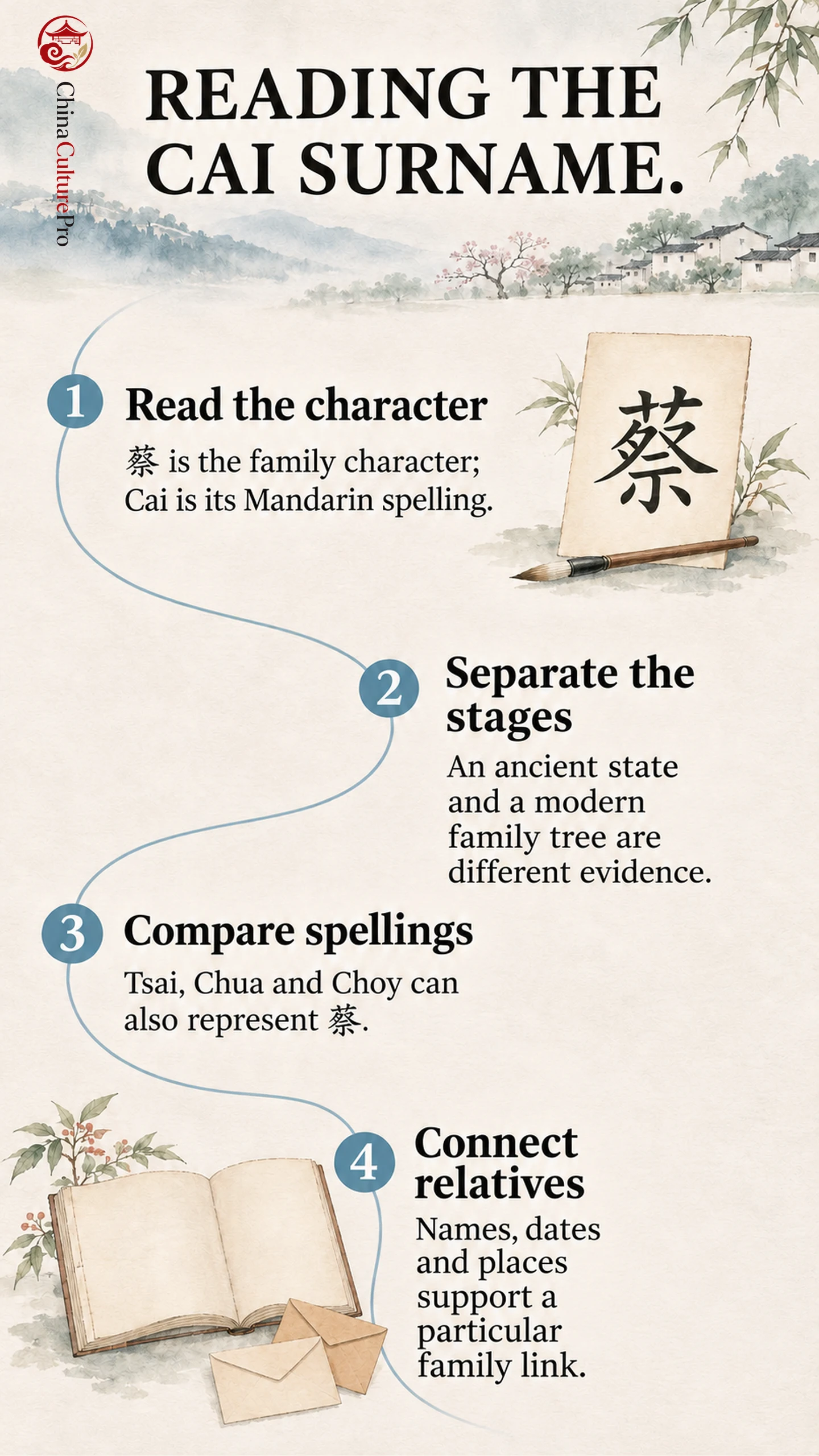
A name written as Cai, Tsai or Chua can look quite different on an English-language page while retaining the same Chinese surname. For readers of Chinese surnames, the useful starting point is the character: it connects pronunciation, historical accounts and personal spelling without making them interchangeable kinds of evidence.
Reading 蔡: Pronunciation and Character Meanings
The Mandarin reading is cài, with a falling fourth tone. The spelling Cai without a tone mark is normal in many English-language names; the marked form helps explain pronunciation rather than prescribing how someone must write a passport name.
Older dictionary senses include wild grass and a large tortoise, alongside the ancient state and surname. Those senses belong to the character’s lexical history. They do not mean that a Cai person’s name describes grass, a tortoise or a personal quality. The similar-looking 菜, the everyday word for vegetables or dishes, is a different character. [2]
This distinction matters when an English surname website offers a one-word “meaning.” A dictionary can explain uses of a written character; explaining how a family acquired that character requires historical or genealogical evidence. Translating one old sense does not supply that evidence.
The State of Cai and the Received Origin Account
The received account in the Records of the Grand Historian separates Cai Shudu(蔡叔度,Cài Shūdù)from his son, Cai Zhong(蔡仲,Cài Zhòng). The first was a brother of the Zhou king who conquered Shang and received a grant at Cai. After joining a rebellion against the Zhou regency, he was exiled. His son, whose personal name was Hu, was subsequently granted Cai and became known as Cai Zhong. [3]
These are two stages in a political narrative: an initial grant and a restoration through the next generation. Treating the two figures as alternative spellings of one founder loses the event that distinguishes them. Equally, calling the whole episode the moment when every modern Cai family began compresses a ruling house, a state and a later surname into one event.
The state’s subsequent history was not a straight succession in one unchanged place. The same chapter describes its destruction and restoration under pressure from Chu before a final conquest. A modern local-history compilation dates that final annexation to 447 BCE and gives the familiar explanation that descendants adopted the state name. It also records other origin traditions and later surname adoptions. [4]
The ancient narrative explains the political setting invoked by the principal surname tradition. It does not list the intervening generations between a Zhou ruler and a particular modern household. A family may preserve that ancestry in its own tradition, but the continuous connection must be evaluated through its records rather than inferred from the character alone.
Cai, Tsai, Chua and Choy in Written Records
Roman letters can preserve different systems and regional naming practices. An indexing reference associates the following forms with 蔡; it is a guide to possible matches rather than proof that two entries identify the same person. [5]
| Written form | What it helps identify |
|---|---|
| Cai | The modern Mandarin pinyin form, usually printed without its tone mark in a personal name. |
| Ts’ai or Tsai | A Wade–Giles form and a familiar spelling with the apostrophe omitted. |
| Chua | An attested alternative to compare against the original Chinese character. |
| Choy | Another attested form; the person’s language and documents establish its context. |
The index also lists Cai Lun(蔡伦,Cài Lún), the historical figure associated with papermaking and its attribution. A famous bearer demonstrates a use of the name; fame supplies no genealogical link to an unrelated household.
For a fuller explanation of why spellings persist across borders, see Chinese names in Taiwan, Hong Kong and the diaspora. Preserve a person’s established spelling when referring to them, even when discussing its pinyin equivalent.
Recognizing a Surname Without Inventing a Family Tree
When comparing two records, ask separate questions. Does each give 蔡? Do the given names, relatives, dates and locations fit the same person or family? The first question identifies a possible surname match; the remaining details can support a particular relationship.
A lineage account that starts with an ancient ruler and a household register that names a parent serve different purposes. Read the first for its account of family identity, and the second for the connection it actually records. Chinese family genealogy provides the wider context for clan books and family trees.
Record both the original characters and each document’s spelling. This preserves the evidence needed to interpret a later change rather than silently rewriting every earlier entry as Cai. The distinction between family and given names in Chinese naming traditions also helps prevent a name element from being assigned the wrong role.
FAQs About Cai Surname
Are Cai and Tsai the same surname?
They can both represent 蔡. Confirm the Chinese character and retain the spelling used by the person concerned.
Does Cai mean vegetable?
The surname is 蔡; the familiar character 菜 means vegetables or dishes. They are different characters despite sharing a Mandarin pronunciation.
Are all Cai families descended from one ancestor?
The shared surname does not establish that. A specific claim of common descent needs evidence linking the families and generations involved.
Sources
[1] Ministry of Education. Concise Mandarin Dictionary: 蔡
[2] Ministry of Education. Revised Mandarin Dictionary: 蔡
[3] Sima Qian. Records of the Grand Historian, chapter 35: Houses of Guan and Cai
[4] Changzhou Local Chronicles Office. Origins of the Cai surname
[5] The Indexer. The hundred surnames: a Pinyin index