
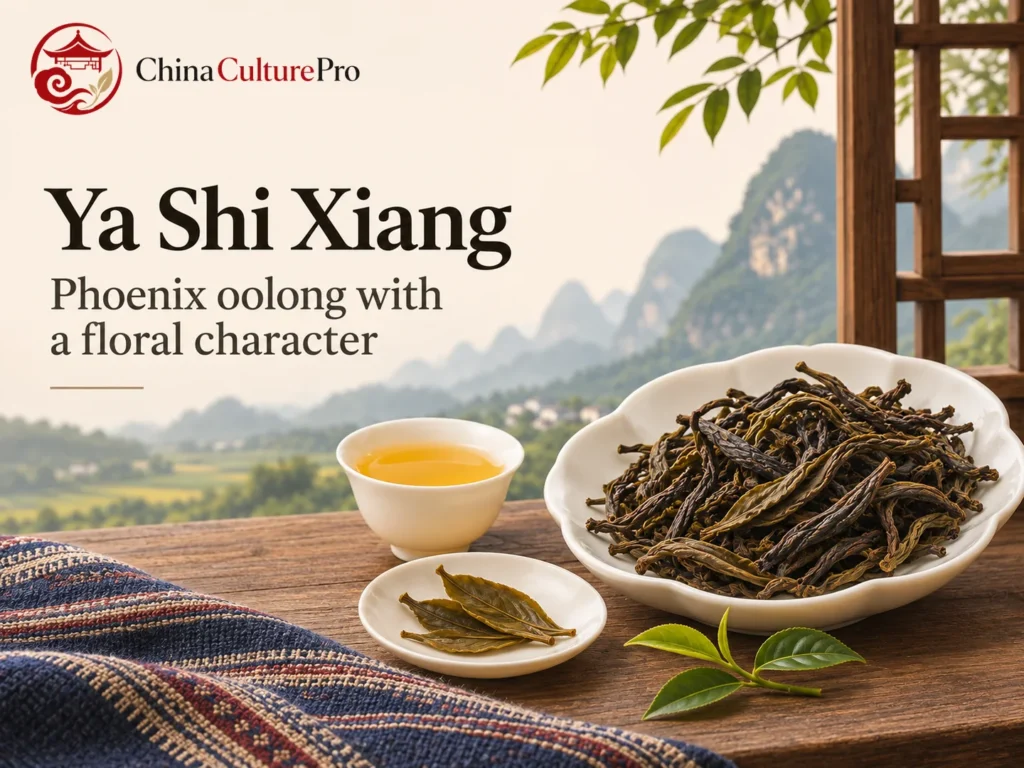

Quick Answer: What Is Ya Shi Xiang Tea?
Ya Shi Xiang(鸭屎香,yā shǐ xiāng), often sold in English as “Duck Shit Oolong,” is a named tea within Phoenix Dancong(凤凰单丛,Fènghuáng dāncóng)from the Chaozhou area of Guangdong. It belongs to the oolong category. [1][2]
- Name: The startling wording is not an ingredient declaration or a description of a dirty drink. [3]
- Aroma: Floral and fruity fragrance is central to the tea’s appeal. [4]
- Leaf: A documented example has substantial, slightly twisted dark-green strips and golden liquor. [7]
- Making: Leaf handling, heating, rolling and roasting develop the finished tea. [5]
The name does not mean duck droppings are added. Nor does it guarantee one roast level, identical flavour or production from a single ancient tree.

The literal translation may catch your attention, but the cup asks for a different vocabulary: flowers, fruit, sweetness and texture. Understanding Ya Shi Xiang means separating a memorable name from the tea itself, then placing it within the broader family of Phoenix Dancong.
Phoenix Dancong: Place, Plant Lines and Tea Names
Phoenix Dancong is a regional strip-style oolong associated with Chaozhou in Guangdong, rather than Fujian. Its plant lines were selected and developed from Phoenix Shuixian(凤凰水仙,Fènghuáng shuǐxiān)tea populations. “Dancong” has a history of selecting and processing individual outstanding plants, but those plants also became the basis for further cultivation. [2]
A group naming standard describes varieties and lines selected from that population and named through their distinctive characteristics. The commercial name alone is therefore not evidence that a packet came from one particular old tree. A specific single-tree claim needs information about that actual lot. [1]
Keep three questions separate: where was it grown, which named line or tea is it, and how was it processed? Our Chinese oolong guide explains the larger category.
Why the Name Says Duck Shit
Yin Hua Xiang(银花香,yín huā xiāng), a name associated with honeysuckle-like fragrance, is also used for this tea. A museum’s public account records two explanations for the less elegant name: a grower supposedly discouraged theft with an unappealing description, or the name referred to a local nickname for the soil. The account explicitly says there is no single agreed explanation. [3]
These are retold origin stories, not proof of a dated conversation or a particular inventor. Neither makes droppings an ingredient.
The 2021 group naming standard still lists Ya Shi Xiang among customary, widely used tea names. That documented usage is a reason to avoid claiming that the term was universally abolished when the more floral name appeared. Both names can be useful when reading a label. [1]
What Ya Shi Xiang Smells and Tastes Like
The floral impression is more informative than the literal name. A scientific study of Dancong aromas combined sensory evaluation with analysis of volatile compounds. It identified multiple aroma substances, with floral and fruity alcohol compounds prominent; the honeysuckle-like and osmanthus-like groups showed distinctive profiles in the tested samples. [4]
That evidence concerns a mixture of compounds and a set of studied teas. It does not reduce the aroma of every packet to one chemical, nor does a flower comparison prove that flowers were added.
One lightly baked product describes gardenia-like, fruity and milky notes with golden liquor. These describe that product, not every lot. [7]
When tasting Chinese tea, notice fragrance separately from sweetness, body and astringency. You may enjoy the aroma while preferring a gentler concentration in the cup.
How Processing and Roasting Shape the Tea
The regional sequence includes sun-withering, resting, zuoqing(做青,zuòqīng), shaqing(杀青,shāqīng), rolling and drying. The leaf is deliberately changed during manufacture; its floral character is not simply the smell of an untouched fresh shoot. [2]
A producer’s craft record describes agitation, heating, rolling and charcoal roasting as coordinated skills, adapted to the material and local conditions. It also documents modern machinery within the production system. “Traditional” should not automatically be translated as “no machine has touched any leaf.” [5]
Roast information is worth reading alongside the name. A lightly baked example does not define the whole category. Ask what the seller means by its roast description and compare actual cups rather than treating the English name as a fixed flavour formula.
Brewing and Comparing Two Approaches
One product’s published directions illustrate how strongly the vessel changes the method:
| Approach | Documented example for that product |
|---|---|
| Larger cup | 3 grams in 355 millilitres, using boiling water and a 3–5 minute infusion. |
| Small-vessel brewing | 8 grams in a 110-millilitre gaiwan(盖碗,gàiwǎn), using boiling water and an initial infusion around 10 seconds after a rinse. |
These are two directions for one product, not interchangeable quantities or a universal prescription. [7]
Small-vessel brewing uses more leaf relative to water and shorter contact. A gaiwan o tetera lets you drain the liquor; adjust one factor at a time.
Record the quantities and the balance you prefer.
Chaozhou Tea Culture and Choosing a Product
Chaozhou gongfu tea(潮州工夫茶,Cháozhōu gōngfu chá)is a local brewing and serving tradition in which oolong tea plays a prominent role. Its recognised practices include heating vessels, pouring, smelling and sipping. The 2008 heritage date belongs to the tea custom, not a separate certificate for every Ya Shi Xiang product. [6]
The full Chaozhou gongfu tea guide explains that social setting. At home, you can still pay attention to fragrance and share several small cups without treating every formal gesture as compulsory.
For a purchase or tasting comparison, read the named producer, origin, harvest information, roast description and ingredients. Family transmission and modern production can coexist; a craft record documents how one producer combines them, rather than establishing a single method for the entire region. [5]
For related caffeine questions, see our tea caffeine guide.
Prepared drinks require another distinction. A lemon or milk drink made with this tea base has additional ingredients and a different sensory balance. Our Chinese lemon-tea culture guide considers that wider beverage context.
FAQs About Ya Shi Xiang Tea
Does Ya Shi Xiang Contain Duck Droppings?
No. The name does not describe an added ingredient. The familiar explanations are stories about naming, not instructions to put droppings into tea. [3]
Is Yin Hua Xiang a Different Tea?
It is also used as a name for Ya Shi Xiang. Compare the full product information, since sharing an alternative name does not make separate lots identical. [3]
Is the Floral Fragrance Always Added?
No. Dancong research documents naturally occurring aroma compounds. Flower-like tasting notes are not, by themselves, evidence of added flavouring; check a blend’s ingredient list. [4]
Is Ya Shi Xiang Caffeine-Free?
No. It is a traditional tea-leaf drink and contains caffeine. The unusual name does not make it an herbal infusion. Its name does not indicate the caffeine level. [8]
Fuentes
[1] Chaozhou tea industry associations. Naming rule of Fenghuang Dancong:T/CZTTBZ002–2021
[2] China delegation to UN food agencies. Phoenix Mountain and Dancong
[3] Guanfu Museum public account. How fragrant is Ya Shi Xiang?
[4] Lu Danmin and colleagues, Food Science. Identification of Aroma Components of Dancong Tea
[5] Ministry of Commerce Old Brands Digital Museum. Nanfu craft and transmission
[6] China ICH Network. Tea traditions in Guangdong
[7] TeaVivre. Ya Shi Xiang product and preparation notes
[8] Harvard Nutrition Source. Té