


Quick Answer: What Is Grandfather-Style Tea Brewing?
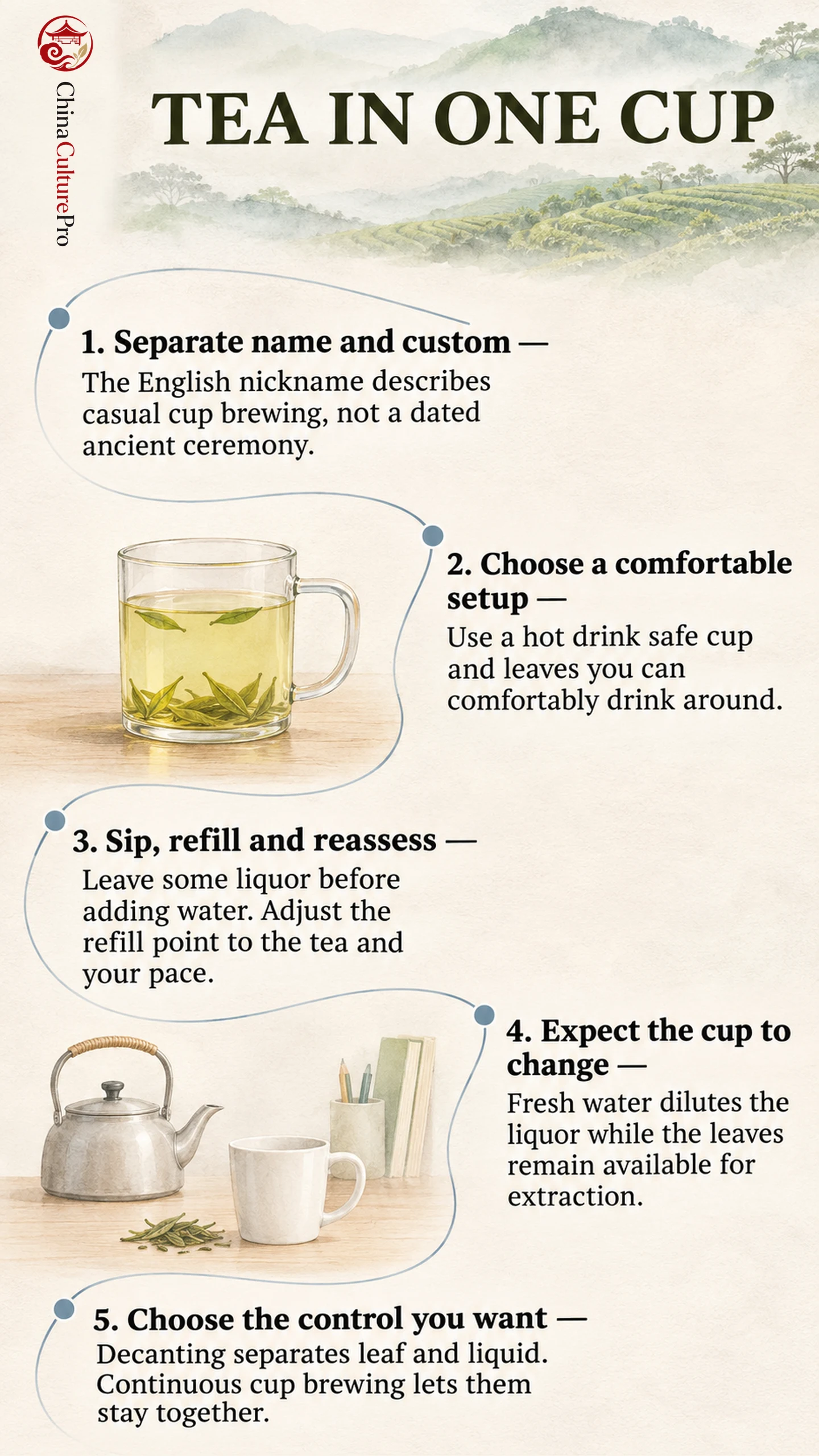
Grandfather-style, often called grandpa-style, is informal loose-leaf brewing in which the leaves stay in a cup while you drink and add more hot water. The cup serves as both brewer and drinking vessel.
- Equipment: A suitable mug or heat-safe glass, tea leaves and water are enough.
- Method: Use a modest amount of leaf, sip when comfortable and refill before the cup is empty.
- Flavor: Strength changes as extraction continues and fresh water dilutes the remaining liquor.
This is a preparation method, not a separate manufactured tea category. Its English nickname does not establish an ancient ceremonial origin.
Green leaves slowly opening in a glass offer a different rhythm from a table of tiny cups and carefully decanted infusions. You sip, add water and return to what you were doing. The method is simple, but leaf quantity, refill timing and your drinking pace still shape how it tastes.
The English Name and the Everyday Practice
The writer who introduced the English nickname explains that he named it after the way his grandfather drank tea: leaves in a large cup, with water added repeatedly.[1] That first-person naming account documents the label, rather than the invention of putting leaves into a drinking vessel.
A dated March 2008 post already uses “grandfather style” for tea brewed casually in a mug.[2] It supplies a clear modern reference without giving us a defensible founding year for the underlying everyday habit.
Keep those histories separate. An English-language label can help readers discuss a familiar practice without being a direct translation of an official Chinese ceremony. Neither age, gender nor a particular family relationship is a condition for using the method.
Choosing Leaves and a Cup for Continuous Brewing
Green tea is a useful starting point. A tea practitioner’s account of visiting the West Lake region describes green leaves brewed directly in glasses and water added as people drank. The same account notes that some leaves do not all settle neatly to the bottom.[3]
It is not a green-tea-only method. The 2008 mug-brewing record describes both a Yunnan black tea and an Assam.[2] Those examples show that other teas can be used, without promising every black tea will behave alike during a long steep.
Choose a leaf form you can comfortably drink around. Large leaves may be easier to avoid at the rim than scattered fragments. Floating leaves are an inconvenience to manage, not proof that you bought bad tea. If you dislike drinking around them, use a removable infuser and accept the useful change in method.
A clear glass lets you watch the leaves; an opaque mug can still brew them. Choose a vessel intended for hot drinks, with room to hold and sip comfortably. The glass and porcelain guide explains that material choice without making transparency a requirement.
How to Brew and Refill the Cup
A practical early account advises using less leaf than a concentrated small-pot session and retaining liquid for the next refill.[4] Begin with the tea’s own brewing guidance and adjust for the fact that you will leave the leaves in the water.
- Choose the cup and leaf: Set a clean hot-drink-safe cup on a stable surface. Add a modest quantity of tea, allowing space for the leaves to open.
- Add water and let it infuse: Use water suited to that tea and leave room below the rim. Allow the infusion to develop and cool to a comfortable drinking temperature.
- Sip without emptying the cup: Drink from the clear space near the surface, keeping floating leaves away from your mouth. Pause if the vessel is uncomfortable to hold.
- Refill and reassess: Add more water while some liquor remains. Taste again as the leaves continue steeping, and repeat only while the flavor remains enjoyable.
For a concrete green-tea example, a 2026 local consumer lesson for Longjing(龙井,Lóngjǐng)recommended roughly 90°C water and a 1:75 tea-to-water ratio, with refilling when one-third to one-half remained.[5] By mass, that ratio corresponds to 2 grams of leaves for about 150 milliliters of water. Use it as a reference for that tea, rather than every tea category.
The earlier practical account preferred refilling sooner, around half-full or above.[4] You can therefore adjust the refill point to your tea and pace instead of treating one-third as a mandatory tradition.
Adjusting Flavor Without Pretending Each Refill Is Identical
Several things happen together: you remove brewed liquid by drinking, add fresh water, and leave the leaf available for further extraction. Refilling changes concentration; it does not reset the leaves to their original condition.
Research on black and green tea infusions found that leaf characteristics and preparation variables, including tea and water quantities, infusion time and agitation, affect beverage composition.[6] It was not a trial establishing one optimal grandfather-style recipe.
If the cup becomes too strong while you drink, try less leaf next time or refill earlier. If it stays thin, reassess the starting quantity and the tea’s suggested water temperature. Change one factor at a time so you can recognize the effect. Bitterness and astringency describe different sensations, so record which one is troubling you.
Repeated dilution is not decaffeination. A pale refill cannot tell you the caffeine already consumed across earlier drinks; tea caffeine is a separate composition question.
How This Differs from Decanted Tea Service
In a decanted session, you separate each infusion from the leaf before drinking. Here, brewing and drinking overlap in the same vessel. The important difference is control over contact between leaf and water.
A fairness cup receives tea after decanting; it is unnecessary for the basic continuous-cup arrangement. Choose separate infusions when you want clearer comparisons between rounds or need to remove the leaf at a particular strength. Choose cup brewing when a simple personal drink suits your pace.
FAQs About Grandfather-Style Tea Brewing
Is grandfather-style brewing only for green tea?
No. Other tea categories can work; choose according to how the particular leaf tastes during continued steeping.
Do all the leaves have to sink?
No. Some remain afloat. Manage them at the rim or use an infuser if you prefer to separate them.
Must you refill at exactly one-third?
No. Published practical examples use different refill points. Keep some liquor and adjust by taste.
Does repeated topping up make the tea caffeine-free?
No. Adding water dilutes an infusion but does not remove caffeine already extracted or consumed.
Fuentes
[1] A Tea Addict’s Journal. What’s grandpa style?
[2] A Tea Addict’s Journal. Making tea lazily, 2008
[3] Garret Sorensen, Mandala Tea. What is Grandpa Style tea brewing?, 2017
[4] A Tea Addict’s Journal. Grandpa style techniques, 2010
[5] Daily Business. Hangzhou consumer education and Longjing brewing, 2026
[6] Conrad Astill and colleagues. Factors affecting the caffeine and polyphenol contents of black and green tea infusions, 2001