


Quick Answer: What Is Dinggu Dafang Tea?
Dinggu Dafang(顶谷大方,Dǐnggǔ dàfāng)is a flat green tea associated with Shexian in Anhui’s Huangshan region. Its straight, smooth leaf and pan-worked character invite comparisons with other flat green teas, but it has its own local identity.
- Place: The name belongs to the Dafang tea tradition of southern Anhui.
- Processing: Heating and shaping help create the flat finished leaf.
- Flavor: Product accounts describe combinations of aromatic, nutty, vegetal or floral impressions.
A resemblance to Longjing does not make it the same tea. Specific flavor and manufacture should be checked against the actual product rather than inferred from shape alone.
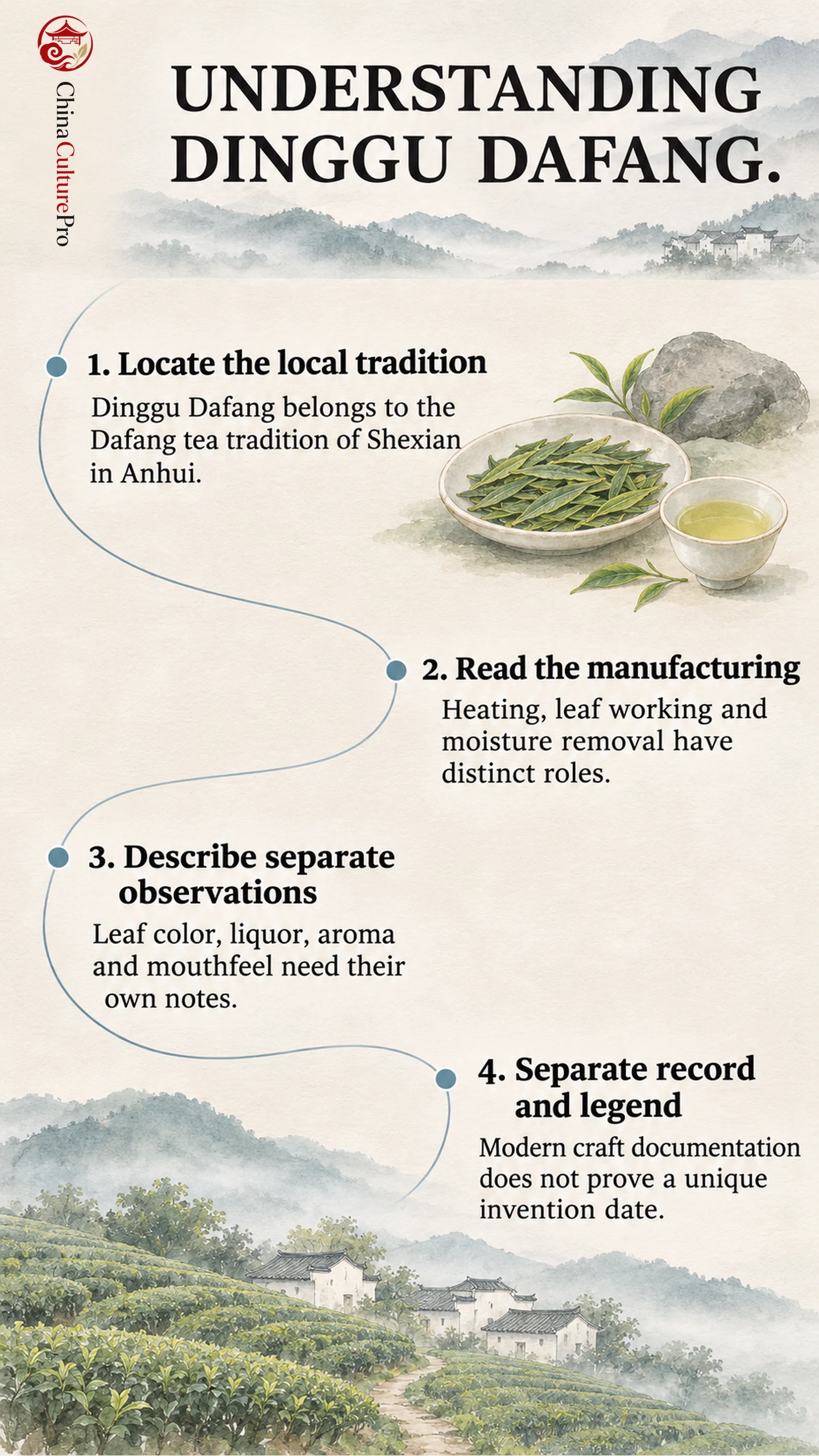
Flat leaves on a tea dish can look deceptively familiar. With Dinggu Dafang, the more useful questions concern where the leaves were grown, how the maker worked them in the pan, and what the brewed cup actually shows. Its local names and craft records offer a clearer introduction than claims that it invented every flat green tea.
Dinggu Dafang, Laozhu Dafang and the Shexian Setting
A Huangshan municipal account places Dinggu Dafang within Laozhu Dafang(老竹大方,Lǎozhú dàfāng), using the former for a particularly valued expression associated with Laozhu Ridge and Fuquan Mountain in Shexian. It describes a smooth, upright leaf with green coloring that can carry a yellowish cast.[1]
These related names should be read in their local context. Dinggu Dafang is not a universal grading term that can be applied to every flat tea, and “Dafang” alone is not a complete growing-location statement.
A firsthand visit account describes tea villages around Laozhu Ridge and other Shexian locations, including local household craft and later efforts to sustain production.[2] This connects the name to people and places, without making every modern package a documented product of one particular village.
For a purchase or tasting comparison, ask for the growing area and maker’s processing information. A broad “Huangshan” label provides regional context, but does not identify an individual garden or batch.
How Pan Work Produces a Flat Green Tea
The tea belongs to a flat, pan-worked green-tea tradition.[2] Its compressed-looking profile is a shape created during manufacture, rather than evidence that it is a compressed cake tea or a separate botanical species.
In green-tea manufacture, fixation uses heat to reduce enzyme activity; working and shaping the leaf and removing moisture have further, distinct roles.[3] Keeping those jobs separate helps explain why “fried tea” is an incomplete English description. It need not mean a food fried in a pool of cooking oil.
The general explanation of fixation concerns enzyme control, while rolling concerns working the leaf. Those principles provide context; they do not establish one compulsory detailed hand sequence for every modern Dafang producer.
Likewise, a flat shape alone cannot establish how much work was done manually. Ask about the production method if hand manufacture matters to you. Avoid using smoothness, color or a romantic label as a substitute for that information.
Reading Leaf Color, Aroma and Taste Separately
A first-person account of tea received from a Shexian producer describes straight, flat, glossy dark green leaves, a clear floral aroma and a fresh, mellow impression.[2] Those are observations of the tea discussed there, not guaranteed characteristics of every harvest.
A separate 2024 product account describes chestnut, toasted hazelnut and cooked-vegetable notes, with a light green infusion and an oily texture.[4] The contrast is useful: one product note should not be turned into the entire tea’s sensory definition.
Record dry-leaf appearance, liquor color, aroma, taste and texture separately. A nut comparison describes an impression; it does not establish the addition of nuts. A floral impression likewise does not prove that the tea was scented with blossoms.
Green tea can display yellow-green leaf or a pale yellowish infusion. That observation does not by itself change the manufacturing category. Amarilleamiento identifies a different processing question from simply noticing yellow in a cup.
Use tea-aroma vocabulary to make your notes consistent. A porcelain or glass vessel also lets you separate the appearance of the infusion from the dry leaf’s color.
Craft Records and the Limits of the Origin Story
There is a concrete modern record of the craft: Anhui local standard DB34/T 1756-2012 was published in December 2012 and took effect in January 2013. Its registered scope concerns traditional Dinggu Dafang production and demonstration within heritage protection.[5] Those dates document a standard, not the invention of the tea.
A separate municipal heritage account identifies Dinggu Dafang as a provincial tea-making heritage project.[6] Preserve that listing level rather than treating all Huangshan tea techniques or individual products as sharing one UNESCO certification.
The monk Dafang story belongs to local memory. A modern visitor recorded a recently erected marker and discussed gaps and alternative explanations in the narrative.[2] Neither the marker nor the story proves a sole inventor, invention date or direct ancestral relationship to Longjing.
When comparing finished teas, keep craft documentation, reported history and your cup observations separate. They enrich one another, but answer different questions.
FAQs About Dinggu Dafang Tea
Is Dinggu Dafang the same tea as Longjing?
No. A similar flat appearance is not evidence that the two names identify the same tea.
Is yellowish Dinggu Dafang a yellow tea?
Not on color alone. Its identity is green tea; the processing route matters.
Is the monk Dafang’s invention story proven?
It should be treated as a naming tradition rather than a securely established invention account.
Does the name guarantee an entirely handmade tea?
No. Confirm the actual production method with the maker or supplier.
Fuentes
[1] Huangshan Municipal Government. Local specialties: Dinggu Dafang
[2] Dongcai Hu. A field account of Dinggu Dafang and Laozhu Ridge, 2022
[3] Tea and Beverage Research Station. Tea classification and processing
[4] Palais des Thés. Ding Gu Da Fang Pre-Qingming: 2024 product and tasting record
[5] National Public Service Platform for Standards Information. DB34/T 1756-2012: Dinggu Dafang making techniques
[6] Huangshan Municipal Government. Tea-making heritage projects and their listing levels