

Quick Answer: Porcelain or Glass Teaware?
Choose glass when seeing the leaves and infusion is part of the pleasure. Choose porcelain when its handling, appearance and working shape suit your brewing routine. Porcelain is a high-fired ceramic; glass is a different material, not simply a transparent version of the same ware.[1]
- Visibility: Clear glass reveals the infusion through the wall; porcelain presents a different visual background.
- Heat: Compare actual vessels, not just material labels.
- Flavor: Brewing conditions and the drinking experience both deserve attention.
Neither choice assigns a tea permanently to one material. Construction, size, pouring and product-specific care matter when choosing a useful set.
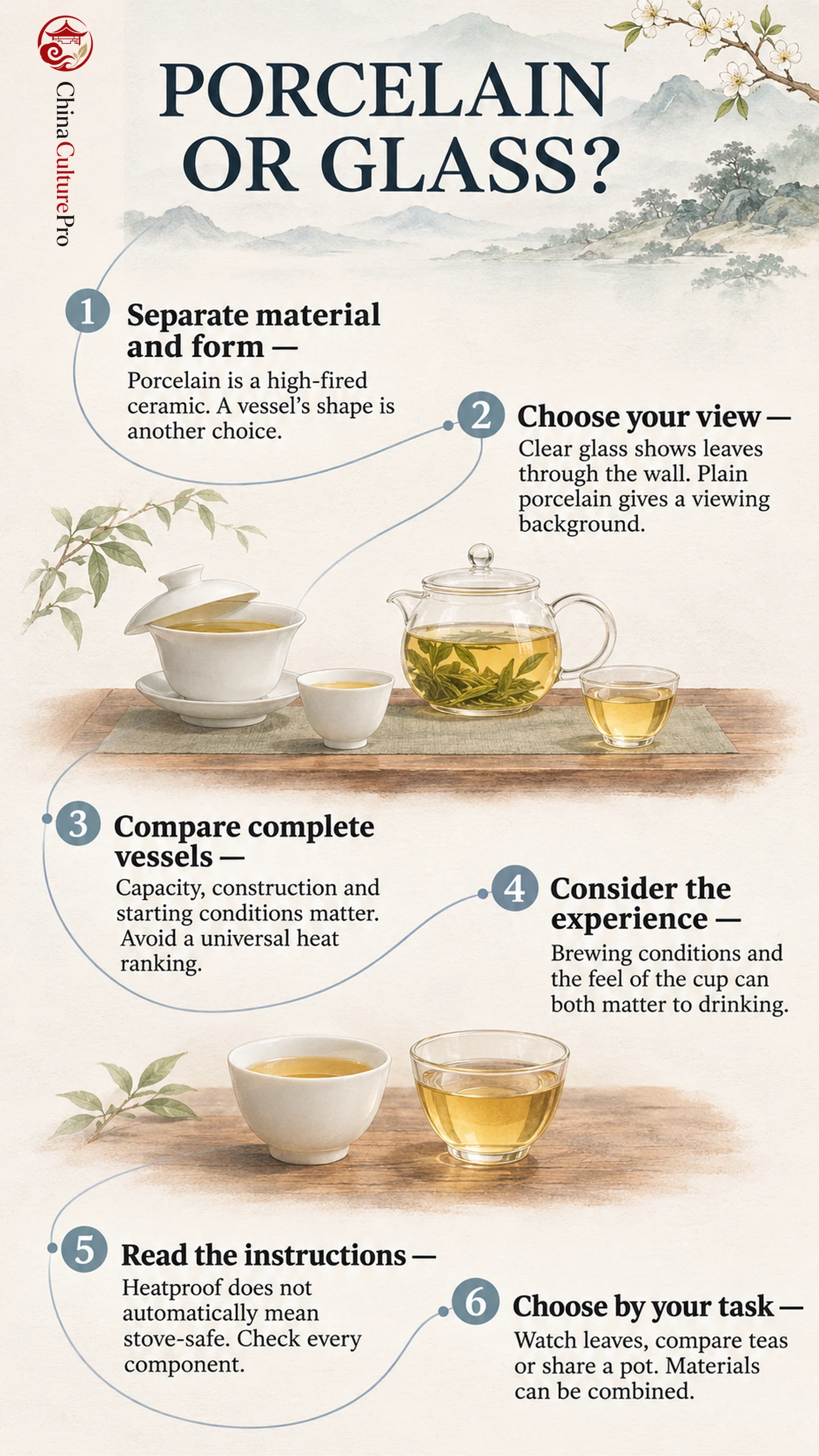
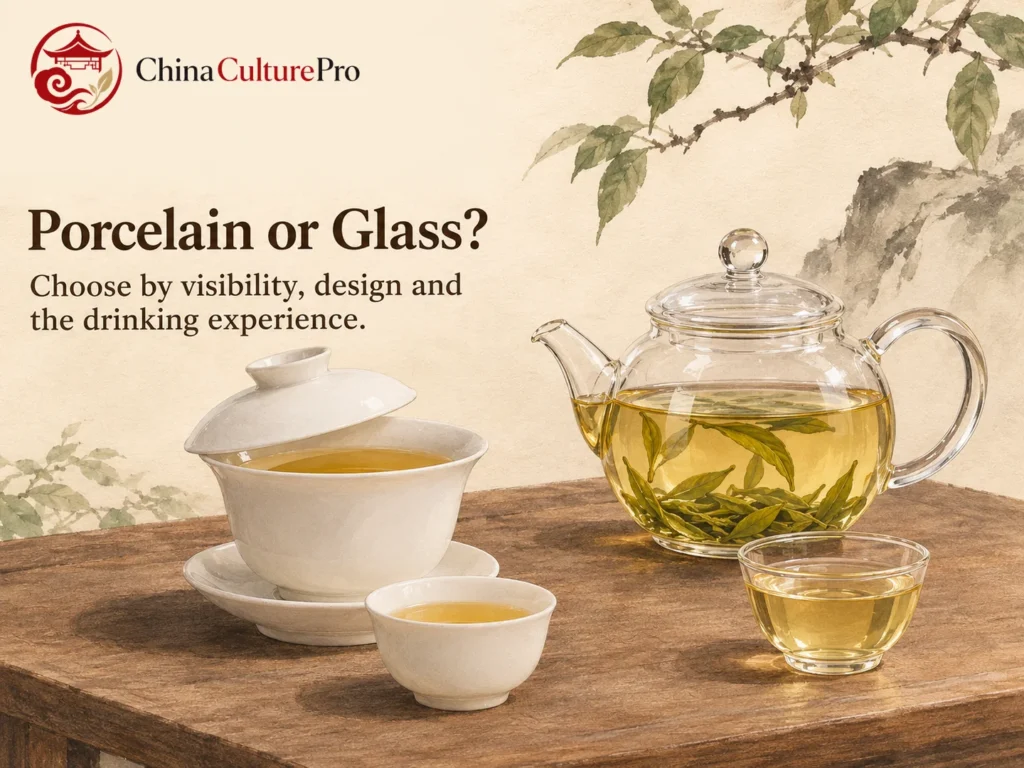
Through a clear glass wall, rolled leaves slowly open in pale golden water. Beside it, a porcelain bowl frames the poured tea against a quiet surface. Both views can be rewarding, but they answer different questions. This comparison separates what you can see, how the vessel works and what you experience when drinking.
Materials and Making: Porcelain Is a Ceramic
White porcelain(白瓷,báicí)belongs to the ceramic family. Hard-paste porcelain develops a dense body through the high firing of its mineral ingredients; whiteness, translucency and non-porosity are characteristic qualities. It is different from porous biscuit ware or every object casually called “clay.”[1] A thin porcelain cup may transmit light without offering a clear view of the leaves through its side.
Glass teaware also needs a more specific description than “glass.” A current teapot example uses heatproof borosilicate glass for its body and lid, with a separate stainless-steel strainer.[2] This identifies that product’s construction; it does not establish that every glass pot uses the same formula or components.
Material and form are separate choices. A gaiwan(盖碗,gàiwǎn), or lidded brewing bowl, and a handled teapot differ in grip and pouring even when made from the same material. Our gaiwan versus teapot guide explains that decision.
What You Can See Through the Vessel
Clear glass makes the movement of leaves visible during brewing. A plain white interior instead supplies a consistent background for looking at the poured liquor. White-porcelain cup-and-bowl sets are used in formal tea assessment, where repeated comparisons need a consistent setup.[3]
| Aspecto | Porcelana | Vidrio |
|---|---|---|
| Looking at leaves | Usually inspect from above | Clear walls allow a side view |
| Viewing tea color | A plain white interior provides a background | Surroundings and any glass tint affect the view |
| Everyday care | Check glaze, decoration and product instructions | Check glass type, components and product instructions |
For a fair visual comparison, use similar lighting and compare similar amounts of tea. Watching the color deepen can be interesting, but appearance alone does not tell you exactly how the infusion will taste.
Heat Retention Depends on the Whole Design
A small, informal thermometer experiment found that vessel size, preheating and underfilling changed the measured temperatures. Two porcelain vessels did not behave identically.[4] This is a useful practical observation, not a controlled test of every porcelain and glass design.
When comparing your own choices, consider capacity, wall construction, the opening and lid, and how much water you actually use. A large pot used for a small portion is a different setup from a vessel matched to that portion. Comparing a thick porcelain pot with a thin glass cup cannot isolate the material’s contribution.
If temperature stability matters to your tea, observe the actual setup or measure it. Keep the starting conditions comparable, including whether the vessel has been warmed. There is no useful universal promise that all porcelain stays a fixed number of degrees hotter than all glass.
Does the Material Change Tea Flavor?
Separate the preparation of the infusion from the experience of drinking it. Changing the vessel can change the brewing setup; changing the cup can also change what your lips and hands encounter. “Flavor-neutral” is therefore not a guarantee that two complete drinking experiences will be identical.
In one experiment, blindfolded participants drank the same unsweetened, room-temperature green tea from glasses with different lip thicknesses. The thicker-lipped glasses produced higher sweetness ratings, while the thinner-lipped glasses produced higher bitterness ratings. The researchers also examined glass weight and found that it contributed to the effect.[5]
That finding concerns perception under those conditions. It does not mean that thick glass adds sugar, or prove that one material makes every hot tea sweeter. Notice whether a vessel is comfortable and how its rim feels, as well as describing the tea. Our tea aroma vocabulary guide helps keep aroma descriptions distinct from other sensations.
Cleaning, Heat and Everyday Handling
Check the instructions for the complete product, including lids, strainers, seals and decorative parts. One heatproof-borosilicate teapot is approved for hot water, microwave use with its metal strainer removed, and dishwashing, while explicitly excluding ovens, induction stoves and open flame.[2] The example shows why “heatproof glass” is not itself permission to place a pot on a burner.
Apply the same habit to porcelain: verify the maker’s directions rather than assuming every decorated cup can be treated like a plain one. When choosing, look for access that makes the interior, lid and filter easy to clean. Check the rim and spout for damage and consider whether you can hold and pour the vessel comfortably.
Rinse away cleaning residues and let the pieces dry before storage.
Choosing for Your Tea-Drinking Habits
Porcelain’s Chinese history does not make glass incompatible with tea culture. In Taiwan, a museum’s account of a dark-green drinking glass describes the expansion of glass household wares with local industrial development during the Japanese period.[6] It is a regional material-history example, not evidence that glass was invented then or that the historical cup is approved for boiling water today.
Green and white teas are not confined to glass; oolong and black teas are not confined to porcelain. Use your preferred brewing conditions and the particular vessel’s performance to guide the pairing.
Begin with the task you want the vessel to perform:
- Watching leaves: A clear glass brewing vessel makes their movement easy to follow.
- Comparing teas: Matching plain porcelain tasting sets can help keep the viewing setup consistent.
- Brewing several rounds: Prioritize comfortable handling, suitable capacity and a pour you can control.
- Serving a shared pot: Choose the volume and grip that work for your table, then check care requirements.
You can also combine materials: brew in one and drink from another. Keep a comfortable, suitable vessel rather than replacing it to follow a rigid material-to-tea chart.
FAQs About Chinese Porcelain vs Glass Teaware
Is porcelain always hotter than glass?
No. Compare the actual vessels, water volume and starting conditions.
Can a glass teapot go on the stove?
Only when its manufacturer explicitly permits that use. A heatproof label alone is insufficient.
Does glass make tea taste worse?
There is no universal rule. Consider the brewing setup, rim, handling and your own experience.
Do you need separate vessels for every tea?
No fixed material rule requires that. Choose suitable, clean equipment and follow its care instructions.
Fuentes
[1] Victoria and Albert Museum. An A–Z of Ceramics
[2] Hario USA. ChaCha Kyusu Maru: materials and care instructions
[3] Tea and Beverage Research Station. Introduction to sensory evaluation of tea
[4] TeaDB, James. Heat Retention Revisited: Size, Material, Underfilling, Kettles, and Pooling Water
[5] Chuo University. The tactile thickness of the lip and weight of a glass can modulate sensory perception of tea beverage
[6] National Museum of Taiwan History. Dark-green glass cup, collection 2002.004.0100