

Quick Answer: How Much Caffeine Is in Chinese Tea?
Caffeine (咖啡因, kāfēiyīn) is naturally present in tea leaves. Chinese green, black, oolong and pu-erh teas can all contribute caffeine, but a category name does not predict the amount in an individual cup.
- Leaf: the starting material has its own caffeine concentration.
- Preparación: leaf quantity, water, time and leaf form affect extraction.
- Serving: cup size and repeated infusions determine how much you actually drink.
A2008 study of20 commercial tea products found14–61mg per6- or8-ounce serving among tested white, green and black teas, without an observable category trend. That sample range is evidence of overlap, not a guaranteed range for every Chinese tea.[1]
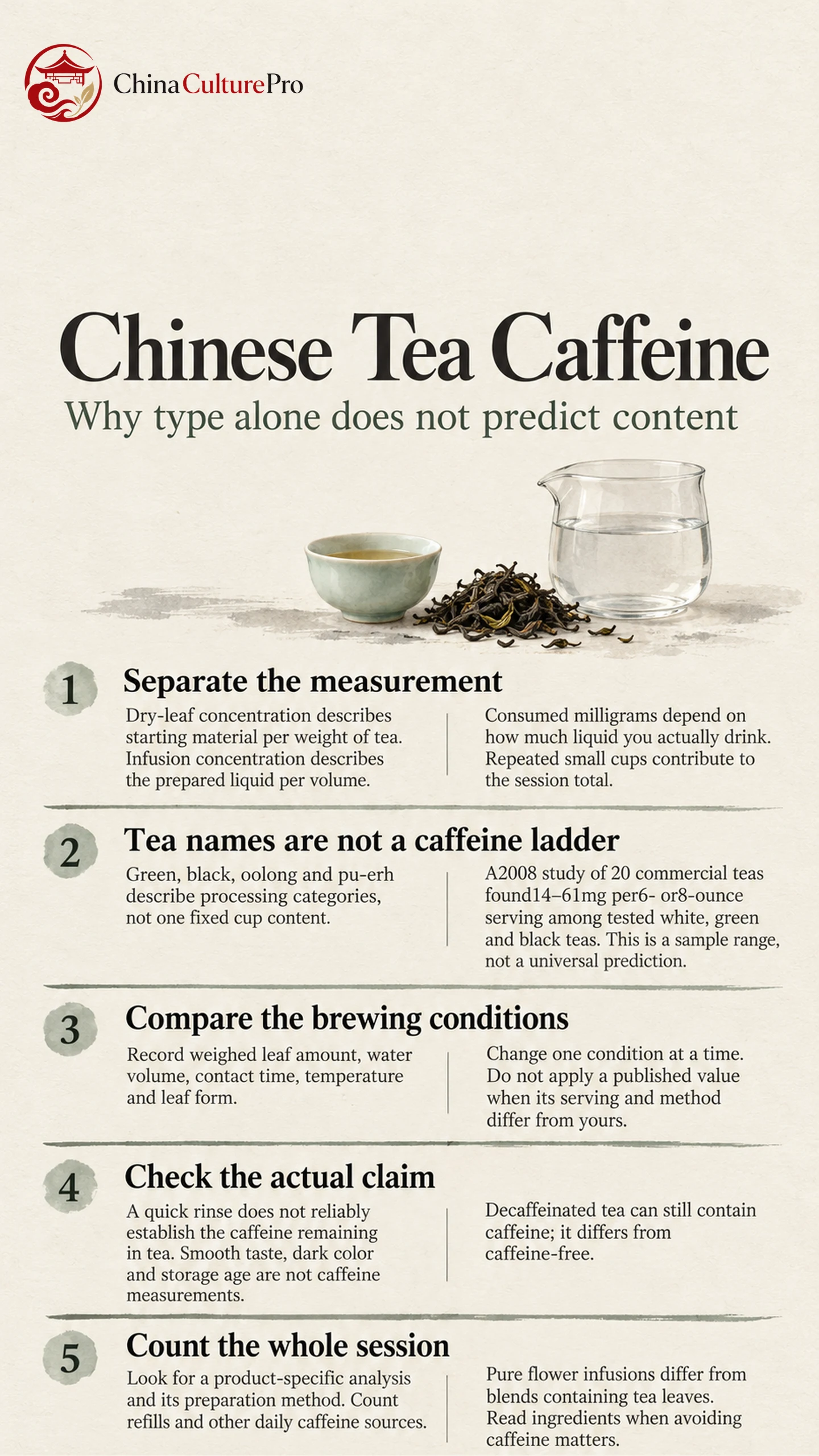
Chinese tea caffeine (咖啡因, kāfēiyīn) cannot be read from a pale cup, a dark leaf or a familiar tea name. The amount you drink depends on the leaf, how it is brewed and how much tea you consume across the whole session.
Dry Leaf, Tea Liquor and Total Intake Are Different Measures
Three different numbers are often described simply as caffeine content. A laboratory result for dry leaf does not tell you how much enters your cup. An infusion result does not tell you how many cups someone drinks.
| Measure | Qué describe | What it answers |
|---|---|---|
| Dry-leaf concentration | Caffeine relative to a stated weight of dry tea | Starting material, before extraction |
| Infusion concentration | Caffeine relative to a stated volume of tea liquor | Strength of the tested liquid |
| Consumed amount | Milligrams in the volume actually drunk | Exposure across a serving or session |
A small concentrated cup may contain fewer total milligrams than a large weaker mug, depending on their actual concentrations and volumes. The amount consumed in small cups also accumulates across a session. Do not multiply the first cup’s concentration by every later cup: successive infusions need not extract caffeine at the same rate.
Why Tea Type Does Not Give a Reliable Caffeine Ranking
Tea categories describe manufacturing paths. They are not laboratory reports for the finished drink. Differences in plant material and product selection sit alongside differences in processing; brewing then adds another source of variation. The commercial samples in the2008 study illustrate why a simple white–green–oolong–black ladder can be misleading.[1]
The distinction between oolong and green tea concerns processing as well as flavor. A partially oxidized label is not a percentage of caffeine removed. Likewise, a roasted aroma, gentle taste or dark infusion is not a dependable caffeine test. Bitterness comes from a mixture of compounds, and taste alone cannot separate or quantify them.
What Brewing Conditions Change
The amount of dry tea relative to water establishes the starting conditions. Contact time, water temperature and the physical form of the leaf then influence what enters the liquid. The Taiwan research station reports increased extraction of caffeine and other components with higher temperatures in its tested conditions; that does not supply one numerical correction for every tea.[2]
- More leaf in the same water can increase the available caffeine, but the final amount still depends on extraction.
- Longer contact changes the infusion; the original commercial-tea study found a steep-time effect.
- Broken and intact leaves expose different surfaces. Keep leaf form in mind when comparing a bag with loose whole leaf.
A useful comparison keeps the product, weighed leaf amount, water volume and brewing method consistent. Change one condition at a time. Published numbers without those conditions cannot establish whether your own cup contains the same amount. Cold water or a brief infusion should not be treated as a guarantee of zero caffeine.[1]
Rinsing, Decaffeination and Other Common Misunderstandings
Rinsing is not a validated home decaffeination method. A quick wash discards extracted material, but it does not establish how much caffeine remains. A claim that one short rinse reliably removes most caffeine needs evidence for the actual leaf and method; the tea name alone supplies none.
Decaffeinated tea has undergone a process intended to reduce caffeine. It can still contain some, as the FDA explains. That label therefore differs from caffeine-free. The2008 study also detected caffeine in its decaffeinated tea samples.[1][3]
The distinction between raw and ripe pu-erh concerns processing, not a certified absence of caffeine. A mellow ripe tea should not be chosen as a caffeine-free drink merely because it tastes smooth. Nor does storing tea establish a dependable decaffeination process.
How to Compare Servings and Read Caffeine Information
Start with a product-specific declaration or analysis when available. Check whether it refers to dry tea, prepared drink or a manufacturer’s serving. A number for bottled tea describes that product; it cannot simply be transferred to a loose-leaf session.
- Record the leaf quantity, water volume and infusion conditions for a meaningful comparison.
- Count the tea actually consumed, including refills and repeated infusions.
- Consider other caffeine sources that day, rather than treating tea as a separate allowance.
The FDA cites400mg a day for most adults as an amount not generally associated with negative effects. This is not a universal personal limit or a target. Sensitivity, medications and health circumstances vary. Its guidance recommends discussing limits with a health professional when pregnant, trying to become pregnant, breastfeeding or concerned about a condition or medication.[3]
If avoiding caffeine matters, check an explicitly caffeine-free product rather than relying on tea color. Pure flower infusions and blends containing tea leaves are different products, so read the ingredient list as well as the name.
FAQs About Chinese Tea Caffeine
Does green tea always have less caffeine than black tea?
No. The tested green and black products in a commercial-tea study overlapped. Leaf material, portion size and brewing conditions can outweigh a simple category comparison.
Does a quick rinse remove most caffeine?
A quick rinse does not reliably establish how much caffeine has been removed. It should not replace a verified decaffeinated or caffeine-free choice when that distinction matters.
Does ripe pu-erh become caffeine-free?
No such conclusion follows from ripe processing or a smooth taste. Ripe pu-erh is still tea; check product-specific information rather than assuming fermentation eliminates caffeine.
Can flower infusions contain caffeine?
Yes, if the drink blends flowers with tea leaves or another caffeinated ingredient. A pure flower infusion and a scented or flower-blended tea are different preparations.
Fuentes
[1] Chin and colleagues, Journal of Analytical Toxicology. Caffeine content of brewed teas
[2] Taiwan Tea and Beverage Research Station. 水質及水溫對茶湯品質之影響
[3] US Food and Drug Administration. Spilling the Beans: How Much Caffeine is Too Much?