

Quick Answer: What Is the Difference between Sheng and Shou?
Pu-erh tea (普洱茶, pǔ’ěr chá) includes raw pu-erh (生茶, shēngchá), or sheng, and ripe pu-erh (熟茶, shúchá), or shou. Their main distinction is whether the prepared leaf undergoes the managed piled-leaf fermentation used for ripe manufacture.
- Raw: A sun-dried leaf base follows a path without the ripe-style accelerated piling stage.
- Ripe: An additional controlled fermentation produces a different starting character.
- Age: Both can change in storage, but an old raw tea does not thereby become ripe-style tea.
Young raw tea is drinkable, and newly made ripe tea is not simply decades-old raw tea. Color and age alone cannot identify the manufacturing process.

The words raw and ripe describe different production paths, not simply a young cake and an old one. To choose between them, compare the manufacturing step, the actual cup and the storage record. This is a useful distinction within Chinese tea and drinks.
One Sun-Dried Base, Two Processing Paths
The common starting material is sun-dried maocha (晒青毛茶, shàiqīng máochá), a prepared loose-leaf base made by heating, rolling and sun drying. “Raw” therefore does not mean untouched fresh leaves. Steaming and compression may follow to create a cake or other shape.[1]
Wet-piling (渥堆, wòduī) is the managed warm, moist piled-leaf fermentation used for ripe pu-erh. It acts on the prepared tea before the finished product is dried and, where intended, compressed. This fermentation step distinguishes the manufacture. Boiling the finished tea or letting a cake darken in storage does not substitute for it.[1]
Ripe manufacture has a modern industrial history. One factory’s own chronology records successful artificial pile-fermentation trials in 1973. That is a documented manufacturing milestone, not evidence that one named person invented every form of ripe tea.[5]
The oxidation and fermentation guide explains the mechanisms. Shape is a separate question: compressed tea can represent more than one style, and compression is not a stand-in for ripe processing.
How the Leaves and Liquor Look and Taste
| Estilo | Typical visual clues | Possible taste and texture |
|---|---|---|
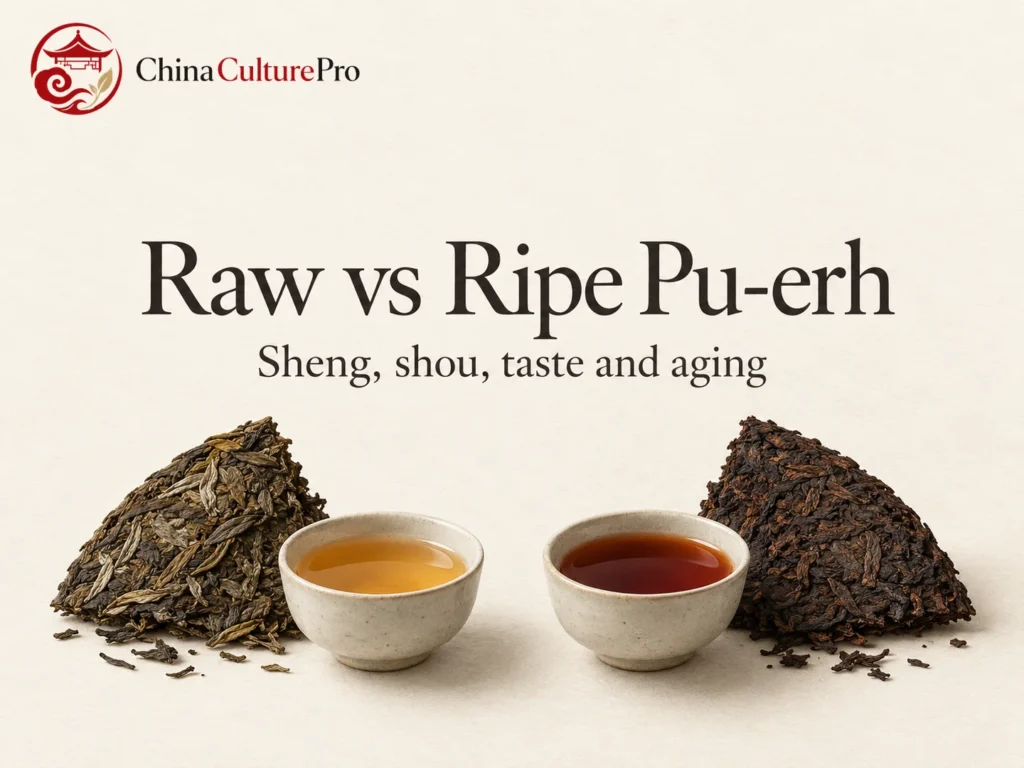
| Young raw / sheng | Dry and infused leaves can retain green or olive tones. Liquor often appears yellow-green to gold. | A brisk, sometimes bitter or astringent cup, with freshness and returning sweetness. |
| Ripe / shou | Leaves commonly appear brown; liquor is often red-brown to very dark. | Often mellow, thick and deep, with an aged-aroma character. |
These are recognition clues, not an authentication test. Aged raw tea can have a darker infusion, and leaf grade, strength and storage can change the picture. Brewing the same tea more strongly also darkens the cup without changing its production category.[1][3]
A study comparing a ripe tea with its corresponding sun-dried raw material investigated the development of mellow, thick mouthfeel during fermentation. That research supports a real sensory difference, rather than a claim that every ripe tea must be mild or every raw tea harsh.[2]
What Aging Changes—and What It Does Not
Storage can change aroma, taste and liquor color. Research on fourteen raw-tea samples at different storage times found changes in sensory character and volatile compounds, including a shift toward darker liquor and mellower taste. The samples illustrate change; they do not set a compulsory drinking age for all raw tea.[3]
Ripe tea can change too. A separate study compared one commercial ripe-tea product across samples stored for one, three, five, seven and nine years. It found sensory and chemical changes within that product series. The series shows that ripe processing does not end all later development. It does not establish that every additional year improves every tea.[4]
Natural storage does not reproduce the managed wet-piling stage. Mature sheng remains aged raw-style tea. Initial material, manufacture and storage condition all matter, so age by itself is not a quality score. The aged tea guide discusses that broader distinction.
Brewing the Two Styles and Comparing Caffeine
One producer’s concentrated small-vessel method suggests about 6 g per 100 ml, water at 95–100°C and short early drinking infusions of twenty seconds or less. Treat this as a documented starting method, not a national standard or a rule for a large mug. Adjust to the particular tea and compression.[6]
A glazed pot or gaiwan makes a side-by-side comparison straightforward. Let a compressed piece loosen and give the leaves room. For young raw tea that tastes too astringent, try a shorter infusion or a lower dose on the next attempt. For ripe tea that seems too dense, reduce extraction rather than assuming the darkest possible cup is best.
Ripe does not mean decaffeinated. In one direct raw-material/ripe-product study, caffeine was an exception to the many components changed by fermentation. That result concerns those samples, but it reinforces why a mellow taste is not a caffeine measurement.[2] The tea caffeine guide covers dose and infusion variables.
Choosing a Tea and Storing It Sensibly
Ask whether the packet is raw or ripe, which year the date describes, and what is known about storage. Harvest, processing and compression can be different events; ask for clarification rather than assuming a prominent year explains all of them. A small sample can answer the taste question before a larger purchase.
For home storage, use a clean, dry, odor-free place and follow guidance appropriate to the product and local conditions. Keep it away from cooking steam and strong smells. Do not wet tea to accelerate aging or assume a wrapper prevents moisture problems. Poorly stored tea can deteriorate regardless of style.[7]
The tea storage guide treats preservation and aging separately. If the confusion is instead about English black tea, the pu-erh versus black tea comparison explains the naming and processing difference.
FAQs About Raw and Ripe Pu-erh
Does raw mean the leaves have never been heated?
No. The raw-style base has already been heated, rolled and sun-dried. “Raw” distinguishes its production path from ripe wet-piling. It does not mean an uncooked leaf served at the table.
Must raw pu-erh be aged before you can drink it?
No. Young raw tea is consumed for its own fresh, brisk character. Aging is a choice that changes some teas; it is not a prerequisite for every raw tea to be drinkable.
Does aged raw pu-erh become ripe pu-erh?
No. Its taste and color may become more mature, but storage does not duplicate managed wet-piling. It remains aged raw-style tea.
Is ripe pu-erh naturally caffeine-free?
No. Ripe tea is still made from tea leaves. Processing and smooth taste do not certify zero caffeine, and the amount in a serving depends on the product and brewing method.
Fuentes
[1] Original national product-protection processing record. 关于批准对普洱茶实施地理标志产品保护的公告(2008年第60号)
[2] Original sensory-directed flavor analysis. Mellow and Thick Taste of Pu-Erh Ripe Tea Based on Chemical Properties by Sensory-Directed Flavor Analysis
[3] Original raw-tea storage study. Characterization of Volatile Substances in Pu-erh Tea (Raw Tea) at Different Storage Times
[4] Original ripe-tea storage study. Metabolomic and Sensory Insights into the Aging Mechanism of Ripened Pu-Erh Tea over Nine Years
[5] TAETEA, original factory history. Our Story: 1973
[6] Yunnan Sourcing, original brewing guide. Brewing Guide for Green, Black, Oolong and Pu-erh Teas
[7] Taiwan Ministry of Agriculture. 網路上有甚多普洱茶致癌的說法,眾說紛紜,是否真有此事?