

Quick Answer: What Is Si Ji Chun Oolong?
Si Ji Chun(四季春,sìjìchūn), often called Four Seasons Spring, is a Taiwanese tea cultivar commonly made into aromatic, lightly oxidized oolong.[6]
- Plant: The name identifies a cultivar selected by farmers in Muzha.[1]
- Growing: Early budding and a long cropping season help explain its association with repeated harvests.[1][2]
- Cup: Fresh floral, sweet and lightly creamy profiles occur in documented products.[6]
- Label: Origin, harvest and processing must still be read separately.
Four Seasons Spring does not mean four teas blended together or a packet guaranteed to taste identical in every season.
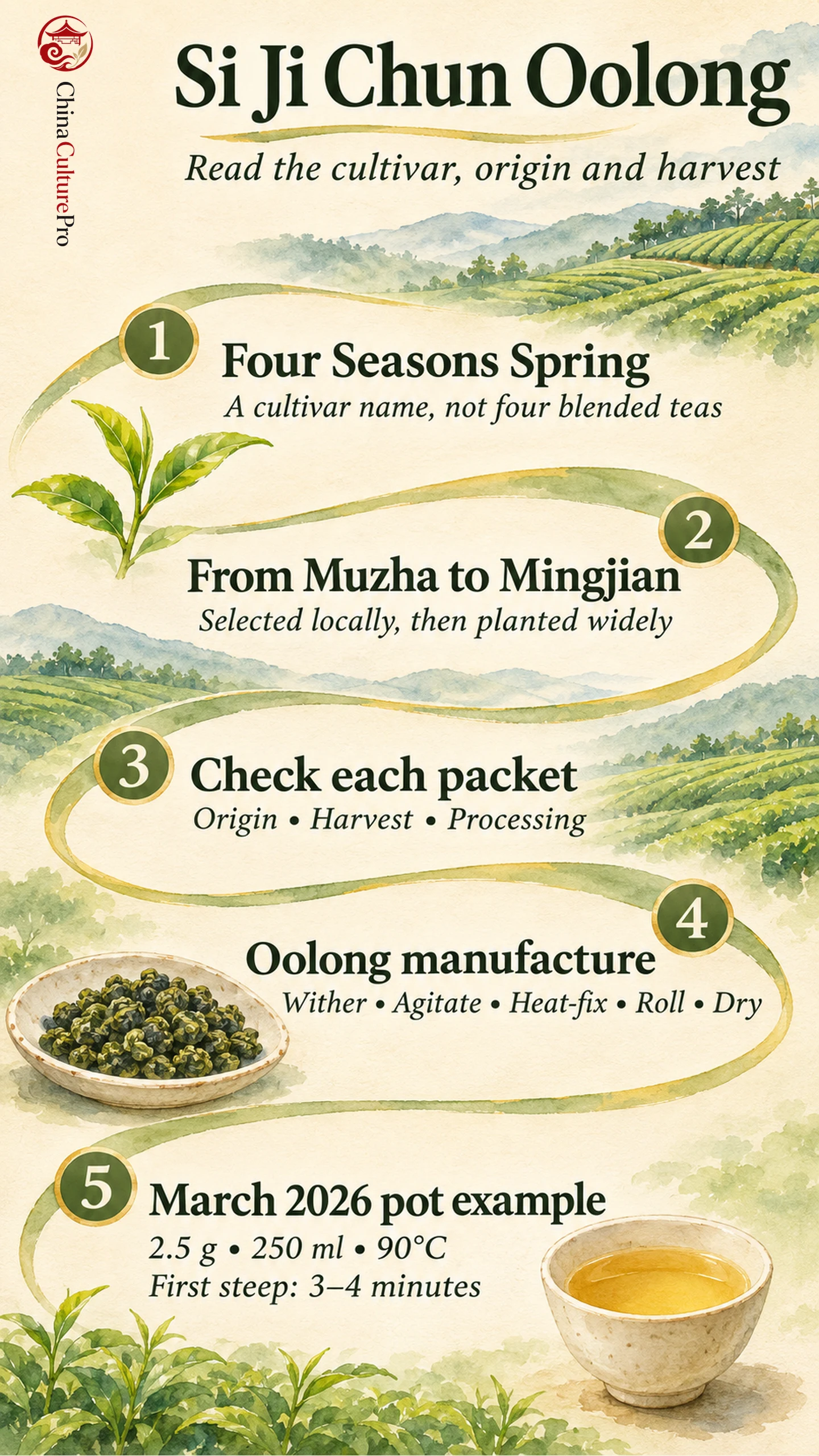
Understanding the plant first makes it easier to read a Four Seasons label without confusing its name with the harvest.
From Muzha Selection to Mingjian Tea Gardens
A cultural-archive account credits Muzha farmer Zhang Wenhui with selecting it in 1985 and Li Caiyun with introducing it to Mingjian, Nantou, where it was planted widely and named Four Seasons Spring. That account describes possible natural-hybrid parentage; it does not establish a confirmed pair of parents.[2]
Mingjian offered a different setting for expansion: flatter tea land suited to mechanized work. The official regional account links Si Ji Chun’s adoption there with strong early-spring and late-winter yields and suitability for machine harvesting. Its regional tea production is predominantly semi-ball-shaped, partially oxidized tea.[3]
One Cultivar, More Than One Origin
These two product records show why growing origin matters alongside the cultivar name.[6][7]
| Documented product | Growing origin | Details that keep the comparison specific |
|---|---|---|
| March 2026 Four Seasons oolong | Mingjian, Nantou, Taiwan | Si Ji Chun, 350 m, lightly oxidized |
| Doi Mae Salong Four Seasons oolong | Northern Thailand | Taiwanese cultivar grown locally; lightly oxidized, with no harvest date specified in the cited description |
The cultivar’s birthplace does not authenticate the origin of a packet. Read tea origin labels with that distinction in mind.
Processing and the Floral Flavor
In partially oxidized tea-making, withering removes moisture and begins changes in aroma. Agitation redistributes moisture and bruises leaf tissue, helping oxidation develop. Heat fixation checks enzyme activity before subsequent rolling and drying. These operations explain why the cultivar and finished tea type are different pieces of information.[4]
The March 2026 Mingjian example has reported floral sweetness, honeysuckle-like fragrance and a lightly creamy finish. The Thai example emphasizes floral, vegetal and herbal notes.[6][7]
Season also matters. Research using Si Ji Chun for partially oxidized tea found that grassy notes declined sharply during the heating stage in spring and winter samples, while floral character increased. Summer and autumn samples followed a different sensory pattern, with less pronounced loss of grassy character. This supports comparing actual batches rather than reading “Four Seasons” as a promise of unchanging flavor.[5]
Choosing and Brewing Four Seasons Oolong
Check that your packet contains a floral rolled oolong before applying this method. The March 2026 Mingjian example uses:[6]
- Measure: Use 2.5 g of tea and 250 ml of water, leaving room for the leaves to expand.
- Infuse: Add water at 90°C and steep for three to four minutes.
- Serve: Pour or strain the infusion away from the leaves.
This is a pot-style example, not a high-leaf-dose small-pot method. Follow your packet’s instructions when supplied. Keep brewing water and measured volume consistent while changing one factor at a time.
FAQs About Si Ji Chun Oolong
Does Si Ji Chun Mean Exactly Four Harvests?
No. A science-museum cultivar profile records up to seven harvests in a year. That is a possible maximum, not a fixed schedule for every garden.[8]
Is Si Ji Chun the Same as TTES No. 15?
No. Si Ji Chun is a farmer-selected local cultivar. The official numbered-variety list identifies TTES No. 15 as Baiyan, a different cultivar.[1][9]
Is Every Si Ji Chun Tea an Oolong?
No. The cultivar is commonly used for partially oxidized tea, but official educational material also records black tea and occasional green-tea production. Processing determines the finished category.[8]
Fuentes
[1] Tea and Beverage Research Station. 四季春
[2] Hu Zhiyi / National Taiwan Craft Research and Development Institute. 臺灣茶樹品種-四季春
[3] Tea and Beverage Research Station. 中南部各茶區特色說明
[4] Tea and Beverage Research Station. 臺灣特色茶分類及加工製程簡介
[5] Chen Yushun. 包種茶製程期間感官特性與香氣變化之關係
[6] Curious Tea. Four Seasons Oolong
[7] Siam Tea Shop. DMS Si Ji Chun Four Seasons Oolong Tea
[8] National Taiwan Science Education Center. 四季春
[9] Tea and Beverage Research Station. 常見問答集-茶業資訊推廣