


Quick Answer: What Is Sichuan Covered-Bowl Tea?
Sichuan covered-bowl tea is a way of brewing and drinking tea with a gaiwan(盖碗,gàiwǎn), especially associated with Chengdu’s teahouses.[1][4]
- Three pieces: A bowl holds the tea, a saucer supports it, and a lid helps manage heat and floating leaves.[1]
- Drinking: Tea can be sipped directly through a gap beside the lid.[2]
- Flavor: The leaves determine the drink; the vessel is not a tea variety.
- Setting: Conversation and repeat cups belong to the experience, alongside the tea itself.[1]
A covered bowl does not require one fixed blend, manufacturing process or elaborate performance.
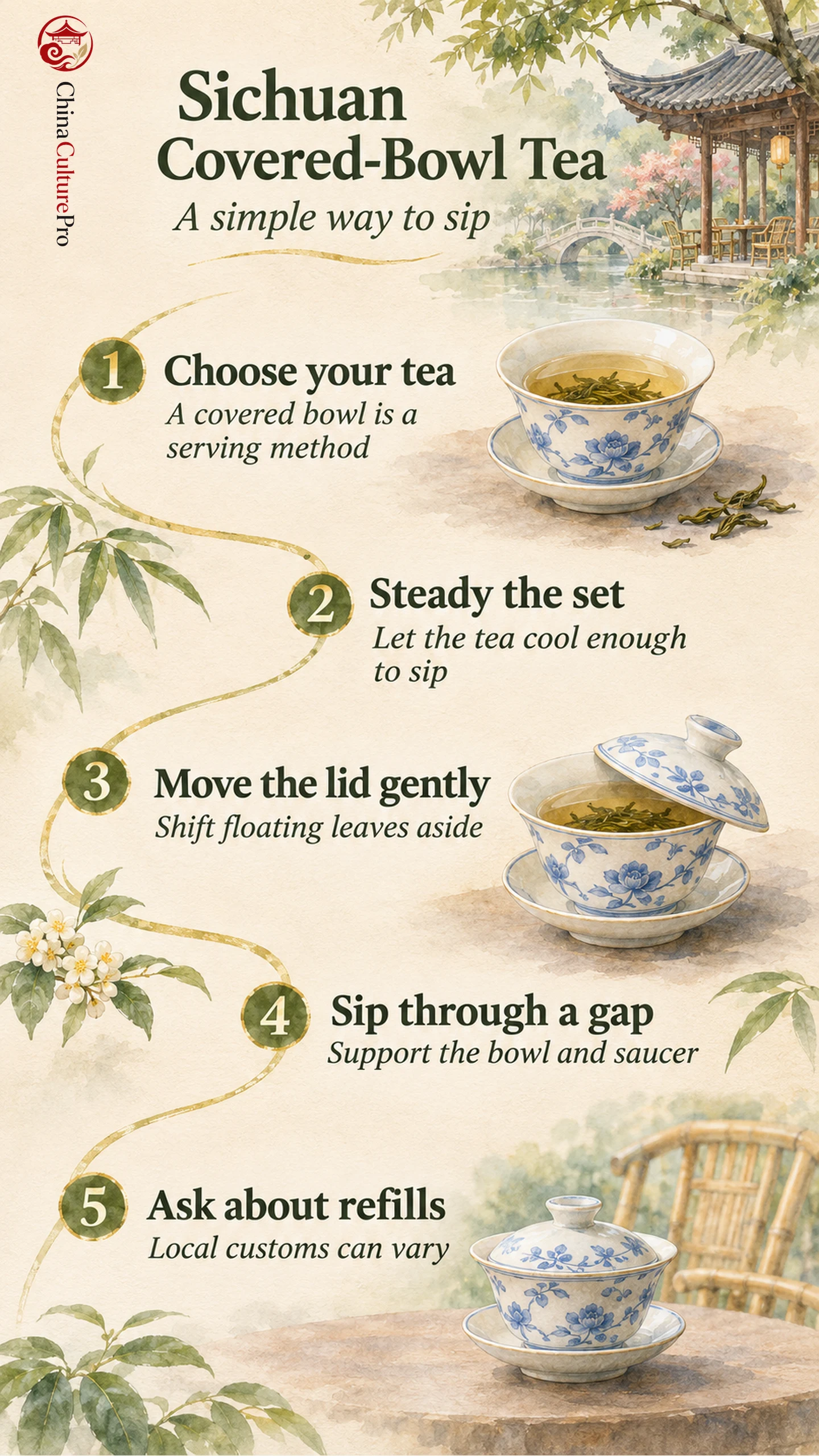
Start by understanding what the three pieces do. Choosing the tea and learning to sip it are separate steps.
The Three Pieces of a Gaiwan
Porcelain is common, while some sets have a metal saucer with a recess that fits the bowl’s foot.[2]
| Piece | Practical role |
|---|---|
| Bowl | Holds leaves and water; its wider mouth makes filling and leaf movement easier |
| Lid | Helps retain heat, stir the tea and hold floating leaves back while drinking |
| Saucer | Supports and steadies the bowl when lifting it or setting it down |
Origins: A Saucer Story and a Living Teahouse Tradition
A Chengdu local-history account cites a Tang-period anecdote about Cui Ning’s daughter using a saucer, then a ring on it, to steady a hot tea cup. The story concerns a cup support. It is not proof that the complete modern bowl, lid and saucer set was invented at that moment.[3]
The living practice has its own modern documentation. Sichuan’s recommended local standard DB51/T 2504-2018 addresses covered-bowl tea procedures and techniques for brewing and drinking in teahouses and tea-related activities. Its scope is service and preparation, not the manufacture of one named leaf tea.[4]
Which Tea Goes in the Bowl?
Jasmine green tea provides a concrete example. A supplier’s account of Guanyin Pavilion Teahouse describes the owner’s preference for jasmine fragrance that does not overwhelm the drink, with enough body to remain enjoyable through repeated infusions. Its associated product was listed as spring 2026 stock when checked.[5]
That is one teahouse’s selection, not a province-wide formula. Ask which tea is being served, whether it is scented, and what preparation the staff recommends. A cultivar or tea-type name tells you something about the leaves; “covered-bowl tea” tells you how they are served.
How to Sip Tea from a Gaiwan
The lid is useful as a movable barrier, not a strainer that must close tightly. A simple direct-drinking sequence is:[2]
- Settle: Keep the bowl stable on its saucer and allow the tea to cool enough to sip.
- Clear: Move the lid gently across the surface to shift floating leaves aside.
- Sip: Leave a small opening between lid and rim, supporting the set steadily as you drink.
- Replace: Return the bowl to the table and rest the lid loosely on top.
If the set feels awkward or too hot, set it down and ask staff to demonstrate. Tea remains in contact with the leaves while you drink, so this is different from immediately emptying the bowl into a separate serving vessel.
Tea, Conversation and Refills
In Chengdu teahouses, the bowl can accompany conversation, card games, storytelling or business discussions. The social use matters as much as an elegant pouring display; neither silence nor a staged ceremony defines every visit.[1]
Local guidance describes etiquette as generally relaxed and dependent on the tea and equipment. Ask staff how refills work at your table.[6]
FAQs About Sichuan Covered-Bowl Tea
Is Covered-Bowl Tea the Same as Gongfu Tea?
Not necessarily. A gaiwan can serve as the drinking bowl described here or as a brewing vessel from which tea is poured into other cups. The vessel alone does not identify the whole method.[3]
Does the Bowl Determine Water Temperature?
No. Choose temperature, leaf quantity and contact time for the actual tea. The gaiwan’s shape does not provide one universal brewing recipe; water for Chinese tea is a separate consideration.
Do Lid Positions Mean the Same Thing Everywhere?
Do not assume a universal code. Etiquette varies with the setting and equipment. Ask staff about local practice rather than treating a photographed lid position as an instruction.[6]
Fuentes
[1] China Daily / Chinaculture. Brewing up a sense of intimate community
[2] CNR Sichuan. 四川风俗之“盖碗茶”
[3] Chengdu Local Chronicles Compilation Office / Sichuan Local Chronicles Office. 盖碗茶的起源
[4] National Public Service Platform for Standards Information. DB51/T 2504-2018 四川盖碗茶茶艺程式与技法
[5] Bitterleaf Teas. 100-Year-Old Sichuan Tea House Experience Spring Jasmine Green Tea
[6] GoChengdu. Drinking Tea Like Chengdu People I