


Quick Answer: What Does Qingxin Oolong Mean?
Qingxin oolong(青心烏龍,qīngxīn wūlóng)names a tea cultivar, not one finished tea. Qingxin is rendered “Green Heart” in English labels; Chin-Shin-Oolong is another romanization.[1][5]
- Plant: A traditional, late-budding cultivar grown in Taiwan.
- Uses: Leaves can become Baozhong(包種茶,bāozhǒng chá), rolled oolong, roasted oolong or black tea.
- Place: The cultivar name and the growing location are separate information.
- Flavor: The plant contributes character, while location and processing shape the finished cup.[1][2][4][5]
A Qingxin label alone does not specify mountain, roast, harvest or brewing parameters.
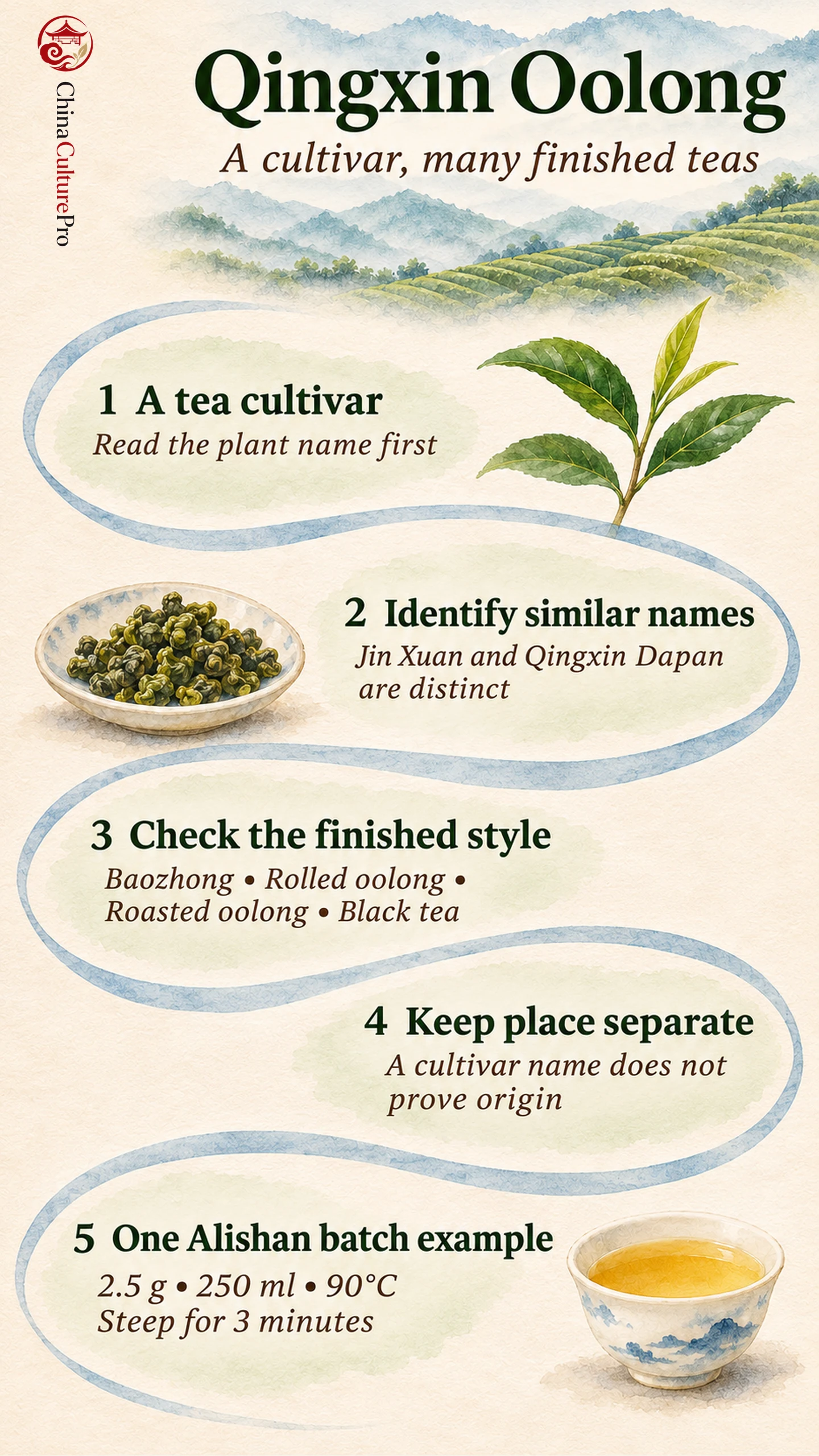
Start with the plant, then read how and where its leaves became tea.
Origins and Features of the Plant
The official cultivar profile describes introduction from mainland China. An archived account by tea researcher Hu Zhiyi describes local selection during Japanese colonial rule and vegetative propagation establishing the line in Taiwan.[1][2]
The plant has elongated, dark-green leaves with a soft, elastic texture and relatively late budding. The official profile also records weaker drought and disease resistance.[1]
Ruanzhi oolong(軟枝烏龍,ruǎnzhī wūlóng), meaning soft-branch oolong, is among its recorded aliases. The archive associates Qingxin with cooler growing conditions and its important role in mountain tea production.[1][2]
Qingxin, Jin Xuan and Qingxin Dapan
| Plant name | Identification point |
|---|---|
| Qingxin oolong | The traditional late-budding cultivar also called Ruanzhi oolong |
| Jin Xuan(金萱,jīnxuān) | TTES No. 12, a different cultivar |
| Qingxin Dapan(青心大冇,qīngxīn dàmǒu) | A separate cultivar associated especially with northern Taiwan and Oriental Beauty production |
The official comparison records three distinct cultivars; Qingxin Dapan is not another spelling of Qingxin oolong.[3]
Other labels, including Si Ji Chun oolong, can also identify a plant rather than a mountain. Use tea cultivar versus tea type to keep those categories distinct.
One Cultivar, Different Finished Teas
The National Taiwan Science Education Center lists several common uses of Qingxin: light-style strip-shaped Baozhong, light-style rolled oolong, roasted rolled oolong and black tea. One cultivar can therefore appear in several shapes and processing categories.[4]
A spring 2026 Alishan batch offers one example: a lightly baked oolong described with floral and buttery notes, creamy texture and a lingering baked finish. These are the supplier’s notes for that batch.[5]
Choosing and Brewing a Qingxin Tea
Read the full cultivar name, producing place, harvest and finish. If a seller only says “Qingxin,” ask whether the product is a lightly finished oolong, roasted tea, black tea or another style. Chinese tea origin labels explain why the plant statement cannot replace a geographical one.
For the named spring 2026 Alishan batch, the published cup-brewing method is:[5]
- Measure 2.5 g of tea for 250 ml of water.
- Add water at 90°C and steep for three minutes.
- Pour off the infusion to separate the drinking tea from the leaves.[5]
Follow your finished tea’s directions. For comparisons, keep brewing water and equipment consistent so the preparation does not obscure their differences.
FAQs About Qingxin Oolong
Is Ruanzhi Oolong Another Name for Qingxin?
Yes. The official cultivar profile records Ruanzhi oolong among Qingxin oolong’s aliases. It is not, by itself, a separate mountain or roast designation.[1]
Does Qingxin Mean the Tea Must Be Oolong?
No. Qingxin names the plant. Its leaves are also made into black tea, as documented in both the researcher’s archive and the science center’s cultivar display.[2][4]
Does the Cultivar Name Prove Taiwanese Origin?
No. The tea research station discusses distinguishing Taiwan-grown Qingxin products from those produced outside Taiwan. Check the stated origin separately.[6]
Fuentes
[1] Tea and Beverage Research Station. Qingxin oolong cultivar profile
[2] Hu Zhiyi, National Cultural Memory Bank. Taiwan tea cultivars: Qingxin oolong
[3] Tea and Beverage Research Station. Introduction to cultivar characteristics
[4] National Taiwan Science Education Center. Qingxin oolong
[5] Curious Tea. Alishan Competition Qing Xin Oolong, spring batch
[6] Tea and Beverage Research Station. Clarifications of tea-related questions