

Quick Answer
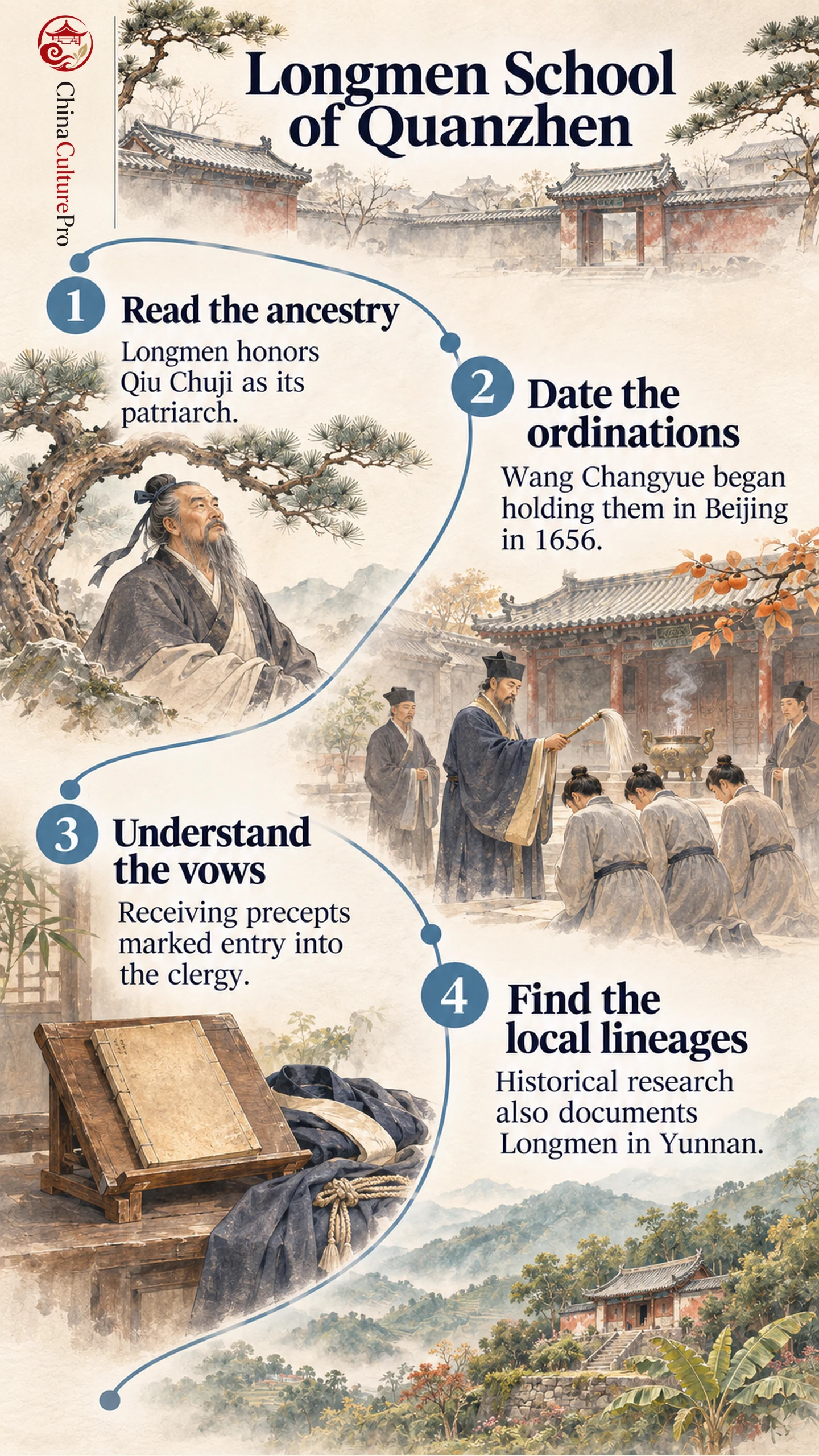
The Longmen lineage (龍門派, Lóngmén Pài), or Dragon Gate, is a major branch of Quanzhen Daoism (全真道, Quánzhēn Dào). It traces its spiritual ancestry to Qiu Chuji (丘處機, Qiū Chǔjī). Its institutional history is clearer in the early Qing, when Wang Changyue (王常月, Wáng Chángyuè) held public ordinations in Beijing.[1][2]
- Ancestry: Longmen remembers Qiu Chuji as a founding patriarch.
- Ordination: Wang Changyue gave the lineage a public precepts program in the seventeenth century.
- Local branches: Historical Longmen communities did not all operate from Beijing.
The ancestral claim and the documented Qing institution answer different historical questions.[1][2][3]
The Beijing monastery had already been a center of Quanzhen under Qiu Chuji in the thirteenth century. The site acquired its familiar name in the early Ming. Its association with Qiu and its later use for ordination show two distinct periods of its history.[2][4][5]
How Longmen Remembers Qiu Chuji
Qiu Chuji was one of the principal disciples of the founder of Quanzhen. His followers organized a major burial gathering in 1228 after his death the previous year. The gathering brought Daoists and lay supporters together, making his community and its leadership visible in a public ceremony.[1][4]
Later Dragon Gate accounts trace the lineage to him as patriarch. That attribution establishes his place in its religious memory. Documentary evidence gives a firmer view of how the lineage was organized in the Qing, several centuries after the burial. The guide to religious Daoism gives the broader setting for Quanzhen’s formation.[1][2][3]
What Changed at White Cloud Temple in 1656
In 1656 Wang Changyue began holding public ordinations at White Cloud Temple (白雲觀, Báiyún Guàn) in Beijing. In the ceremony of receiving precepts (受戒, shòujiè), novices took vows at an authorized monastery and were recognized as members of the clergy. Government sponsorship gave the ceremonies an institutional base.[2]
Wang’s program joined rules of conduct with spiritual teaching. The public character of ordination mattered because it made entry into the clergy something a religious institution could recognize. The rites helped give this branch of Quanzhen a framework for transmitting discipline.[1][2]
Why Longmen History Extends Beyond Beijing
Research on a local lineage in late Ming and early Qing Yunnan traces a Longmen history outside the capital. The genealogy written for an institution in Beijing supplies one kind of evidence. Accounts of particular teachers in another region help establish the local succession.[1][3]
Quanzhen in its organized monastic form is associated with celibacy, meditation, and internal alchemy. Historians also document non-monastic forms associated with its name. White Cloud Temple is therefore a starting point for the history of Longmen ordination, while related traditions also developed through local teachers.[1][3]
FAQs About Longmen Quanzhen
Are Longmen and Quanzhen the same?
Quanzhen is the broader tradition. Longmen is a major branch whose early Qing ordinations became particularly influential.[1][2]
Who founded Longmen?
The lineage honors Qiu Chuji as its patriarch. Wang Changyue organized a historically documented form of Longmen centered on public ordination in the early Qing.[1][2][3]
What happened in 1656?
Wang Changyue began conducting public ordinations at Beijing’s White Cloud Temple. Novices formally received precepts there.[2]
Fuentes
[1] Fabrizio Pregadio, Stanford Encyclopedia of Philosophy. Religious Daoism, section 3.6
[2] Monica Esposito. Longmen Taoism in Qing China: Doctrinal Ideal and Local Reality
[3] Richard G. Wang, Institute of East Asian Studies, University of California, Berkeley. A Local Longmen Lineage in Late Ming–Early Qing Yunnan
[4] Journal of Chinese History. Reburials of Eminent Masters: The Construction of Quanzhen Daoist Lineages in North China under Mongol Rule
[5] Beijing Municipal Government. White Cloud Temple and its history