

Quick Answer: Who Was the Buddhist Pilgrim Yijing?
Yijing (义净, Yìjìng, 635–713) was a Tang Buddhist monk and translator. He sailed from southern China in 671, studied in Srivijaya (室利佛逝, Shìlìfóshì) and at Nālandā (那烂陀, Nàlàntuó) in India, and returned to China in 695. His account describes monastic practices he encountered abroad.[1][2][3]
- Route: He traveled by sea through a Buddhist center in Sumatra.[2]
- Study: He spent years studying in India and collecting texts.[3]
- Record: He wrote about rules and practices that governed ordinary monastic life.[3][5]
The voyage helps explain why a text about daily practice also preserves evidence of Buddhist connections across the sea.
Yijing (义净, Yìjìng) traveled to study Buddhist texts and observe the way monasteries used them. His record brings small decisions about daily life into the history of a long voyage.
Why Yijing Stopped in Srivijaya
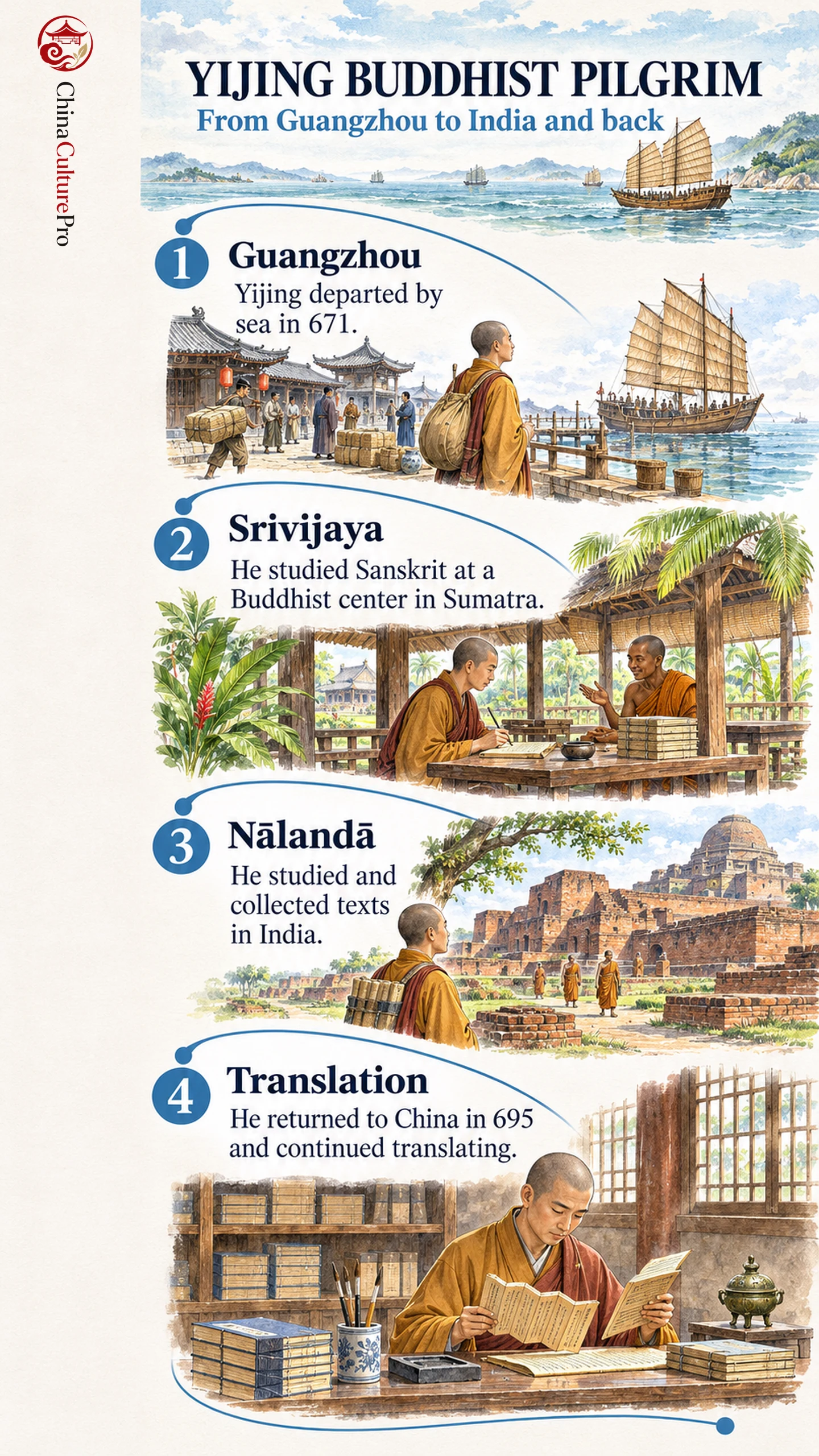
Yijing sailed from Guangzhou in 671. He studied Sanskrit in Srivijaya (室利佛逝, Shìlìfóshì), a Buddhist center in Sumatra, before continuing to India by sea. He studied at Nālandā (那烂陀, Nàlàntuó), then spent time again in Srivijaya on the way home. These places were part of a network of study as well as the maritime routes used by merchants and travelers.[1][2][3]
What He Recorded About Monastic Life
Yijing’s Record of Buddhist Practices Sent Home from the Southern Sea describes rules for conduct and daily activity. A chapter on foods permitted under monastic rules shows how rules about everyday meals could shape communal life. The text helps readers compare customs Yijing saw or learned about. It also conveys his judgments about proper practice.[5]
The 1896 English translation by Junjirō Takakusu includes a foldout map. The map helps a reader follow the route. It was prepared for readers centuries after the journey.[4]
From Travel Record to Translation
Yijing returned to China in 695 and continued work on Buddhist translations, including texts in the Mūlasarvāstivāda Vinaya tradition. The monastic code and the travel record serve different purposes. His concern with discipline gives him something in common with Faxian, while his maritime journey differs from Xuanzang’s better-known overland journey.[1][3]
In Chinese, his name is written differently from the title of the I Ching, a work also called the Book of Changes.
FAQs About the Buddhist Pilgrim Yijing
Is the monk Yijing the same as the Yijing or I Ching book?
The monk’s name and the title of the Book of Changes can look similar in English. They have different Chinese characters and refer to different subjects.
Did Yijing travel to India by sea?
He sailed from Guangzhou and traveled through Southeast Asian ports on his way to India.
What did he study at Nālandā?
He studied Buddhist texts and teachings. Monastic discipline became a major focus of his record and translation work.
Fuentes
[1] Columbia University, Asia for Educators. Tansen Sen, The Travel Records of Chinese Pilgrims
[2] National Library Board, Singapore. Journey to the West: Dusty Roads, Stormy Seas and Transcendence
[3] Tsadra Foundation, Buddha-Nature. Yijing
[4] Smithsonian Libraries and Archives. A Record of the Buddhist Religion as Practised in India and the Malay Archipelago
[5] Clarendon Press, digitized edition. J. Takakusu, A Record of the Buddhist Religion as Practised in India and the Malay Archipelago