


Quick Answer: What Is the I Ching?
The I Ching (易经, Yìjīng), or Book of Changes, is a Chinese classic that combines an ancient divination text with later commentaries about change, conduct and the world.[1][6]
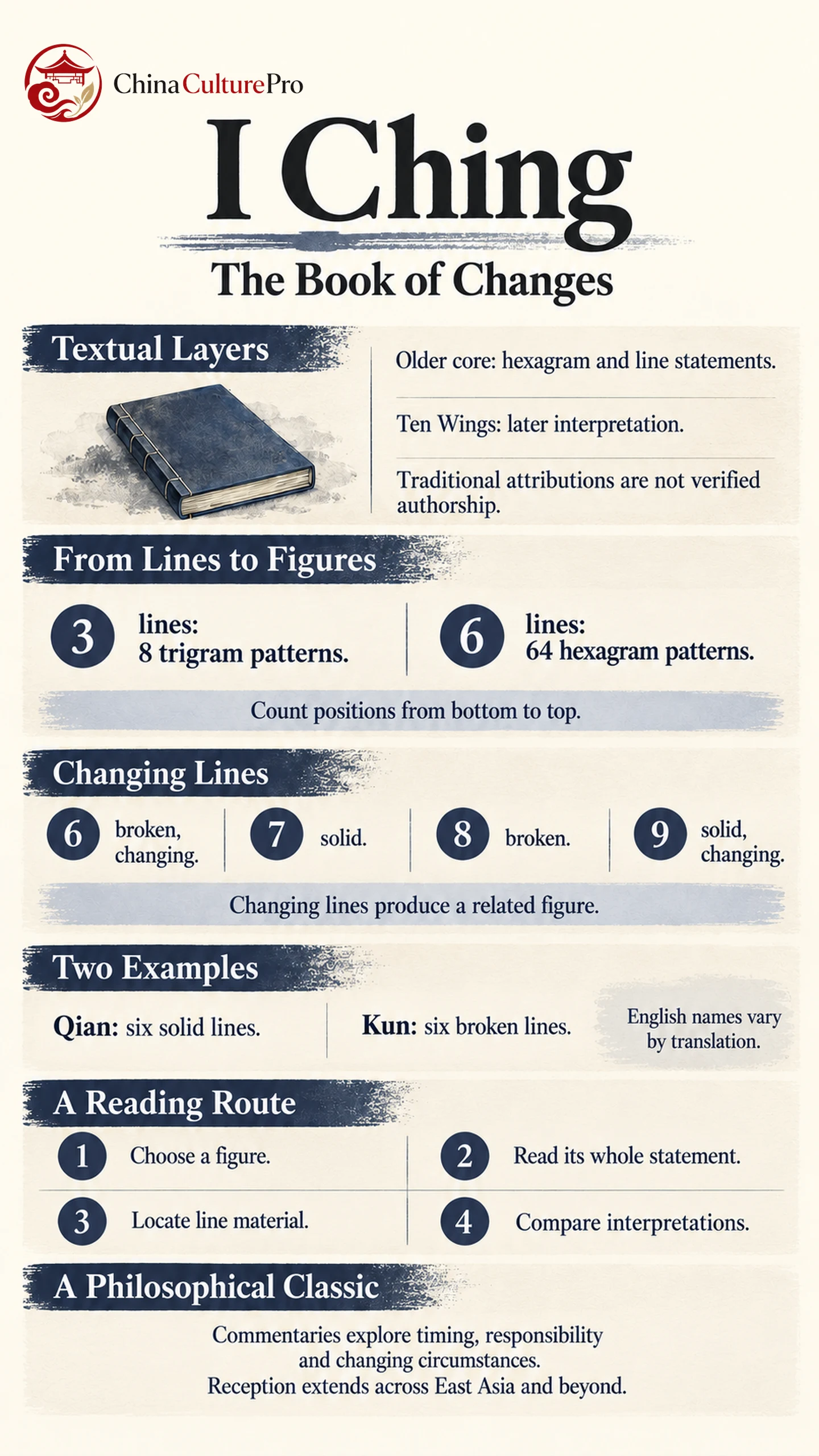
- Its 64 hexagrams are figures of six solid or broken lines.
- Three-line patterns form the eight trigrams; two trigrams make a hexagram.
- The older Zhouyi (周易, Zhōuyì) material includes hexagram and line statements.
- The Ten Wings (十翼, Shíyì) add later interpretive and philosophical layers.
Traditional accounts associate its formation with legendary and historical sages. Those attributions should be distinguished from verified authorship.
The I Ching can look like a symbol chart, a fortune-telling manual or a philosophical book, depending on the edition and the reader’s purpose. Its history includes all those uses. Understanding the figure, the short ancient statement and the later explanation as different layers helps keep a modern reading grounded in the text.
One Book with Several Textual Layers
The received book is a composite rather than the work of one identifiable author. Its older core contains named hexagrams, statements applying to a whole figure, and statements attached to individual lines. The later Ten Wings discuss images, patterns and ethical implications.[6]
Traditional narratives associate the trigrams with Fu Xi, the hexagram statements with King Wen, the line statements with the Duke of Zhou, and the commentaries with Confucius. These accounts establish a prestigious cultural lineage; they do not prove that those figures personally wrote the received text.[2]
Excavated manuscripts show differences in wording, figures and arrangement. They help explain the book’s development and warn against imagining that every detail of a familiar modern edition existed unchanged from the beginning.[2]
How Lines, Trigrams and Hexagrams Fit Together
Solid and broken lines became associated with yin and yang (阴阳, yīnyáng): the broken form with yin, the solid form with yang. With two possible forms at each of three positions, there are eight trigrams. Bagua (八卦, bāguà) is the name for this eight-trigram set.[1]
A hexagram has six positions, so there are 64 possible solid/broken patterns. The lower three lines form its lower trigram; the upper three form its upper trigram. Line positions are conventionally numbered from the bottom upward, making the bottom line first and the top line sixth.[1][3]
The eight-trigram guide explains the names and associations. A hexagram is more than the addition of two dictionary meanings: the sequence, line positions and attached text all contribute to interpretation.
The neighboring yin-yang and Five Elements systems should also remain distinct. A six-line figure is not a diagram containing six chemical elements.
What Changing Lines Mean in a Consultation
Consultation methods generate a six-line figure. Familiar approaches use yarrow stalks or three coins; each line receives a value from 6 to 9. In a common convention, 6 and 9 are changing lines, while 7 and 8 are unchanging.[2][3]
| Value | Initial line | If it changes |
|---|---|---|
| 6 | Broken, yin | Becomes solid |
| 7 | Solid, yang | Remains solid |
| 8 | Broken, yin | Remains broken |
| 9 | Solid, yang | Becomes broken |
Changing the marked lines produces a related hexagram. Readers may consider the initial figure, relevant line statements and the resulting figure together. Detailed rules for multiple changing lines vary by interpretive method; the edition should explain the convention it follows.[3]
The operation supplies a structured encounter with symbols and texts. It does not establish that a randomly generated figure reliably predicts a person’s future. Its place within Chinese divination traditions is a cultural fact separate from that predictive claim.
Qian and Kun: Two Clear Examples
Qian (乾, Qián), the first hexagram in the received sequence, has six solid lines. Kun (坤, Kūn), the second, has six broken lines. Both use the same line form throughout, so they provide straightforward examples for recognizing a complete six-line figure.[4][5]
Later readings associate Qian with Heaven, creative activity and strength, and Kun with Earth, receptivity and sustaining activity. These are interpretive relationships rather than instructions to label strength good and receptivity bad. The figures acquire meaning through their statements and commentaries.[1]
English names such as “The Creative” and “The Receptive” reflect translation choices. Another edition may use different labels. Retaining Qian and Kun alongside an English rendering helps identify the same figure across translations.
How to Begin Reading a Hexagram as a Text
You can study the book without conducting a divination. This reading route separates what the page actually contains before asking what a passage might mean for a present situation.
- Choose one hexagram. Start with Qian or Kun and identify its six-line figure.
- Read the whole-figure statement. Read the hexagram statement before isolating a line.
- Locate the line material. Distinguish the six line statements from later explanatory commentary.
- Compare interpretations. Check how the edition translates the same passage and explains its textual layer.
Keep a note of whether a sentence belongs to the ancient statement, an early commentary or a modern translator’s explanation. This small distinction prevents a memorable modern paraphrase from being quoted as the exact words of an ancient author.
A culturally responsible reading also identifies the limits of an analogy. A passage about waiting, withdrawal or completion can suggest a question about conduct without becoming a guaranteed instruction for an unrelated decision.
Why the Book Became a Philosophical Classic
The commentarial tradition used the Changes to consider timing, responsibility and the human response to changing circumstances. That development helped make a divination text central to Confucian learning, while other readers approached it through additional philosophical and religious concerns.[6]
Later thinkers, including Zhu Xi, contributed to the history of interpreting the Changes. Readers across East Asia, and eventually globally, encountered different combinations of text, commentary and practice. Its enduring presence in Chinese philosophy cannot be reduced to one method of consultation.[1][6]
Within Chinese cosmology, the book offers a language of patterned transformation. For a beginner, the most useful habit is to ask which textual layer makes a particular claim and how the interpretation connects it to the figure.
FAQs About the I Ching
Are I Ching and Yijing different books?
No. They are different romanizations of the same Chinese title, commonly translated as Book of Changes or Classic of Changes.
Did Confucius write the I Ching?
Traditional accounts associate him with the commentaries. The received work has multiple layers and cannot responsibly be presented as a single book demonstrably written by Confucius.
Do you need to cast coins to read it?
No. You can study the figures, statements and commentaries as historical and philosophical texts. Casting belongs to consultation practices.
Are there 64 or 4096 hexagrams?
There are 64 solid/broken six-line figures. Counting four possible values at each of six positions produces 4096 casting configurations, because changing status adds information beyond the basic figure.
Fuentes
[1] Stanford Encyclopedia of Philosophy. Chinese Philosophy of Change
[2] Bent Nielsen. Notes on the Origins of the Hexagrams of the Book of Change
[3] Steve VanDevender, University of Oregon hosted project. I Ching Readings: Method Explanation
[4] Chinese Text Project. Book of Changes: Qian
[5] Chinese Text Project. Book of Changes: Kun
[6] Oxford University Press. The Yijing: A Guide