

Quick Answer
A Dragon King (龍王, Lóngwáng) can be a local deity associated with rain and water. In some parts of China, communities petitioned a Dragon King during drought or sought favorable weather for crops. The shrine’s location, the people who sponsored the rite, and the source that records it help identify which Dragon King is meant.[1][2][3]
- Place: A shrine may serve a valley, county, or group of villages.
- Petition: Historical records describe offerings for rain during drought.
- Water management: In the Hexi Corridor, some temples were tied to irrigated agriculture.
The rites record what people asked for and how they organized the request.[1][2][3]
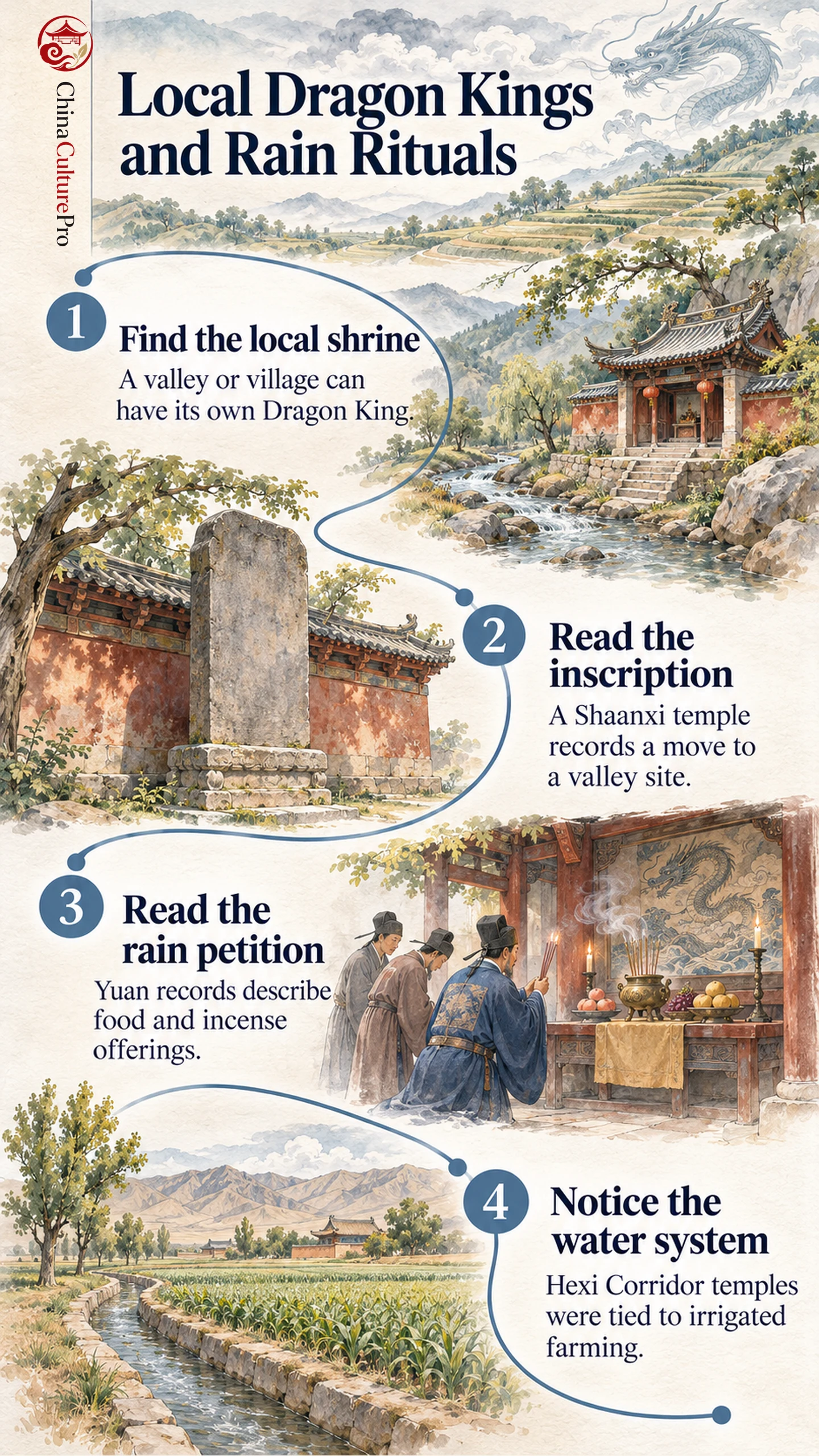
In northern Shaanxi, a temple inscription tells why worship of a local Dragon King moved to a valley site. It connects the move from Chenjiapo to the features of the valley. An inscription like this ties the title Dragon King to a particular place and community.[1]
Why a Local Shrine Had Its Own Dragon King
Dragon King shrines could be associated with a small group of settlements. Their deities had separate local stories even when they shared a title. In Dragon King Valley (龍王溝, Lóngwánggōu), near Zhenchuan in northern Shaanxi, the Black Dragon King (黑龍大王, Hēilóng Dàwáng) is known through the valley temple and its accounts of the deity’s presence there.[1]
The title also appears in literature and larger pantheons. The overview of the Dragon King in Chinese mythology explains why a title associated with the Four Seas can also be used for a local authority. A valley shrine’s name and records are the better clues to the role of the deity honored there.[1]
What a Historical Petition for Rain Involved
Yuan-era stone inscriptions describe local officials at Dragon King temples making petitions for rain. In the cases studied, officials first purify themselves, then offer food and incense at the temple. The sequence identifies a religious request made at a specific place.[2]
The inscriptions also show that a rite could involve officials as well as devotees connected with a shrine. Iiyama notes that all three inscriptions concern counties with major Dragon King temples. The records show officials making use of established local shrines in a period of agricultural concern.[1][2]
How Temples Became Part of Local Water Arrangements
In the Hexi Corridor of northwestern China, irrigated farming depended on limited supplies of water. A historical study traces Dragon King temples there from places of sacrifice and prayer into institutions that also expressed the region’s organization of irrigation. The local temple was part of the setting in which communities dealt with water together.[3]
At the Black Dragon King’s temple in Shaanxi, the religious revival of the 1980s and 1990s brought petitions for concerns beyond rain, including business success. The two cases show different changes: one tied to an irrigation system and another to an expanding range of requests at a valley shrine.[1][3]
FAQs About Local Dragon Kings and Rain Rituals
Were local Dragon Kings the same as the rulers of the Four Seas?
Local traditions often concerned a named place and its own deity. Use the local shrine’s title and records to see how it identifies its Dragon King.[1]
Who could ask a Dragon King for rain?
The Yuan inscriptions document officials making petitions at local temples. Other records show individual communities maintaining their own shrines and seeking favorable weather for crops.[1][2]
Did Dragon King temples only concern rain?
Some handled a broader range of concerns. The temple near Zhenchuan, for example, has also drawn petitions about business.[1][3]
Fuentes
[1] Adam Yuet Chau. Ritual Terroir: The Generation of Site-Specific Vitality
[2] Tomoyasu Iiyama, Academia Sinica. A Tangut Family’s Community Compact and Rituals: Aspects of the Society of North China, ca. 1350 to the Present
[3] Jingping Zhang and Zhongjing Wang, Journal of Modern Chinese History. State and cult in six hundred years of irrigation activities in an arid area of China