


Quick Answer: What Is Feiyi?
Feiyi (肥遗, féiyí) refers to several creatures in the Shan Hai Jing (山海经, Shānhǎi Jīng), the *Classic of Mountains and Seas*. Two entries describe serpents associated with drought. A third uses the name for a small, brightly colored bird. The mountain name helps you tell the entries apart.[1][2][3]
- Mount Taihua: A serpent has six feet and four wings.
- Mount Hunxi: A serpent has one head and two bodies.
- Mount Ying: A quail-like bird has a yellow body and red beak.
An illustration may combine features that the text assigns to separate entries.
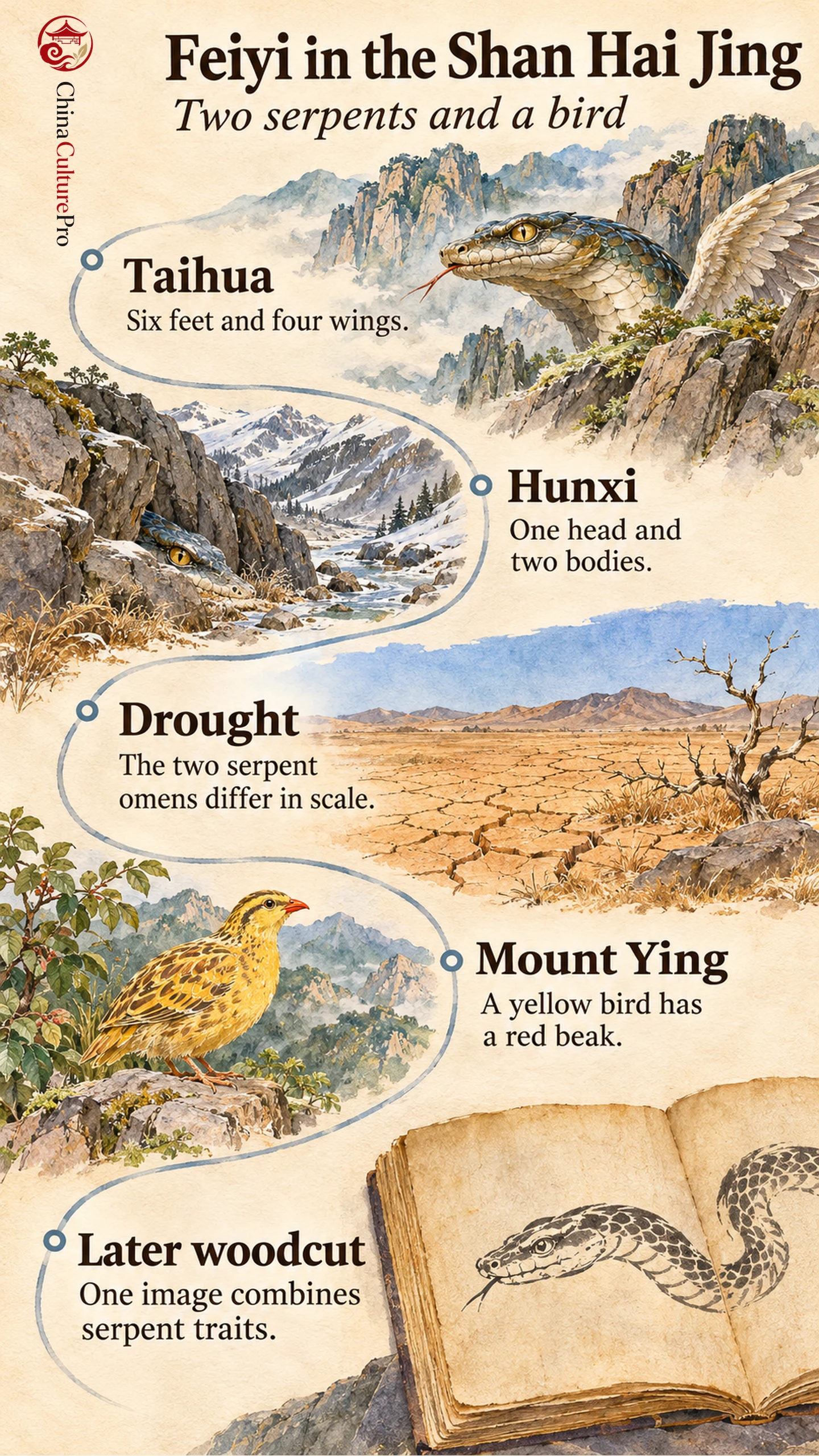
A feathered serpent, a serpent with a forked body and a yellow bird can all appear under the English name Feiyi. To recognize which one a source describes, look first at the mountain and then at the body.
The Winged Serpent of Mount Taihua
The Western Mountains entry describes Taihua as a steep, squared-off mountain that ordinary birds and beasts cannot inhabit. The passage goes on to describe a serpent with six feet and four wings. Its appearance signals severe drought across the realm.[1]
The main text and quotations collected alongside it transmit more than one written form of the creature’s name. Feiyi is the familiar rendering of 肥遗, which appears in parallel versions of the passage.[1] For identification, the combination of Taihua, feet and wings is more informative than the romanization alone.
The text connects a sighting with drought. That is a statement about how the omen works in the story. The passage leaves the shape of its wings and the cause of the drought unspecified.
The Two-Bodied Serpent of Mount Hunxi
At Mount Hunxi in the Northern Mountains, the text describes a serpent with one head and two bodies. Its appearance signals drought in the country where it is seen.[2] The number of bodies distinguishes it from the Taihua description, which specifies feet and wings without giving a second body.[1][2]
The two drought omens also differ in scale. The western entry speaks of drought under heaven. The northern entry refers to the country concerned.[1][2] Nüba’s drought story gives dry weather a different explanation: rain fails where the celestial woman remains.
The Yellow Bird of Mount Ying
The Mount Ying entry in the Western Mountains names a bird. It compares the shape to a quail and specifies a yellow body and red beak. The passage gives it a different effect within the book’s lore about animals. It does not tie this bird to the drought prediction.[3]
Keep the bird’s name apart from Feifei, the catlike animal of Mount Huo. The first test is whether the entry actually names a bird, serpent or catlike beast. A similar sound in English gives little guidance by itself.
When Illustrations Combine Details
A woodcut cataloged as coming from the *Sancai Tuhui* brings together a single head and paired bodies with feet and wings.[4] The paired bodies recall the Mount Hunxi entry, while the feet and wings recall Mount Taihua. The woodcut shows that artists could combine the traits in a single picture.
Other names also carry more than one image, as with the composite creature Feilian. For Feiyi, identify the mountain if the caption gives one, then check the anatomy. A picture labeled only with the creature’s name can follow either passage or an illustrated tradition of its own.
FAQs About Feiyi
Does Feiyi have one head or two?
The Mount Hunxi serpent has one head and two bodies. The Mount Taihua passage gives feet and wings without describing two heads.[1][2]
Does every Feiyi bring drought?
The two serpent entries link sightings with drought. The quail-like Feiyi at Mount Ying has a different role in the book.[1][2][3]
Is Feiyi the same as Feifei?
Feiyi and Feifei have different written names and appearances. Feifei is the catlike creature with a white tail. Feiyi names serpents and a bird.[1][2][3]
Fuentes
[1] Chinese Text Project. Classic of Mountains and Seas: Western Mountains, Mount Taihua
[2] Chinese Text Project. Classic of Mountains and Seas: Northern Mountains, Mount Hunxi
[3] Chinese Text Project. Classic of Mountains and Seas: Western Mountains, Mount Ying
[4] Source Library Gallery. Feiyi Woodcut from the Sancai Tuhui