
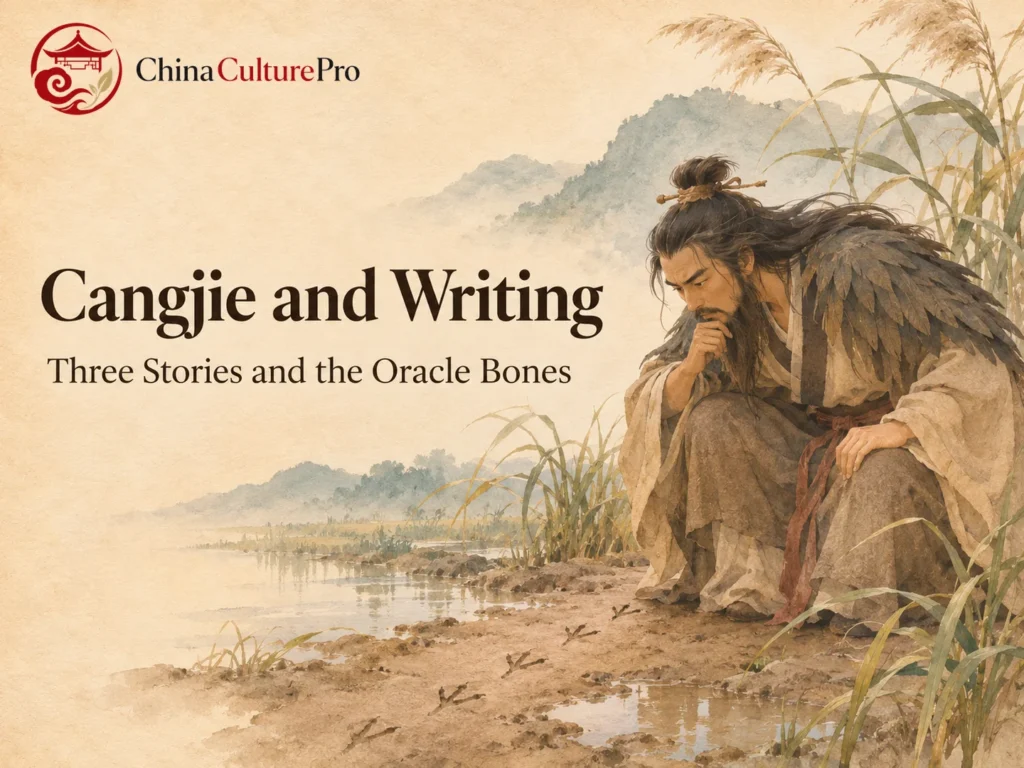

Quick Answer: Who Is Cangjie?
Cangjie (仓颉, Cāngjié) is the legendary figure credited with creating Chinese writing. One account says he noticed how tracks could distinguish birds and animals. Surviving inscriptions give a separate record of how writing was used in the late Shang dynasty.[1][4][5]
- Footprints: In a Han dictionary preface, tracks show how distinct marks can be recognized.[1]
- Omens: Another account has millet fall from the sky and ghosts cry at night.[2]
- Material evidence: Late Shang oracle bones preserve a script already able to record language.[4][6]
Read the old stories for the meanings they give to writing, then turn to the inscribed objects for its documented use.

Bird tracks and falling grain belong to different accounts. Read them alongside a late Shang bone inscription and each source answers a different question.[1][2]
Footprints in the Shuowen Preface
In the preface to the Shuowen Jiezi (说文解字, Shuōwén Jiězì), Xu Shen presents Cangjie as a scribe of the Yellow Emperor (黄帝, Huángdì). Cangjie sees that the tracks of birds and beasts have patterns distinct enough to tell apart. The preface uses that observation to explain how a written shape might carry a recognizable distinction. It goes on to discuss characters whose parts suggest a sound.[1]
Millet and Ghosts in the Huainanzi
The Huainanzi (淮南子, Huáinánzǐ) says the sky rained millet and ghosts wept at night when Cangjie made writing. The passage sets the event among inventions that change people’s habits. Its discussion asks what is lost as technical skill increases. The Xunzi (荀子, Xúnzǐ) uses the figure differently. It singles him out among many people who cared about writing and uses his reputation to make a point about concentration.[2][3]
What the Oracle Bones Can Show
Late Shang inscriptions from Yinxu (殷墟, Yīnxū), near Anyang, record questions put to diviners about matters such as weather and harvest. The inscriptions survive on objects such as ox shoulder blades and the undersides of turtle shells. The variety of things that oracle bone script can express shows that a developed writing system was already in use by this period. The bones show that people were writing by the late Shang. The earlier stages of development are harder to trace.[4][5][6]
FAQs About Cangjie
Do we know when Cangjie lived?
The written tradition places him in the legendary age of the Yellow Emperor. The archaeological evidence dates surviving inscriptions and gives no secure date for Cangjie’s lifetime.[1][4][5]
Does the footprints story say every character is a picture?
The story uses tracks to explain recognizable marks. Xu Shen’s preface also describes formations that combine a clue to meaning with a clue to sound, a pattern found in many Chinese characters in use today.[1]
Fuentes
[1] Palace Museum. Transcription of Xu Shen’s Shuowen Preface
[2] Huainanzi, Benjing xun. The Root of the Way
[3] Xunzi, Jiebi. Undoing Fixation
[4] UNESCO Memory of the World. Chinese Oracle-Bone Inscriptions
[5] Cambridge University Press, Radiocarbon. Radiocarbon Dating of Late Shang Oracle Bones
[6] William G. Boltz, World Archaeology. Early Chinese Writing