


Quick Answer: What Is Zhuyan?
Zhuyan (朱厭, Zhūyàn) is an ape-like creature in the Classic of Mountains and Seas. The Western Mountains chapter places it at Mount Xiaoci and gives it a white head and red feet. Its appearance is associated with the outbreak of armed conflict in the text.[1][2]
- Place: Zhuyan appears in a named mountain entry, alongside a description of local minerals.
- Appearance: Its pale head and red feet are the most specific visual cues.
- Omen: The chapter connects a sighting with war.
The short account identifies the animal by form and meaning rather than by a series of adventures.[1][2]
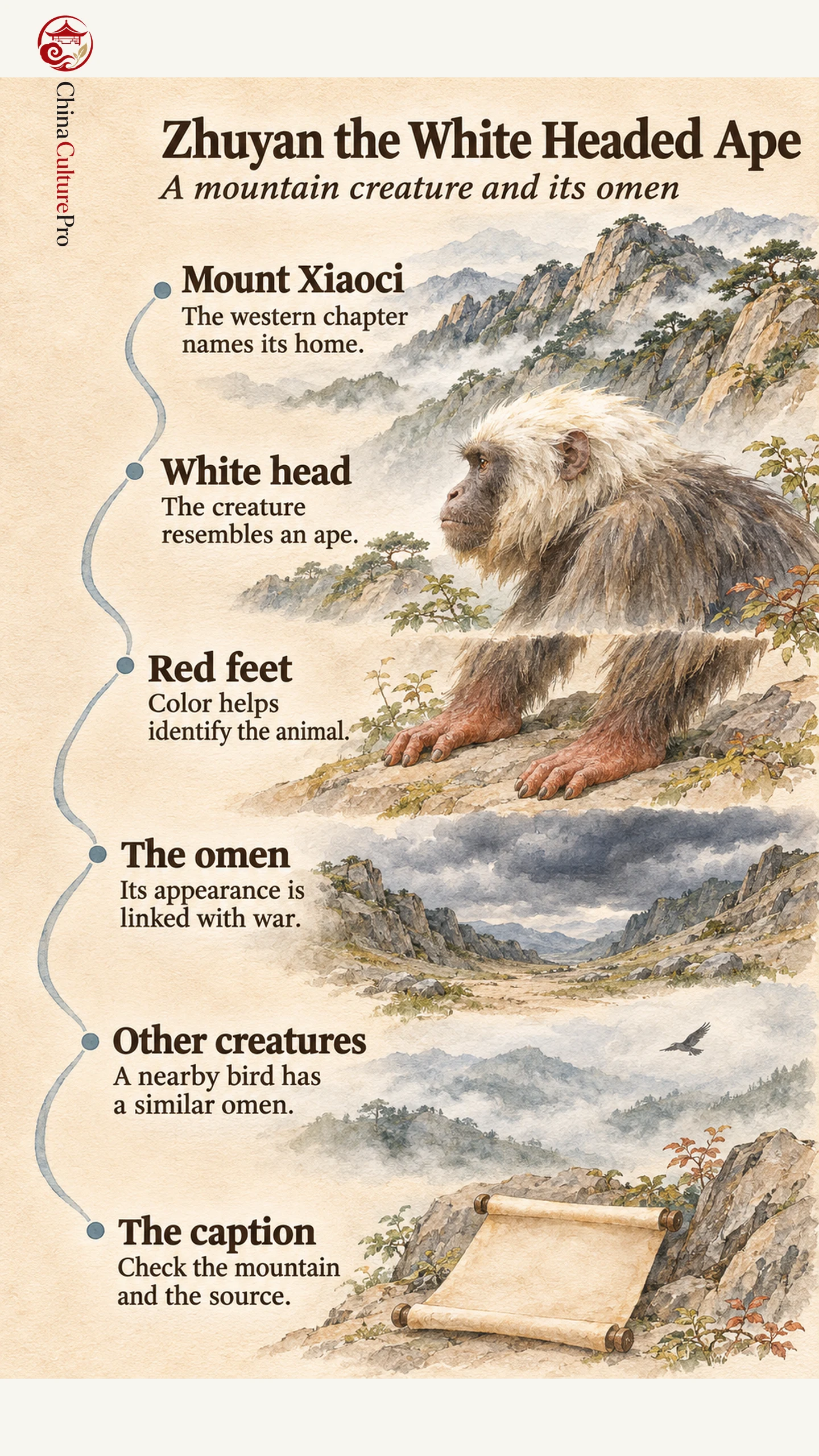
Red feet and a white head are all an artist needs to begin a picture of Zhuyan. The creature’s setting and omen explain why the classical entry says so much with so few details.
The Ape at Mount Xiaoci
The Western Mountains entry for Mount Xiaoci starts with the place and its materials. It mentions white jade above and red copper below. It then describes a beast resembling an ape, with a white head and red feet, and names it Zhuyan. White and red appear both in the description of the place and in the description of the creature.[1][2]
An image can bring out those details without taking a position on the creature’s size, exact species or color elsewhere. The early passage describes a resemblance to an ape and supplies a few features. The mountain name is the surest way to identify the original location.[1][2]
What the Omen of War Means in the Text
After giving the name, the passage links a sighting with great warfare. Variant wording also says that armed conflict will arise when it appears. The account uses the animal as an omen. It does not describe it leading troops or starting a battle.[1]
The expression “omen of war” captures the role the animal has in the entry. The part of the story that survives in the mountain entry is the connection between seeing a creature and anticipating an event. It is more precise to call the appearance an omen of war.[1][2]
Zhuyan and Other Animals That Mark an Omen
A nearby entry describes the Fuxi bird (鳧徯, fúxī), a human-faced bird that resembles a rooster and gives a call like its name. It too is associated with the approach of conflict. A later commentary compares Zhuyan with the bird because different forms can carry a similar omen.[2][3]
The luan bird offers another comparison from the western mountain tradition. Its appearance signals peace. In those passages, an appearance can carry a different meaning depending on the creature, so the omen and the body both help identify an account.[1]
How to Identify Zhuyan in an Image
In an illustration, look first for an ape-like animal with a pale head and red feet. Then look at the caption. Mount Xiaoci, the Western Mountains and an omen of conflict are further clues. A picture can choose to emphasize a color or a landscape without adding armor, a weapon or a new story.[1][2]
An ape in Chinese fiction may also evoke the Monkey King, as in the story of the peaches of immortality. His adventures in Journey to the West provide their own setting. Zhuyan’s mountain entry gives a separate creature with its own visible features and omen.[1][4]
FAQs About Zhuyan
What does Zhuyan look like?
The Western Mountains chapter describes a creature like an ape, with a white head and red feet. It places the animal at Mount Xiaoci.[1][2]
Does Zhuyan start wars?
The text gives the appearance as an omen. It says war follows or arises when the creature is seen and gives no account of Zhuyan fighting.[1]
Is Zhuyan the Monkey King?
The Western Mountains entry identifies Zhuyan through its body and the war omen. The Monkey King is a character with a distinct story in Journey to the West.[1][4]
Fuentes
[1] Chinese Wikisource. Classic of Mountains and Seas, Western Mountains
[2] Shidian Classics. Classic of Mountains and Seas, Western Mountains, Siku edition
[3] Chinese Wikisource. Imperial Collection of Books, Birds and Insects, volume 123
[4] Journey to the West Online. Journey to the West, chapter five